DeepSeek is a chatbot developed by a Chinese company named DeepSeek. A chatbot is a computer program designed to simulate conversation with human users, especially over the internet. DeepSeek uses advanced artificial intelligence (AI) to answer questions and engage in discussions with users. It became very popular because it could provide information quickly and interactively.
Why Are Countries Banning DeepSeek?
Several countries have decided to ban DeepSeek, especially on government devices. The primary reason is concern over data security and privacy. Authorities worry that the app might collect sensitive information and share it with external entities without permission. For instance, Texas became the first U.S. state to ban DeepSeek from government devices, citing security concerns.
Data Privacy: Experts have found that DeepSeek has significant security flaws, especially in its iOS version. These flaws could allow unauthorized access to user data, leading to potential data breaches. cincodias.elpais.com
National Security: There are fears that the app could be used for espionage or to gather sensitive information from government officials. This concern has led to bans not only in the U.S. but also in countries like Australia and South Korea. aljazeera.com
Global Response
The reaction to DeepSeek has been swift and widespread:
Australia: The Australian government has banned DeepSeek from all government systems and devices due to national security concerns. news.com.au
South Korea: South Korea’s government has also blocked DeepSeek on official devices, following similar actions by other countries. apnews.com
Italy: Italy’s data protection authority has ordered DeepSeek to block its chatbot in the country after the company failed to address privacy concerns. reuters.com
What Does This Mean for Users?
If you’re using DeepSeek, it’s essential to be aware of these concerns. While the app offers innovative features, the potential risks associated with data privacy and security cannot be ignored. It’s advisable to stay informed about the app’s status in your country and to follow any guidelines or recommendations issued by authorities.
Conclusion
The bans on DeepSeek highlight the importance of data security and privacy in today’s digital age. As technology continues to evolve, it’s crucial for both developers and users to prioritize the protection of personal and sensitive information. Staying informed and cautious can help ensure that we enjoy the benefits of technology without compromising our security.
Is Your AI Chatbot Spying on You? A Privacy Comparison of DeepSeek, OpenAI, Google Gemini, and Claude
Introduction
In today’s AI-driven world, chatbots have become a part of our daily lives. From OpenAI’s ChatGPT to Google Gemini and Anthropic’s Claude, AI-powered tools assist with everything from research to customer service. But have you ever stopped to wonder how these AI models handle your private conversations?
A recent review of DeepSeek’s privacy policy raises serious concerns about data collection, storage, and government access. Compared to OpenAI, Google, and Anthropic, how does DeepSeek stack up? Which AI model offers the best privacy protections? Let’s dive in.
1. DeepSeek’s Privacy Policy: A Deep Dive
DeepSeek is a rising Chinese AI startup, but its privacy policy contains multiple red flags.
📌 What DeepSeek Collects:
Personal Data: Username, email, phone number, IP address, device ID, location data.
User Input: Every message, prompt, file upload, and chat history is stored.
Technical Information: Device model, keystroke patterns, cookies, and browsing activity.
Third-Party Data: DeepSeek partners with advertisers and analytics firms.
📌 Where is Your Data Stored?
DeepSeek stores all user data in China, which has strict data laws allowing government access.
The policy does not confirm whether user interactions are used for AI training, but states user input is reviewed, raising concerns about long-term storage and usage.
📌 Who Has Access to Your Data?
Advertising and Business Partners: Your data is shared for targeted advertising.
Law Enforcement & Government Agencies: DeepSeek can hand over user data if requested.
Corporate Transactions: If DeepSeek merges or is acquired, your data may be transferred.
🚨 Biggest Privacy Concern:Data stored in China could be subject to government surveillance, and DeepSeek does not give users full control over data deletion.
2. How Does DeepSeek Compare to OpenAI, Google, and Claude?
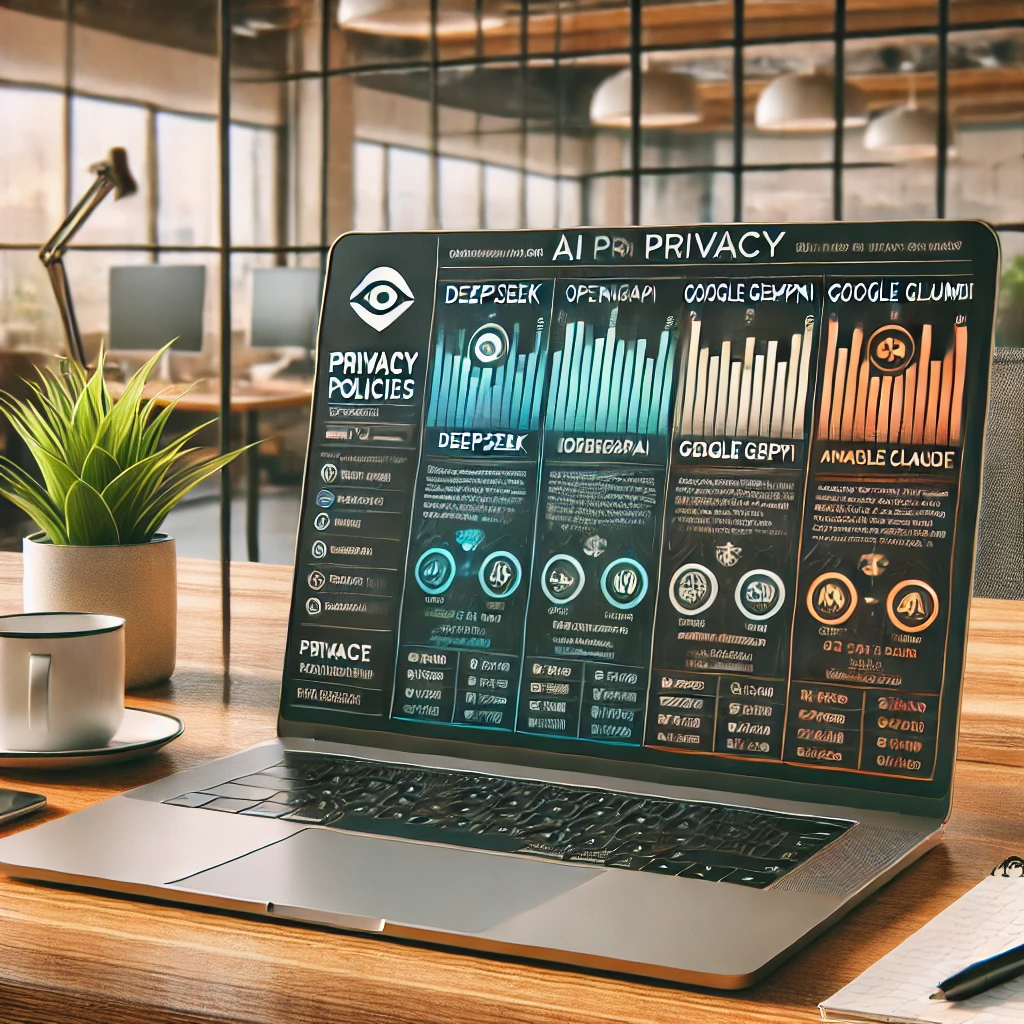
Each AI company has a different approach to privacy. Here’s how DeepSeek compares to ChatGPT, Google Gemini, and Claude.
AI Platform
Data Collection
AI Training
Data Storage
Third-Party Sharing
User Control
DeepSeek
Extensive (IP, keystrokes, chat history, cookies)
Unclear, but likely
China (subject to gov. access)
Shared with advertisers, business partners, and law enforcement
Limited deletion options
OpenAI (ChatGPT)
Collects user input for model improvement unless opted out
API data is excluded from training
Stored on U.S. servers
Shared with law enforcement when required
Users can request deletions
Google Gemini
Logs chat data, device details, and location (if enabled)
Used for AI refinement
Stored globally
Shares with Google services and law enforcement
Users can delete history, but not guaranteed
Anthropic Claude
Minimal data collection, no ad tracking
Does NOT use chats for AI training
Stored in U.S. servers
No ad sharing or external tracking
Users can fully delete conversations
🔍 Key Takeaways
✅ Claude (Anthropic) is the most privacy-friendly AI – it doesn’t use conversations for AI training and allows full data deletion. ⚠️ OpenAI (ChatGPT) and Google Gemini are moderate – they collect data but offer some user controls. 🚨 DeepSeek is the least private AI – it collects extensive user data, shares it widely, and stores it in China.
3. Why Does AI Privacy Matter?
Many people don’t realize how much data AI chatbots collect or where that data goes. Here are three major risks:
🔴 Risk #1: Data Used for AI Training Without Consent
Some AI models use real user input to improve responses, but what if your personal conversations are used? This raises ethical concerns about data ownership.
🔴 Risk #2: AI Privacy & Government Access
DeepSeek’s data is stored in China, meaning it could be subject to government surveillance.
Google, OpenAI, and Anthropic are headquartered in the U.S., which has different data privacy laws.
🔴 Risk #3: Data Breaches & AI Security Threats
If AI companies store user data indefinitely, that data could be hacked.
Example: If DeepSeek’s servers were hacked, millions of user conversations could be exposed.
Solution? AI platforms should store less data and offer full user control over deletion.
4. Which AI Platform Protects Your Privacy the Best?
If privacy is your top concern, here’s how to choose the safest AI platform:
Best for Privacy
AI Platform
🔥 Best overall privacy
Claude (Anthropic) – no tracking, full chat deletion, no AI training on user data.
⚖️ Balanced privacy & functionality
ChatGPT (OpenAI) – user input can be excluded from training, data deletion possible.
🚨 Worst privacy
DeepSeek – invasive tracking, broad data sharing, stored in China.
✅ Recommendation: Use Claude (Anthropic) or OpenAI (ChatGPT with privacy settings enabled) for the best privacy protection.
5. How to Protect Your Privacy While Using AI
Regardless of which AI you use, follow these steps:
1️⃣ Use privacy settings: Turn off chat history in ChatGPT, Google Gemini, or Claude. 2️⃣ Avoid linking accounts: Don’t log in with Google, Apple, or Facebook. 3️⃣ Limit what you share: Never input sensitive data (passwords, financial details, medical info). 4️⃣ Choose AI models carefully: Avoid DeepSeek or any AI storing data indefinitely. 5️⃣ Check AI privacy policies regularly: Companies change policies often – stay informed.
Conclusion
AI chatbots are powerful tools, but not all platforms prioritize user privacy.
DeepSeek is the most invasive, collecting extensive data and storing it in China.
OpenAI and Google offer some protections but still collect input data.
Anthropic’s Claude is the most privacy-friendly AI with no AI training on chats and full deletion options.
🚀 Final Tip: If privacy is a concern, choose Claude, adjust OpenAI settings, and avoid DeepSeek