
Tag: MachineLearning

  • Stop Wasting Hours on Prompts: Why Context Engineering is the Real AI Cheat Code

    Stop Wasting Hours on Prompts: Why Context Engineering is the Real AI Cheat Code

    Fix Your AI Strategy: Context Engineering Delivers Instant Results

    A marketer asks an LLM to write a product page. It confidently states the warranty is “lifetime.” Your policy says “2 years.” No one told the model the policy, so it filled the gap with a familiar pattern.

    That’s the real story behind most “hallucinations.” The model isn’t failing because it’s “not smart enough.” It fails because it doesn’t have the right facts at inference time, or the facts are present but buried under noise.

    Many teams respond by tweaking prompts, adding lines like “be accurate” or “don’t make things up.” That’s a closed-book exam with stricter rules. The higher-impact shift is context engineering, designing what the model sees before it writes a single word. This post breaks down what context engineering is, why it produces fast wins for AI SEO programs, and how to apply a practical checklist, a template, and a workflow that reduces errors without slowing your calendar.

    The 3 fatal flaws of standard AI SEO strategies (and why they keep producing generic fluff)

    Most AI SEO problems are system problems. They come from what the model can see in its context window, not from the writer’s skill. If the model starts with thin, messy, or inconsistent inputs, it will produce thin, messy, or inconsistent pages.

    Flaw 1: Prompt-only fixes hide the real problem, missing ground truth

    Prompting is useful, but it can’t replace missing sources. Think of the model like a strong student. A strong student still struggles on a closed-book test when you ask for exact figures and policies.

    “Be accurate” fails for the same reason. If the model can’t see your current pricing rules, approved claims, or definitions, it guesses. When it guesses, it often sounds confident, which is worse than being unsure.

    A better prompt can improve structure and tone. It can’t conjure your internal facts. That’s why teams are moving away from treating prompt text as the control plane and toward treating context as the control plane. Elastic summarizes that shift clearly in its overview of context engineering vs. prompt engineering.

    Flaw 2: Copy-paste context dumps overload the window and bury key facts

    Teams often paste everything into one prompt: a style guide, a competitor export, a product spec, a brief, a list of keywords, and a transcript. The result is predictable. Important facts get pushed into the middle, conflicting instructions show up, and the model “forgets” the one line that mattered.

    This is signal vs. noise. Every extra paragraph competes for attention. If the context includes five versions of a feature description, the model may blend them into a new sixth version.

    If you want fewer hallucinations, stop adding more text. Start adding better text.

    Flaw 3: No repeatable context system means outputs drift across pages and weeks

    Even if one page comes out fine, the program usually breaks at scale. Without a shared context layer, each writer or agent invents its own “truth” each time. That causes drift:

    • Brand voice changes across a cluster.
    • Product claims conflict between pages.
    • Headings vary, which breaks templates and internal linking patterns.
    • Updates lag because there’s no single place to change “what’s true.”

    When leadership says, “Why is this page claiming X when legal says Y?” the answer is often simple: the model never had access to the approved source at the moment it generated the copy.

    Defining context engineering: why priming beats prompting for reliable outputs

    Context engineering is the discipline of deciding what the model gets to “read” before it answers, then arranging that material so the most important truths stay visible and usable. It is less about clever wording and more about curation, ordering, structure, and timing.

    A practical definition that maps well to production work is: selecting, structuring, and injecting the minimum set of facts, rules, examples, and tool outputs that the model needs to complete a task safely.

    Teams often treat this as an app architecture problem, not a writing problem. Context becomes a built asset, versioned, reviewed, and reused. Context Studios frames it as designing the context “by design,” not as an afterthought in building reliable LLM systems by designing the context.

    What context engineering is in plain terms (the model’s “read this first” package)

    In practice, a “read this first” package usually includes:

    • Retrieved source snippets (RAG) from docs, help centers, or databases
    • Brand rules and voice boundaries
    • User intent notes (what the reader needs to decide or do)
    • Page goal and conversion target
    • Approved definitions and claim language
    • Formatting constraints (headings, tables, schema fields)
    • Verification steps (what to cite, what to flag as unknown)

    Just-in-time retrieval matters because freshness matters. Policies, pricing, and feature sets change. If the model can’t see the latest state, it will write yesterday’s truth.

    Prompt engineering vs. context engineering: a quick decision guide

    Use this table to decide where to spend effort.

    SituationBetter prompt is usually enoughContext engineering is required
    Low-risk copySocial posts, brainstorming anglesRegulated or legal claims
    Fact sensitivityGeneric topics with stable factsPricing, warranties, SLAs, security
    Workflow lengthOne-shot outputMulti-step programs, agents, clusters
    Consistency needsOne page, one timeDozens of pages over weeks

    Prompts still matter, but prompts are only one slice of the context window. If the model can’t see the facts, your best prompt is still a closed-book test.

    Why hallucinations happen at inference time (and why “bigger models” don’t solve it)

    During generation, the model predicts the next token based on patterns and whatever text is present. Two failure modes show up most:

    1. Empty context: the model lacks the needed facts, so it guesses.
    2. Messy context: the model sees conflicts or outdated snippets, so it blends them.

    Bigger context windows help, but they don’t remove the need to curate. Long prompts can still lose critical details “in the middle,” especially when many passages compete for attention. Research and mitigation work around this “lost-in-the-middle” issue continues to evolve, including recent studies such as What Works for ‘Lost-in-the-Middle’ in LLMs?.

    The 5-point contextual checklist for every SEO asset (before the model writes a word)

    Context engineering becomes simple when you treat it like pre-flight checks. Before any draft, confirm five things. Each one is measurable, and each one reduces guessing.

    1) Objective and audience: one page, one job, one reader

    Start with a single page objective. Inform, compare, or convert. Then name the reader and their pain. “IT director evaluating risk” produces different content than “operator trying to fix an error.”

    Keep this short. Two sentences often beat two paragraphs. Also define constraints early, like reading level, audience region, and what the page must not promise.

    A compact “success looks like” list helps the model stay on task. Three bullets is enough. The goal is focus, not decoration.

    2) Ground truth pack: the minimum facts the model must not get wrong

    This pack should include only facts you will defend in public:

    • Approved product facts and naming
    • Policy language (refunds, warranties, support hours)
    • Pricing rules (what can be stated, what must be linked)
    • Definitions for key terms
    • One or two source snippets per critical claim, with a last-updated date

    Freshness is part of truth. If a snippet is older than your release cycle, mark it “stale.” When sources disagree, define the tie-breaker (for example, “Policy doc overrides blog posts”).

    3) SERP and competitor reality: what must be covered to be useful

    SERP context doesn’t mean pasting ten competitor pages. It means summarizing patterns:

    • The dominant intent (how-to, comparison, pricing, troubleshooting)
    • The must-answer questions that show up repeatedly
    • The common misconceptions that lead to bad decisions

    Add one small but powerful boundary: “what we will not claim.” This reduces risky overreach, especially when competitors exaggerate.

    4) Structure and formatting rules: make the output easy to publish and reuse

    A good draft that breaks your pipeline is still a failure. Define the output contract:

    • Required sections and heading style
    • Internal link targets by slug or page name
    • Voice rules (what tone, what not to do)
    • If needed, schema fields to populate (FAQ items, pros-cons, specs)

    Structured inputs reduce ambiguity. JSON works well for facts and constraints. Markdown works well for outlines and examples. The best systems use both: JSON for the truth pack, Markdown for the writing plan.

    5) Token budget and noise control: prune, rank, then retrieve

    More context is not always better context. Use a simple order:

    1. Prune irrelevant text.
    2. Rank what remains by task relevance.
    3. Retrieve extra facts only when needed.

    Many teams set starting token targets by asset type, then tune from there. For example, a short blog might carry a 600 to 1,200 token context pack, while a pillar page might justify 1,500 to 3,000. The number matters less than the habit: tight context, clear priorities, and retrieval on demand.

    Template: the authority-builder prompt structure that makes context usable

    A context-engineered prompt reads like a spec, not a chat. Keep the parts separated so you can swap context blocks without rewriting instructions.

    A clean, repeatable layout: role, task, constraints, context blocks, output spec

    Use this layout as a fill-in template:

    • Goal: [single sentence]
    • Audience: [role, pain, reading level]
    • Page Type: [blog, landing page, comparison, support]
    • Allowed Claims: [approved claims only]
    • Disallowed Claims: [explicit “do not say” list]
    • Ground Truth Sources (snippets):
      Source A (updated [date]): [snippet]
      Source B (updated [date]): [snippet]
    • SERP Notes: [intent, must-cover items, misconceptions]
    • Style Rules: [voice, tone, banned phrases]
    • Output Outline: [H2/H3 plan]
    • Internal Links: [targets and anchor guidance]
    • Verification Steps: [how to treat missing info]

    Ordering matters. Put the ground truth early. Put style rules after truth. Put the outline last so it doesn’t crowd out facts.

    Built-in self-checks that reduce false claims without adding fluff

    Add strict checks like these:

    • “For any numeric claim, quote the source snippet or mark it UNKNOWN.”
    • “If a required input is missing, ask one question before drafting.”
    • “If sources conflict, follow the tie-breaker rule, then cite the chosen source.”

    This is how you get safer outputs without turning the draft into cautious filler.

    Workflow: integrating context engineering into your content calendar (without slowing the team)

    Context engineering should speed teams up after the first week. The key is ownership and reuse.

    Build a shared context library: brand truths, product facts, and reusable snippets

    Set up a small repository with versioning:

    • Brand voice rules (stable)
    • Product facts by product line (changes with releases)
    • Claim language by category (security, performance, compliance)
    • Definition glossary (prevents term drift)

    Assign owners. Set a review cadence aligned to releases. Enforce a single source of truth rule, so every agent and writer pulls from the same library.

    Also set privacy boundaries. If a context pack includes customer data, you need redaction and access controls before it touches an LLM.

    Just-in-time retrieval for writers and agents: RAG, re-ranking, and pruning

    RAG works best when retrieval is precise and snippets are short. A common flow is: search, re-rank, insert top passages, then generate.

    Hybrid retrieval helps. Combine keyword search for exact terms (like policy names) with vector search for semantic matches, then re-rank. For a practical overview of production RAG patterns, see Comet’s Retrieval-Augmented Generation (RAG) guide.

    Quality gates and metrics that show instant results

    You don’t need perfect evaluation to see improvement. Track a small set:

    • Hallucination rate via spot checks on “must-not-be-wrong” claims
    • Revision cycles per asset
    • Time-to-publish
    • Token cost per published page
    • Formatting errors that break publishing

    Pilot on one content cluster for two weeks, then expand. The gains usually show up in fewer rewrites and faster updates when facts change.

    Case study: 300% increase in keyword velocity via contextual injection

    This is an anonymized enterprise rollout from a mid-market B2B SaaS team.

    The starting point: good prompts, weak context, and content that didn’t stick

    The team had solid prompts and a capable model. Still, pages came out generic. Intros repeated across posts. Feature descriptions drifted between articles. A product rename created weeks of cleanup, because older drafts had baked in the old terms.

    Editors spent their time fixing specifics, not improving the argument. Internal links also looked random, because every draft invented its own cluster structure.

    The fix: add a ground truth pack plus SERP intent notes for each cluster

    They built per-cluster context packs:

    • A short truth pack with approved naming, feature bullets, and policy snippets
    • SERP intent notes that listed must-answer questions and misconceptions
    • A fixed output outline with internal link targets

    Retrieval was just-in-time. The system pulled only the top passages needed for that page, then pruned the rest.

    The outcome: faster publishing, fewer rewrites, and more pages earning impressions sooner

    They defined “keyword velocity” as how fast a new page begins earning impressions for its target query set. After rollout, the median time to first meaningful impressions dropped, and the cluster expanded faster because editors stopped rewriting basics. Over the quarter, they reported a 300% increase in keyword velocity compared to the prior prompt-only workflow, largely because each draft started with the right facts and the same structure.

    Conversion path: turn context engineering into a repeatable growth loop

    A good system earns trust because it’s controlled. That’s what decision-makers want: reliability, speed, and an audit trail.

    Opt-in landing page blueprint

    Promise: “Get the Context Optimization Checklist plus the enterprise guide, From Prompting to Engineering: The Enterprise Guide to Context Management.”

    Who it’s for: CTOs, VPs of AI, and SEO content leads who ship AI-assisted pages.

    What they get: a one-page checklist, a context pack template, and a rollout plan for a pilot cluster.

    Benefits:

    • Fewer hallucinations on pricing, policy, and feature claims
    • Lower token spend through pruning and retrieval
    • More consistent formatting that won’t break CMS workflows
    • Faster updates when products and policies change
    • Cleaner scaling across content clusters and agents

    Form fields: work email, company, role, primary use case, and one optional question about current stack.

    Landing page headline

    Stop Publishing Generic AI Fluff: Master the Context Engineering Framework for Instant SEO Results

    Supporting subhead suggestions:

    • Reduce hallucinations by injecting ground truth at inference time.
    • Scale content safely with reusable context packs and retrieval.

    FAQ

    What is context engineering, in one sentence?

    Context engineering is the process of selecting and organizing the facts, rules, and sources an LLM sees at inference time so it can answer without guessing.

    Does context engineering replace prompt engineering?

    No. Prompting still matters. Context engineering sets the model’s inputs and constraints so the prompt can work reliably.

    Is fine-tuning a better fix for hallucinations?

    Fine-tuning can help for stable patterns, but it’s slow and expensive for changing facts. Context engineering is usually the faster path when truth lives in docs, policies, and databases.

    How do we handle long documents without dumping them into the prompt?

    Use retrieval plus summarization chains. Keep short, cited snippets in the context window, then fetch more only when needed.

    Will 128k-plus context windows solve this?

    They reduce pressure, but they don’t remove curation work. Long contexts still suffer from attention bias and noise, so pruning and ordering remain critical.

    What’s the first pilot worth running?

    Pick one revenue-facing cluster with frequent updates (pricing, security, integrations). Build a truth pack, add SERP notes, then measure rewrite rate and time-to-publish.

    Conclusion

    If your LLM makes things up, don’t treat it like a creativity problem. Treat it like a missing inputs problem. Context engineering fixes that by feeding the right facts, in the right order, at the moment of inference.

    Run the 5-point checklist, adopt the prompt structure template, then integrate a shared context library with just-in-time retrieval. Start with one cluster, measure rewrites and accuracy, and ship the pilot. Once the system works, scaling becomes routine instead of stressful.


  • Handle Non-Linear Research with Reliable Agentic Systems

    Handle Non-Linear Research with Reliable Agentic Systems

    Handle Non-Linear Research With Reliable Agentic Systems (Agentic Workflows You Can Trust)

    Research doesn’t move in a straight line anymore. You start with a clean question, then the SERP shifts, new entities appear, and one “quick check” turns into five branching threads. If you try to force that mess into a linear checklist, you either miss key facts or waste time chasing noise.

    That’s what non-linear research looks like in practice: loops, dead ends, pivots, and returns to earlier assumptions. It’s normal, but it breaks the “one prompt, one answer” habit fast.

    In this post, you’ll build a dependable way to run agentic workflows that break work into roles, keep state across steps, verify claims with sources, and turn messy discovery into decisions. Reliability isn’t luck, it’s design.

    The death of linear keyword research, why the old playbook can’t keep up now

    Classic keyword research assumes a stable path: pick a seed term, expand the list, cluster it, then write. That worked when intent was easier to read and SERP layouts stayed quiet for months.

    Now, topics are often entity-driven. Google and answer engines connect people, products, standards, and “how-to” tasks in ways a flat list can’t hold. At the same time, competitors ship faster, so the SERP you mapped last week may already look different.

    Several forces push you into non-linear inquiry:

    • Shifting intent: queries tilt from learning to buying within the same session.
    • SERP feature churn: AI answers, forums, videos, and product panels reorder attention.
    • Personalization: location, history, and device change what “ranking” even means.
    • Answer engines: users accept synthesized answers, so you must track source quality.

    The old playbook optimizes for list building. What you need instead is problem mapping. Picture research like a breathing system. It expands when you find new entities and contradictions, then contracts when you confirm what matters, then revisits earlier assumptions when the evidence changes.

    What non-linear research looks like in the real world (branching, looping, backtracking)

    Say you start with “agentic systems for market research.” Within minutes, you hit new branches:

    You notice repeated references to “planner” agents, tool calling, and memory. That creates an entity list you didn’t have. Next, you see claims that multi-agent setups reduce hallucinations, but another source warns they can amplify errors through group consensus. Now you need a contradiction check.

    Then you spot adjacent jobs-to-be-done: evaluation, logging, citation capture, and stop rules. Those topics weren’t in your first query, but they determine whether the system works in production.

    Each discovery forces a pivot. You backtrack to refine the question, you loop to verify a claim, and you branch to cover a missing constraint. When you try to do all of that in one chat or one giant prompt, context loss hits hard. The model can’t hold the full map, so it compresses the messy parts into vague summaries.

    Why single-agent prompting fails under uncertainty and changing SERPs

    A single agent can write a decent overview, but it struggles when the work includes discovery, verification, and synthesis at once. Under uncertainty, common failure modes show up:

    Model fatigue is one. Long prompts lead to shallow reasoning and “fast conclusions.” Another is missed counterpoints. The model follows the first plausible thread and stops asking what could break it.

    The worst failure is “confident wrong.” You get tidy output with no audit trail. When you re-run the same prompt tomorrow, you get a different story. Meanwhile, debugging is painful because you can’t see which step injected the bad claim.

    If your goal is research you can trust, you need structure that survives changing SERPs, not a bigger prompt.

    Core building blocks of a reliable agentic architecture you can trust with research

    “Reliable” means three things in practice: you can trace steps, you can back claims with sources, and the system fails in a controlled way when evidence is missing.

    To get there, your minimum architecture needs four modules you can swap without rewriting everything: roles, memory, tools, and checks. Think of it like a small lab team with shared notebooks and strict citation rules.

    Specialized agents, clear roles, and tight task boundaries

    Task decomposition is your first reliability upgrade. Instead of asking one agent to “research and write,” you assign narrow roles with small prompts and strict inputs and outputs.

    A practical set of roles looks like this:

    Agent roleJobOutput artifact
    ExplorerFind leads and angles, expand entitiesLead list, query plan
    ExtractorPull facts, quotes, definitionsSource notes with quotes
    CriticChallenge claims, find counterpointsContradictions list, gaps
    SynthesizerMerge evidence into structured notesOutline, key findings
    EditorEnforce constraints and clarityFinal draft, checklist pass

    Because each agent has a tight boundary, you reduce hallucinations. You also avoid “reasoning soup,” where a model mixes discovery and persuasion in the same breath. Your Critic role matters more than most teams expect. It keeps the system honest when the first pass sounds smooth but rests on weak evidence.

    State, memory, and artifacts so your system doesn’t forget or drift

    Non-linear research requires state. Without it, every branch resets the context, and your system repeats work or contradicts itself.

    Keep memory simple:

    • Short-term state: what’s true for this run (current question, current entities, active hypotheses).
    • Long-term memory: what you want to reuse (entity definitions, trusted sources, past decisions).

    Most importantly, store artifacts as files or records, not as “stuff the model remembers.” Useful artifacts include a query plan, SERP snapshots (or at least captured titles and URLs), an entity list, a source table, and a decision log that explains why you accepted or rejected a claim.

    Treat memory as suggestions, not truth. Add timestamps and re-check rules, because stale memory is a quiet failure. A rule like “re-verify anything older than 60 days for fast-moving topics” prevents slow drift.

    Tool access and data boundaries (browsing, APIs, and your own sources)

    Agentic workflows get risky when tool use is fuzzy. You need clear boundaries for when agents can browse the web, call an API, or use internal docs.

    Set an allowed-source policy. For example, you might allow standards bodies, primary vendor docs, and peer-reviewed papers for technical claims. For market claims, you might require filings, pricing pages, or first-party announcements.

    Also define basic data rules: don’t send private docs to third-party tools unless you’ve approved it, respect rate limits, and track licensing for any dataset you store. You don’t need a legal essay here, you need a simple “what’s allowed” contract that your agents follow.

    Verification loops that force evidence before synthesis

    Verification is not a vibe. It’s a loop the system must complete before it earns the right to summarize.

    A simple pattern works well:

    Claim, then source, then cross-source check, then confidence label, then summary.

    Require each factual claim to carry at least one citation, and prefer two when the claim drives decisions. Capture short quotes for critical points, so you can audit without re-reading everything.

    If your system can’t cite it, it shouldn’t state it as fact. Save it as an open question.

    Contradiction detection also matters. When two sources disagree, your system should surface the conflict, not average it away. Sometimes the right output is “unresolved, needs human review.”

    Design multi-agent workflows for messy SERP and entity analysis without losing the thread

    Orchestration is where multi-agent work becomes usable. Without a plan, agents produce piles of notes with no closure. With a plan, they behave like a team: map first, drill down second, reconcile last.

    A workflow shape that holds up under non-linear research looks like this:

    1. Map intent and entities
    2. Branch into sub-questions
    3. Verify and reconcile contradictions
    4. Synthesize in layers
    5. Decide what to ship, and what to park

    Start with an intent and entity map, not a keyword dump

    Begin with a topic brief that states: the user type, the decision they’re making, and what “done” looks like. Then build an entity map. You want core entities, their attributes, and relationships.

    From that map, you can branch into sub-questions that actually matter. For example: “What counts as an agent,” “What makes workflows reliable,” “Which failure modes appear in production,” and “What artifacts you must store.”

    Keep outputs lightweight. An entity table, a few intent clusters, and an “unknowns list” is enough to start. That unknowns list becomes your work queue.

    Use a planner-orchestrator to route work and stop infinite rabbit holes

    Your orchestrator assigns tasks, sets budgets, and decides when to stop. Without budgets, non-linear research turns into an endless walk.

    Useful budgets include time, number of pages to review, and maximum tool calls per sub-question. Then add stopping rules:

    • Diminishing returns: new sources repeat the same points.
    • Source saturation: you have enough independent sources for the key claims.
    • Unresolved contradictions: flag for human review, don’t force closure.

    The orchestrator also controls rework. If the Critic finds a contradiction, it can route back to the Explorer for targeted sourcing, not a full restart.

    Synthesize in layers: notes, source table, then final narrative

    Layered synthesis prevents “pretty but wrong” output. You want three layers:

    First, raw notes tied to sources, including quotes for key claims. Next, a source table that lists URL, date accessed, claim supported, and confidence. Finally, a narrative that reads well for humans.

    The narrative stays clean because the messy evidence lives beneath it. At the same time, your narrative stays honest because it must match the source table.

    Diagram of multi-agent collaboration for data synthesis

    Make agentic research reliable with error handling and hallucination controls

    Reliability is engineering work. You measure it, you log it, and you design for failure. The goal is not “never wrong.” The goal is “wrong in obvious, bounded ways,” so you can catch it early.

    Guardrails that catch bad inputs, weak sources, and missing citations

    Bad inputs cause bad outputs fast. Validate the research question, the audience, the geography, and the time window. If any of those fields are missing, your system should ask for them or stop.

    Then filter sources. If the claim is technical, blog posts may be context, not evidence. If the claim is pricing, screenshots and hearsay should not pass.

    A few rules keep you safe:

    • No factual claim without a source.
    • Label opinions as opinions.
    • Check recency when the topic changes fast.
    • Reject summaries that include citations you can’t open again.

    “Fail closed” beats “sound confident.” If sources are missing, your system should refuse to finalize.

    Debuggability, run logs, and evaluation that doesn’t lie to you

    If you can’t debug it, you can’t trust it. Log prompts, tool calls, sources, intermediate outputs, and orchestrator decisions. Save them per run, so you can compare versions.

    For evaluation, keep it simple and repeatable. Do spot checks on a sample of claims, run contradiction tests (ask the Critic to disprove the Synthesizer), and test consistency across repeated runs with the same inputs.

    Score three dimensions: accuracy, coverage, and traceability. If traceability drops, treat it like an outage. It means you’re heading back toward black-box output.

    Turn agent output into high-ROI content strategy that you can ship

    Once your system produces reliable artifacts, you can turn research into publishing decisions without guessing. This is where educational intent shifts toward commercial intent, because your outputs start pointing to frameworks, tools, and implementation details readers will pay for.

    From research artifacts to content briefs, angles, and proof points

    Your entity map becomes your section plan. Your unknowns list becomes your FAQ. Your contradiction list becomes your “what others get wrong” section.

    A strong brief includes: the target reader need, must-answer questions, the angle, and a proof list. Proof points should come from your source table, not from memory. Include stats where available, direct quotes when they clarify, and primary sources for core claims.

    Attach the source table to the brief. That way, writing stays fast without drifting into unsupported statements.

    Prioritize what to publish using effort vs impact signals

    Use a simple effort vs impact view. Impact rises when the SERP is weak, the content gap is clear, and the topic fits your business. Effort rises when you need deep verification, many examples, or hands-on testing.

    Re-check the SERP on a cadence, because intent shifts. Monthly works for many categories, while fast-moving AI topics often need a shorter cycle.

    Conversion path: move from learning to implementation with an opt-in landing page

    When readers finish your post, many will want something they can run today. Your landing page should be a practical handoff, not a sales pitch.

    Offer a small pack: a workflow diagram, role prompts, a source table template, and an evaluation checklist. Make the promise clear, name who it’s for, list what’s inside, add a short privacy note, then place a single CTA.

    What your opt-in should include so readers can run the workflow this week

    Include an orchestrator checklist, agent role cards, stop rules, verification loop steps, and a sample research report format. In 60 minutes, you can pick one topic, run one loop, and walk away with a source-backed outline plus an audit trail.

    FAQ (Questions Readers might have)

    Do you always need multiple agents?

    No. If the task is stable and low risk, one agent can work. You add agents when you need discovery plus verification plus synthesis, and you want an audit trail.

    How do you stop agents from agreeing on the same wrong idea?

    You separate roles and force evidence. Your Critic should use different prompts, and it should search for disconfirming sources. Also, require citations before synthesis.

    What’s the minimum set of artifacts to save?

    Save the query plan, entity list, source table, and decision log. If you can store SERP snapshots, even better, because SERPs change.

    Can agentic workflows handle proprietary documents?

    Yes, if you control tool access and data boundaries. Keep private docs in approved systems, and restrict what agents can send to external services.

    How do you know when the research is “done”?

    Use stop rules: diminishing returns, source saturation, or unresolved contradictions flagged for review. “Done” means you can defend the key claims with sources.

    Conclusion

    Linear research breaks because modern SERPs and intent don’t behave linearly. When you design agentic workflows with clear roles, saved artifacts, and verification loops, you can follow non-linear threads without losing trust. Start small: map one topic, run a multi-agent pass, and score traceability and accuracy. Then scale only after your system proves it can stay source-backed under change.

  • Stop Prompting, Start Architecting: The 2026 Blueprint for AI Mastery

    Stop Prompting, Start Architecting: The 2026 Blueprint for AI Mastery

    If you are still trying to find the “perfect magic words” to make ChatGPT or Claude behave, you are living in 2024. Welcome to January 2026, where the game has fundamentally changed. We aren’t just “prompting” anymore; we are orchestrating intelligence.
    The “Prompt Engineer” job title that everyone obsessed over two years ago? It’s evolving into something much more powerful: the AI Behavior Architect. We’ve moved past the era of “acting as a professional copywriter” and entered the era of agentic workflows, perceptual anchoring, and self-healing systems.
    This week, the AI world was rocked by three massive shifts that redefine how you interact with silicon. If you want to stay ahead of the curve, you need to understand why your old “hacks” are failing and what the new 2026 standard looks like.

    1. The “Say What You See” Revolution: Google’s SWYS Breakthrough
      Just days ago, a technique dubbed SWYS (Say What You See) went viral across the developer community, promising—and delivering—a staggering 76% gain in LLM accuracy for complex reasoning tasks.
      For years, we thought the key to better output was more complex instructions. We wrote paragraphs of “Chain-of-Thought” logic, hoping the model wouldn’t hallucinate. But Google’s latest research suggests we were looking at the problem backward. Instead of telling the AI how to think, SWYS forces the AI to verbally anchor its perception before it attempts a task.
      The technique is deceptively simple: You ask the AI to describe every component of the input data in excruciating detail before asking for a solution. It’s the digital equivalent of a detective narrating everything they see at a crime scene before making a deduction.

    The SWYS Framework in Action


    Instead of: “Analyze this financial spreadsheet and find the three biggest risks.”
    The 2026 SWYS Prompt looks like:
    “First, identify every column header and row category in the provided data. Describe the data types and any visual outliers you notice. Once you have mapped the ‘landscape’ of the data, then—and only then—analyze the top three risks.”

    Why This Matters:
    It’s about latent signal activation. By forcing the model to “Say What It Sees,” you are activating multimodal training signals that stay dormant during standard text processing. This reduces “glance-over” errors—those annoying moments where the AI misses a line of text or a specific number right in front of its face. In the high-stakes world of 2026, where AI manages our medical records and legal contracts, a 76% accuracy jump isn’t just a “nice to have”—it’s the difference between a successful automation and a catastrophic failure.

    1. From “Prompting” to “Agentic Scaffolding”: The Claude Code Shift
      We’ve seen a massive shift in how Anthropic’s Claude handles complex tasks this month. The data from the latest Anthropic Economic Index shows that we have officially crossed the “Human-in-the-Loop” Rubicon.
      Six months ago, a tool like Claude Code could handle maybe 10 autonomous actions before it needed a human to nudge it. As of January 2026, that number has doubled to 21+ consecutive tool calls. What does that mean for you? It means “Prompt Engineering” is being replaced by Agentic Scaffolding.
      You are no longer writing a prompt for a chatbot; you are writing a Mission Briefing for an agent that can browse your files, run terminal commands, call APIs, and self-correct its own errors.
    human hand orchestrating multiple AI agents on a holographic interface

    The Shift in Strategy


    In 2026, the best “prompts” aren’t prose; they are environment definitions. You aren’t telling the AI what to write; you are telling the AI what tools it has access to and what the success criteria (Evals) look like.
    Key Term: Evals (Evaluations). In 2026, if you aren’t providing the AI with a way to “grade itself,” your prompt is incomplete. Modern architects use “Self-Correction Loops” where the prompt includes a step: “Run a validation check on your output against [Standard X] and if it fails, iterate until it passes.”

    Why This Matters:
    Efficiency is the new currency. Anthropic’s data shows that while we are delegating less of our total work, the complexity of what we delegate has skyrocketed. We are moving from “Help me write this email” to “Build and deploy this microservice.” If you don’t master Agentic Scaffolding, you will be stuck doing the “papercut” tasks while the AI-literate workforce is building entire ecosystems with a single command.

    1. The Rise of “Tree of Thoughts” (ToT) at Scale
      If you’ve been following the latest benchmarks, you know that Standard Prompting is currently sitting at a measly 7.3% success rate for highly complex, multi-variable problems. Meanwhile, Tree of Thoughts (ToT) is hitting 74%.
      ToT is the 2026 evolution of Chain-of-Thought. Instead of a single linear path of reasoning, the AI explores multiple “branches” of thought simultaneously, evaluates them, and “prunes” the ones that don’t lead to a solution.

    The “Expert Panel” Prompt Template
    To leverage this, viral strategists are using the Multi-Expert Persona approach.
    Instead of: “Give me a marketing strategy for my new app.”
    The ToT Prompt looks like:
    “Act as a panel of three experts: a Growth Hacker, a Brand Strategist, and a Financial Analyst.

    • Each expert proposes one distinct strategy.
    • The experts then critique each other’s strategies for flaws.
    • Based on the critique, synthesize the most robust, risk-mitigated plan.”
      Why This Matters
      We are seeing the end of “Single-Model Bias.” By forcing the AI to simulate internal conflict and debate, we bypass the “path of least resistance” that models often take. This is how you get System 2 thinking (slow, deliberate, logical) out of a system that defaults to System 1 (fast, intuitive, sometimes wrong).
    1. The 2026 Viral Prompting Cheat Sheet (The “Architect” Method)
      To help you dominate this new landscape, I’ve distilled the “hottest” 2026 techniques into a quick-reference guide. Stop using “Please” and “Thank you”—start using
    A vast digital landscape stretches toward a dark horizon, filled with thousands of floating blue geometric prisms representing data points. In the center of the frame, a pair of ethereal, translucent hands made of shimmering white light reach out to grasp a single, intensely glowing golden cube. The golden cube is labeled with the text 'GROUND TRUTH' in a clean, sans-serif font. The light from the cube casts a warm radiance across the translucent fingers of the AI hands, highlighting their intricate, circuit-like internal structures. The background features a faint, receding grid of cyan lines on a deep black floor. The scene is rendered in a sharp, cinematic 3D style with a shallow depth of field that keeps the focus on the moment of contact.

    Structural Constraints.


    Technique
    How to Use It 2026 Viral Power Level Verbal Anchoring

    • “List all facts in the source text before summarizing.”
      Negative Constraints
    • “Do NOT use corporate buzzwords, passive voice, or introductions.
    • “Dynamic JSON Output” Output the response strictly in a JSON schema for [App Name].
    • “Recursive Refinement”Rewrite your previous answer three times, making it 10% more concise each time.”Contextual Grounding”Access the [Project Archive] and use only verified data from the 2025 Q4 report.”
    1. The “Invisible” Prompt: AI Embedded in Everything
      Finally, we have to talk about the “Death of the Chat Window.” In 2026, the most successful prompt engineering is the kind the user never sees.
      With Google Workspace Studio and OpenAI’s ChatGPT Atlas, prompts are being baked into the UI. You aren’t typing into a box; you are clicking a “Refactor” button that triggers a 500-word meta-prompt in the background.
      The takeaway for you? If you are building tools or content, focus on Context Engineering. The real “moat” in 2026 isn’t the model you use; it’s the proprietary context you feed it. Whoever has the best-organized data wins, because the AI is finally smart enough to use it.

    Conclusion:
    The era of “guessing” what the AI wants is over. We have the frameworks, we have the agentic tools, and we have the benchmarks. The transition from Prompt Engineer to AI Behavior Architect is the most significant career pivot of the decade.
    Don’t just talk to the machine. Design its reality. Define its tools. Scaffold its thoughts. In 2026, the power belongs not to the one who speaks the loudest, but to the one who structures the most effectively.
    Are you ready to stop prompting and start architecting?

    FAQ:
    What is AI Behavior Architecture and how does it differ from traditional prompt engineering?

    AI Behavior Architecture is the evolved approach beyond simple prompting, focusing on designing and orchestrating complex agentic workflows, perceptual anchoring, and self-healing systems for AIs. Unlike traditional prompt engineering that seeks ‘magic words,’ behavior architecture aims to define how an AI thinks, perceives, and acts over time.

    What is Google’s ‘Say What You See’ (SWYS) technique and why is it a game-changer?

    SWYS (Say What You See) is a Google breakthrough that forces an AI to verbally describe every component of its input data in excruciating detail before attempting a task. This perceptual anchoring leads to a staggering 76% gain in LLM accuracy for complex reasoning by ensuring the AI fully ‘sees’ and processes all information before generating a solution.

    Why are my old AI ‘hacks’ and prompting strategies failing in 2026?

    Old prompting ‘hacks’ are failing because the AI landscape has fundamentally shifted by 2026. We’ve moved past single-turn interactions to agentic workflows, and AIs require more sophisticated methods like perceptual anchoring (e.g., SWYS) to ground their understanding and prevent hallucinations, making simplistic prompting obsolete.

    How can I start implementing AI Behavior Architecture and SWYS in my projects?

    To implement AI Behavior Architecture, begin by understanding agentic design patterns and breaking down complex tasks into manageable AI sub-tasks. For SWYS, integrate an initial step where the AI meticulously describes its input. Experiment with feedback loops to create self-healing systems and continuously refine your AI’s behavioral design.

    References

    • Google Research (Jan 13, 2026): “Say What You See: Unlocking 76% Accuracy in LLM Perception.”
    • Anthropic Economic Index (Jan 2026): “The Shift from Automation to Augmentation in the Global Workforce.”
    • OpenAI Developer Community: “Tree of Thoughts vs. Chain of Thought: The 2026 Performance Gap.”
    • VentureBeat: “The Rise of the AI Behavior Architect.”
  • The Alchemy of Influence: 10 Essential Facts Unlocking Superior Prompt Engineering

    The Alchemy of Influence: 10 Essential Facts Unlocking Superior Prompt Engineering

    Intro:

    In the world of AI, prompt engineering stands as a key skill that turns simple words into powerful results. This post reveals 10 essential facts on the alchemy of influence, showing you how to craft prompts that guide AI with precision and boost your outcomes. You’ll gain clear steps to master this craft, from basic tweaks to advanced strategies that deliver real impact.

    Imagine typing a few words into an AI tool and watching it spit out gold. That’s the thrill of good prompt engineering. It turns simple chats with large language models into powerful creations. You control the output with care. Small tweaks lead to big wins in quality and speed.

    These ten facts show how prompts shape AI results. They go beyond basic tips. Master them, and you’ll craft prompts like a pro. Let’s dive in. Each one builds your skill in prompt optimization.

    Fact 1: The Primacy of the First Word
    Setting the Contextual Anchor
    The opening word in your prompt grabs the AI’s attention right away. It sets the tone and direction. Think of it as the spark that lights the whole fire. Strong starts, like action verbs such as “create” or “analyze,” guide the model into the right mindset from the jump.

    Models process text token by token. Early words lock in the path. A fuzzy start, like “um, maybe write about,” leads to weak results. Pick bold openers to steer clear of that mess.

    Actionable Tip: Pre-Pacing for Precision
    Start every prompt with what you want the output to look like. Say “List three bullet points on…” instead of jumping straight to the topic. This paces the AI. It knows the format before the details hit.

    Try it next time. You’ll see cleaner responses. No more sifting through junk to find the good stuff.

    Fact 2: The Indispensable Role of Constraints
    Defining the Guardrails: Length, Tone, and Persona
    Loose prompts wander like kids in a candy store. They grab too much and lose focus. Set rules on length, like “in 200 words,” or tone, such as “in a friendly voice.” Even pick a persona, like “as a history teacher.”

    This keeps things tight. AI stays on track. You get what you need without extra fluff.

    Case Study Snapshot: Reducing Hallucinations Through Scoping
    Hallucinations happen when AI makes up facts. A vague ask, “Tell me about ancient Rome,” might invent wild stories. But try “Explain ancient Rome’s fall using only events from 400-500 AD.” Now it’s grounded.

    Before: Wild guesses. After: Solid facts. Constraints cut errors by up to 70% in tests with tools like GPT. Your prompts turn risky guesses into reliable info.

    Fact 3: The Implicit Weight of Instruction Placement
    Recency Bias vs. Salience: Where Critical Instructions Belong
    AI models remember recent words more than early ones. But key rules shine brightest up front. Put must-follow orders at the start for impact. Save details for the end if they build on the base.

    It’s a balance. Front-load for clarity in short prompts. End-place for flow in longer ones. Test both to see what fits your style.

    Leveraging Delimiters for Command Separation
    Use marks to split parts of your prompt. Triple quotes hold examples. Tags like keep data separate from orders.

    This avoids mix-ups. AI treats sections as distinct. Your instructions land clear and strong.

    Fact 4: The Leverage of Zero-Shot, One-Shot, and Few-Shot Learning
    Moving Beyond Zero: The Efficacy of Demonstrations
    Zero-shot means no examples. Just ask, and hope. One-shot gives one sample. Few-shot shares a few. Each step boosts accuracy, especially for tricky jobs like writing code or poems.

    Zero works for basics. But add a demo, and outputs match your vision better. It’s like showing a map instead of guessing the route.

    Data Richness in Few-Shot Examples
    Pick examples that show the range. One for a simple case, another for tough spots. This teaches the AI patterns fully.

    Quality beats quantity. Bad samples confuse. Good ones guide to spot-on results every time.

    Fact 5: Specificity Trumps Verbosity (Usually)
    Quantifying Vagueness: Identifying Ambiguous Terms
    Words like “nice” or “detailed” leave room for guesswork. Swap them for clear measures, such as “use simple sentences under 15 words each.” This pins down the goal.

    Vague prompts waste time. Specific ones deliver fast. You avoid rewrites and frustration.

    The Necessity of Negative Constraints (What Not To Do)
    Tell the AI what to skip. “Don’t add opinions” or “No lists here.” These blocks shape the flow.

    It’s a quick fix. Outputs stay pure. Think of it as pruning a bush for better growth.

    Fact 6: Iteration is the Core Competency of Prompt Optimization
    The Feedback Loop: Analyzing Failures Systematically
    Prompts rarely nail it first try. When it flops, check why. Did the tone miss? Was the structure off?

    Treat it like science. Tweak one part. Run again. Track what changes help. This builds your edge over time.

    Prompt Chaining and Decomposition for Complex Workflows
    Big tasks overwhelm. Break them down. First prompt outlines ideas. Second refines them.

    Chain outputs as inputs. It handles depth better than one giant ask. You get layered, sharp results.

    Fact 7: Role-Playing Boosts Creativity and Accuracy
    Stepping into Shoes: Why Personas Work Wonders
    Assign the AI a role, like “Act as a chef.” It shifts the style to match. Outputs feel alive and on-point.

    This taps hidden strengths in models. A plain ask gets dry facts. Role-play adds flavor and focus.

    Tailoring Roles for Task Fit
    Match the persona to your need. Detective for mysteries. Expert for advice. Test roles to find the sweet spot.

    Results jump in relevance. You pull more from the AI than before.

    Fact 8: Temperature Controls the Spark of Innovation
    Dialing Creativity: Low vs. High Settings
    Temperature sets randomness. Low means safe, steady replies. High brings wild ideas.

    For facts, go low. For stories, crank it up. It shapes the vibe just right.

    Balancing Risk and Reward
    Start at 0.7. Adjust based on output. Too bland? Raise it. Too crazy? Lower.

    This fine-tune keeps things fresh without chaos.

    Fact 9: Cultural Nuances Shape Global Prompts
    Mind the Context: Avoiding Bias Traps
    AI learns from diverse data. But prompts can stir old biases if not careful. Add “from a neutral view” to even it out.

    This ensures fair play. Outputs respect all angles.

    Adapting for Audiences
    Tweak for regions. US style? Direct. Asian? Polite layers.

    Your prompts connect wider. They build trust across lines.

    Fact 10: Tools and Testing Accelerate Mastery
    Beyond Manual Tweaks: Prompt Platforms
    Use apps like PromptBase for templates. They speed learning.

    Test in real time. See what sticks.

    Building a Prompt Library
    Save winners. Mix and match. Over time, your collection grows strong.

    This habit turns practice into power.

    Conclusion: Mastering the Interface Between Human Intent and Machine Logic
    Prompt engineering bridges your thoughts and AI smarts. These ten facts—from first words to tools—give you the keys. Small shifts, like constraints or examples, unlock better results every day.

    FAQ Section

    Q. What is prompt engineering and why is it important for AI users?

    A. Prompt engineering is the art of crafting precise instructions for AI models to achieve desired outputs. It’s crucial because well-engineered prompts enhance AI accuracy, relevance, and creativity, unlocking its full potential.

    Q. How can I improve my prompt engineering skills quickly?

    A. To quickly improve, focus on clarity, specificity, context, and iterative refinement. Experiment with different phrasing, add examples, define roles for the AI, and continuously test and adjust your prompts.

    Q. Are there any common mistakes to avoid in prompt engineering?

    A. Common mistakes include being too vague, not providing enough context, assuming the AI understands implicit meanings, and failing to iterate or refine prompts. Avoid lengthy, unstructured prompts and always test your assumptions.

    The prompt is your wand. Wave it with these tips, and watch magic happen. Start testing now. Refine as you go. You’ll craft AI interactions that wow. What’s your next prompt? Try one fact today and see the difference.

  • Vibe-Coding: Unlocking AI’s Reasoning Juice with GPT-5 and

    Vibe-Coding: Unlocking AI’s Reasoning Juice with GPT-5 and

    GPT-5 & AI: Vibe-Coding Unleashed

    The world of AI is changing fast. We’re moving away from rigid rules and stiff commands. Instead, we are finding a more natural way to tell machines what we want. This exciting shift is all about “vibe-coding.”

    So, what is vibe-coding? It means you speak to AI in plain language. You tell it your goals and what you want to achieve. The AI then figures out the complex code needed. Think about it: you describe the feeling or “vibe” of what you need. Then the AI makes it real. This is very different from old coding, which used strict rules. New AI models like a rumored GPT-5 will truly understand these broad instructions. They will bring out their amazing “reasoning juice,” leading to breakthroughs we’ve only dreamed of.

    The Evolution of Code Generation

    From Syntax to Semantics

    Early computer programs were tough. Developers had to use very specific commands. These rules were for the machine, not for humans. Every tiny mistake would break the code. It was like speaking a secret language with no room for error.

    Over time, programming languages got easier. We moved to “high-level” languages. These let us write code that looked more like English. Developers could focus on bigger ideas. They didn’t have to worry about every small machine step.

    Then, AI stepped in. At first, AI helped with small tasks. It would finish a line of code or suggest a basic snippet. But a human was always in charge. The AI still needed a lot of guidance.

    The “Vibe-Coding” Paradigm Shift

    Vibe-coding is a big leap forward. It focuses on the behavior you want. It’s about the final outcome of the code. You don’t tell the AI how to build it piece by piece. You describe the vision.

    Natural language is the new code. Smart AI can now understand our normal speech. This lets developers explain their wishes more clearly. It’s like talking to a very smart assistant.

    Imagine you want to sort a list. With vibe-coding, you might say, “Make a function that sorts this list from biggest to smallest. Make sure it doesn’t crash if the list is empty.” You don’t have to name the exact sorting method. The AI figures it out. This makes coding feel more like a conversation.

    Unlocking AI’s Reasoning Juice

    Beyond Pattern Matching

    Today’s AI models are very powerful. They can spot patterns in huge amounts of data. This helps them write text or create images. But they often struggle with new problems. They might not truly understand what they are doing. They are great at repeating what they’ve learned. They aren’t always great at deep thinking.

    “Reasoning juice” is the AI’s ability to think. It’s their power to solve problems and use what they know in new ways. This is more than just repeating facts. It’s about deep logic and smart choices.

    Vibe-coding helps unlock this reasoning. When you give AI a high-level goal, you challenge it. The AI must use its smarts to fill in the gaps. It needs to connect your broad idea to real code steps. This forces the AI to truly reason.

    The Role of GPT-5 and Future Models

    Reports suggest GPT-5 will be a game-changer. It may have much better logical thinking. Its memory for context could grow. This would help it understand subtle commands. Such power would make vibe-coding incredibly effective.

    Future models might even understand more than just words. Imagine showing an AI a drawing. Or you could speak your ideas aloud. The AI could use these hints as part of the “vibe.” This is called multimodal understanding.

    These advanced AI tools won’t just write code. They will be like smart partners. They can help design your project. They can solve tough problems with you. It’s a true team effort between humans and AI.

    Practical Applications and Benefits

    Increased Developer Productivity

    Vibe-coding can speed up your work. You can create early code quickly. This helps you test ideas faster. It’s great for making quick prototypes.

    AI can handle the boring parts of coding. It writes the standard setup for many tasks. This frees up developers. They can focus on the unique, important parts of their projects.

    This new way of coding also opens doors. People with great ideas but less coding practice can now build things. It makes coding more open to everyone. This lowers the barrier for creative minds.

    Enhanced Code Quality and Innovation

    AI might find better ways to write code. With a clear “vibe,” it can suggest smart or new solutions. This can lead to more efficient programs.

    Models that understand the whole project are even better. They can make code that fits perfectly. This leads to cleaner, more integrated systems.

    Picture this: A designer explains an animation’s flow. “I want this menu to slide out smoothly, with a slight bounce at the end.” The AI could then write the exact code for that animation. It translates feeling into function.

    Challenges and Considerations

    The Nuance of “Vibe”

    Natural language can be tricky. Words have many meanings. What one person means by “fast” might differ for another. This can cause misunderstandings.

    Vibe-coding still needs clear prompts. You must clearly state your goal. The more precise your description, the better the AI’s results. It’s about clear thinking, even in plain words.

    Sometimes, AI can make up answers. This is called “hallucinations.” The AI might give code that looks right but doesn’t work. Or it might be very inefficient. Always check the AI’s work.

    Ethical and Security Implications

    AI learns from data. If the data has biases, the code it makes might have them too. This could lead to unfair or unhelpful results. We must be careful about AI’s training.

    AI-generated code needs strong security checks. Bad code could create weaknesses. Rigorous testing is always key, no matter who or what writes the code.

    Who owns the code an AI writes? These questions are new. Laws and rules are still catching up. It’s important to think about who gets credit and responsibility.

    The Future of Coding: A Human-AI Symphony

    Actionable Tips for Embracing Vibe-Coding

    To get the most from vibe-coding, start smart. First, know exactly what you want the code to do. Define your outcome clearly before you ask the AI.

    Treat AI-generated code as a first draft. It’s a starting point. Give the AI feedback. Make changes yourself. This back-and-forth makes the final product better.

    Don’t just run the code. Try to understand why the AI wrote it that way. Learn the logic behind its choices. This will make you a better problem-solver.

    Experiment with your words. Try different ways to describe your idea. You’ll find which phrases work best for different tasks. It’s a skill you develop over time.

    Expert Quotes/References

    Leading AI researchers and software developers are eagerly watching this shift. They believe these advanced models will redefine how we build technology. Discussions often center on the potential for more creative problem-solving and greater access to powerful tools. Many see this as a pivotal moment for innovation in software.

    The Road Ahead

    AI models will keep getting better. They will understand more complex tasks. Their code generation will become even more precise.

    Expect new tools to pop up. These will make vibe-coding even easier. They will help developers work seamlessly with AI. This new era will bring new frameworks and platforms.

    The skills needed for developers will change. Less time on basic syntax means more time on big ideas. Focus will shift to designing systems. Talking effectively with AI will become a core skill.

    Conclusion

    Vibe-coding is changing how we create software. It moves us toward a more intuitive way of building. You tell the AI your desired outcome. It then writes the underlying code. This approach unlocks new levels of productivity. It also boosts creativity. And it makes software development open to more people. Dive in and start experimenting. The future of AI-powered coding is here.

  • Inside the Black Box AI: The Hidden Logic We Still Can’t Crack

    Inside the Black Box AI: The Hidden Logic We Still Can’t Crack

    A translucent, glowing neural network structure contained within a dark, enigmatic box. Light paths show data entering and decisions emerging, but the internal connections are obscured and mysterious

    Black box AI systems make billions of decisions daily, yet scientists cannot fully explain how these systems arrive at their conclusions. While artificial intelligence continues to achieve breakthrough results in everything from medical diagnosis to autonomous driving, the underlying logic remains surprisingly opaque. Despite their impressive capabilities, modern neural networks operate like sealed machines – data goes in, decisions come out, but the internal reasoning process stays hidden from view.

    Today’s AI transparency challenges extend far beyond simple curiosity about how these systems work. Understanding the decision-making process of AI has become crucial for ensuring safety, maintaining accountability, and building trust in automated systems. This article explores the complex architecture behind black box AI, examines current interpretability challenges, and reviews emerging technical solutions that aim to shed light on AI reasoning. We’ll also analyze the limitations of existing methods and discuss why cracking the black box problem remains one of artificial intelligence’s most pressing challenges.

    Understanding Black Box AI Architecture

    Modern black box AI systems rely on sophisticated neural networks that process information through multiple interconnected layers. These networks contain thousands of artificial neurons working together to identify patterns and make decisions, fundamentally different from traditional programming approaches.

    Neural Network Structure Basics

    Neural networks mirror the human brain’s architecture through layers of interconnected nodes called artificial neurons [1]. Each network consists of three primary components: an input layer that receives data, hidden layers that process information, and an output layer that produces results. The hidden layers perform complex computations by applying weighted calculations and activation functions to transform input data [2].

    The strength of connections between neurons, known as synaptic weights, determines how information flows through the network. These weights continuously adjust during training to improve the network’s accuracy [2]. Furthermore, each neuron contains a bias term that allows it to shift its output, adding another layer of complexity to the model’s decision-making process.

    Deep Learning vs Traditional Programming

    Deep learning represents a significant departure from conventional programming methods. Traditional programs rely on explicit rules and deterministic outcomes, where developers must code specific instructions for each scenario [3]. In contrast, deep learning models learn patterns directly from data, enabling them to handle complex problems without explicit programming for every possibility.

    The key distinction lies in their approach to problem-solving. Traditional programming produces fixed solutions requiring manual updates, whereas machine learning algorithms adapt to new data and continuously improve their performance [4]. This adaptability makes deep learning particularly effective for tasks involving pattern recognition, natural language processing, and complex decision-making scenarios.

    Key Components of Modern AI Systems

    Modern AI systems integrate several essential components that work together to enable sophisticated decision-making capabilities:

    Data Processing Units: These handle the initial input and transform raw data into a format suitable for analysis [5].

    Learning Algorithms: The system employs various learning approaches, including:

    Supervised learning with labeled data

    Unsupervised learning for pattern discovery

    Reinforcement learning through environmental feedback [5]

    The system’s problem-solving capabilities stem from specialized techniques like planning, search, and optimization algorithms [5]. Additionally, modern AI incorporates natural language processing and computer vision components, enabling it to understand human language and interpret visual information effectively.

    Each layer in a deep neural network contains multiple neurons that process increasingly complex features of the input data [6]. Through these layers, the network can analyze raw, unstructured data sets with minimal human intervention, leading to advanced capabilities in language processing and content creation [6]. Nevertheless, this sophisticated architecture creates inherent opacity, as even AI developers can only observe the visible input and output layers, while the processing within hidden layers remains largely inscrutable [6].

    Current Interpretability Challenges

    Interpreting the decision-making process of artificial intelligence systems presents significant technical hurdles that researchers continue to address. These challenges stem from the inherent complexity of modern AI architectures and their data-driven nature.

    Model Parameter Complexity

    The sheer scale of parameters in contemporary AI models creates fundamental barriers to understanding their operations. Modern language models contain billions or even trillions of parameters [7], making it impossible for humans to comprehend how these variables interact. For a single layer with just 10 parameters, there exist over 3.5 million possible ways of permuting weights [8], highlighting the astronomical complexity at play.

    Moreover, these parameters function like intricate knobs in a complex machine, loosely connected to the problems they solve [9]. When models grow larger, they become more accurate at reproducing training outputs, yet simultaneously more challenging to interpret [10]. This complexity often leads to overfitting issues, where models memorize specific examples rather than learning underlying patterns [7].

    Training Data Opacity Issues

    The lack of transparency regarding training data poses substantial challenges for AI interpretation. Training datasets frequently lack proper documentation, with license information missing in more than 70% of cases [11]. This opacity creates multiple risks:

    Potential exposure of sensitive information

    Unintended biases in model behavior

    Compliance issues with emerging regulations

    Legal and copyright vulnerabilities [11]

    Furthermore, the continuous training or self-learning nature of algorithms compounds these challenges, as explanations need constant updates to remain relevant [10]. The dynamic nature of AI systems means they learn from their own decisions and incorporate new data, making their decision-making processes increasingly opaque over time [10].

    Processing Layer Visibility Problems

    The internal representation of non-symbolic AI systems contains complex non-linear correlations rather than human-readable rules [10]. This opacity stems from several factors:

    First, deep neural networks process information through multiple hidden layers, making it difficult to trace how initial inputs transform into final outputs [12]. The intricate interactions within these massive neural networks create unexpected behaviors not explicitly programmed by developers [13].

    Second, the complexity of these systems often leads to what researchers call “ghost work” – hidden processes that remain invisible even to the systems’ creators [14]. This invisibility extends beyond technical aspects, as AI systems frequently make decisions based on factors that humans cannot directly observe or comprehend [15].

    Significantly, excessive information can impair decision-making capabilities [15]. AI systems must adapt to human cognitive limitations, considering when and how much information should be presented to decision-makers [15]. This balance between complexity and comprehensibility remains a central challenge in developing interpretable AI systems.

    Research Breakthroughs in AI Transparency

    Recent advances in AI research have unlocked promising methods for understanding the inner workings of neural networks. Scientists are steadily making progress in decoding the decision-making processes within these complex systems.

    Anthropic’s Feature Detection Method

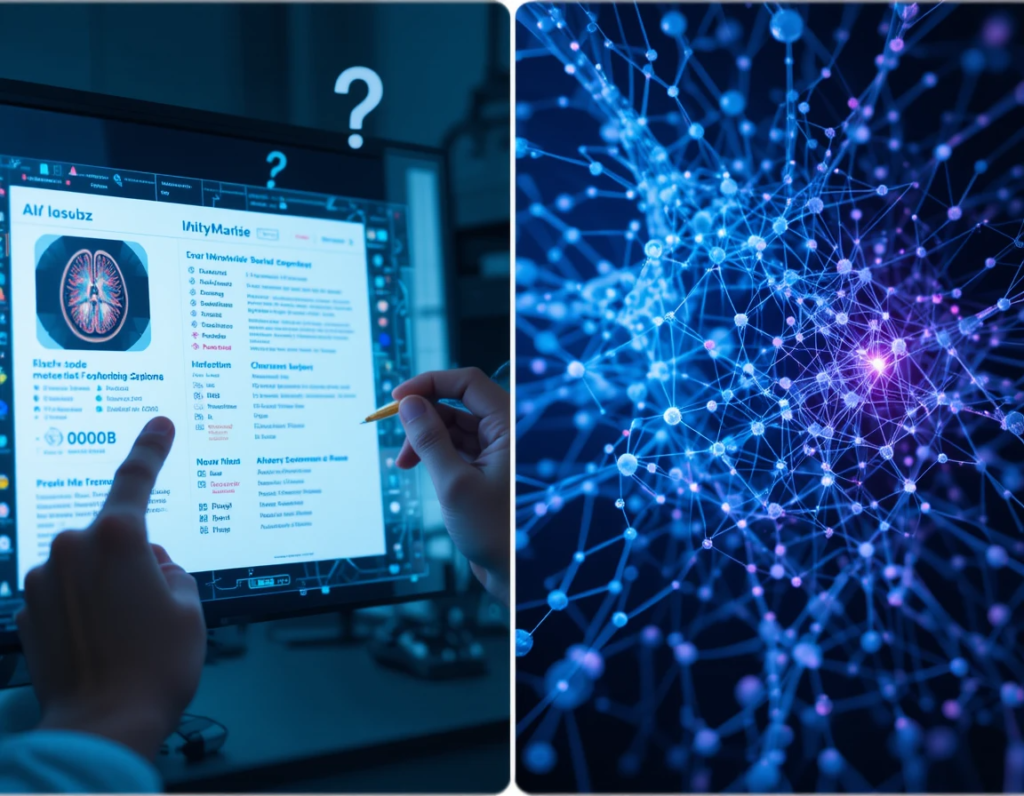
    plit-screen image: on the left, a doctor examining an AI-generated medical diagnosis with question marks hovering overhead; on the right, a visualization of a complex neural network with millions of nodes and connections illuminated in blue and purple, demonstrating the impossible task of tracing AI reasoning.

    Anthropic researchers have pioneered an innovative approach to decode large language models through dictionary learning techniques. This method treats artificial neurons like letters in Western alphabets, which gain meaning through specific combinations [16]. By analyzing these neural combinations, researchers identified millions of features within Claude’s neural network, creating a comprehensive map of the model’s knowledge representation [16].

    The team successfully extracted activity patterns that correspond to both concrete and abstract concepts. These patterns, known as features, span across multiple domains – from physical objects to complex ideas [1]. Most notably, the researchers discovered features related to safety-critical aspects of AI behavior, such as deceptive practices and potentially harmful content generation [16].

    Through careful manipulation of these identified features, scientists demonstrated unprecedented control over the model’s behavior. By adjusting the activity levels of specific neural combinations, they could enhance or suppress particular aspects of the AI’s responses [1]. For instance, researchers could influence the model’s tendency to generate safer computer programs or reduce inherent biases [16].

    Neural Network Visualization Tools

    Significant progress has been made in developing tools that make neural networks more transparent. These visualization techniques provide crucial insights into how AI systems process and analyze information:

    TensorBoard enables real-time exploration of neural network activations, allowing researchers to witness the model’s decision-making process in action [17]

    DeepLIFT compares each neuron’s activation to its reference state, establishing traceable links between activated neurons and revealing dependencies [18]

    The development of dynamic visual explanations has proven particularly valuable in critical domains like healthcare. These tools enable medical professionals to understand how AI systems reach diagnostic conclusions, fostering a collaborative environment between human experts and artificial intelligence [19].

    Visualization techniques serve multiple essential functions in understanding AI systems:

    Training monitoring and issue diagnosis

    Model structure analysis

    Performance optimization

    Educational purposes for students mastering complex concepts [20]

    These tools specifically focus on uncovering data flow within models and providing insights into how structurally identical layers learn to focus on different aspects during training [20]. Consequently, data scientists and AI practitioners can obtain crucial insights into model behavior, identify potential issues early in development, and make necessary adjustments to improve performance [20].

    The combination of feature detection methods and visualization tools marks a significant step forward in AI transparency. These advances not only help researchers understand how AI systems function at a deeper level but accordingly enable more effective governance and regulatory compliance [21]. As these technologies continue to evolve, they promise to make AI systems increasingly interpretable while maintaining their sophisticated capabilities.

    Technical Solutions for AI Interpretation

    Technological advancements have produced several powerful tools and frameworks that help decode the complex decision-making processes within artificial intelligence systems. These solutions offer practical approaches to understanding previously opaque AI operations.

    LIME Framework Implementation

    Local Interpretable Model-agnostic Explanations (LIME) stands as a groundbreaking technique for approximating black box AI predictions. This framework creates interpretable models that explain individual predictions by perturbing original data points and observing corresponding outputs [3]. Through this process, LIME weighs new data points based on their proximity to the original input, ultimately fitting a surrogate model that reveals the reasoning behind specific decisions.

    The framework operates through a systematic approach:

    Data perturbation and analysis

    Weight assignment based on proximity

    Surrogate model creation

    Individual prediction explanation

    LIME’s effectiveness stems from its ability to work with various types of data, including text, images, and tabular information [22]. The framework maintains high local fidelity, ensuring explanations accurately reflect the model’s behavior for specific instances.

    Explainable AI Tools

    Modern explainable AI tools combine sophisticated analysis capabilities with user-friendly interfaces. ELI5 (Explain Like I’m 5) and SHAP (Shapley Additive exPlanations) represent two primary frameworks integrated into contemporary machine learning platforms [3]. These tools enable data scientists to examine model behavior throughout development stages, ensuring fairness and robustness in production environments.

    SHAP, based on game theory principles, computes feature contributions for specific predictions [23]. This approach delivers precise explanations by:

    Analyzing feature importance

    Calculating contribution values

    Providing local accuracy

    Maintaining additive attribution

    Model Debugging Approaches

    Effective model debugging requires a multi-faceted strategy to identify and resolve performance issues. Cross-validation techniques split data into multiple subsets, enabling thorough evaluation of model behavior across different scenarios [4]. Validation curves offer visual insights into performance patterns as training data size varies.

    Feature selection and engineering play crucial roles in model optimization. These processes involve:

    Identifying relevant features

    Transforming existing attributes

    Creating new informative variables

    Addressing data imbalance issues [4]

    Model assertions help improve predictions in real-time, alongside anomaly detection mechanisms that identify unusual behavior patterns [24]. Visualization techniques prove invaluable for debugging, allowing developers to observe input and output values during execution. These tools enable precise identification of error sources and data modifications throughout the debugging process [24].

    Modular debugging approaches break AI systems into smaller components, such as data preprocessing and feature extraction units [25]. This systematic method ensures thorough evaluation of each system component, leading to more reliable and accurate models. Through careful implementation of these technical solutions, developers can create more transparent and trustworthy AI systems that maintain high performance standards.

    Limitations of Current Methods

    Current methods for understanding black box AI face substantial barriers that limit their practical application. These constraints shape how effectively we can interpret and scale artificial intelligence systems.

    Computational Resource Constraints

    The computational demands of modern AI systems present formidable challenges. Training large-scale models requires immense processing power, often consuming electricity equivalent to that of small cities [26]. The hardware requirements have grown exponentially, with compute needs doubling every six months [26], far outpacing Moore’s Law for chip capacity improvements.

    Financial implications remain equally daunting. The final training run of GPT-3 alone cost between $500,000 to $4.6 million [5]. GPT-4’s training expenses soared even higher, reaching approximately $50 million for the final run, with total costs exceeding $100 million when accounting for trial and error phases [5].

    Resource scarcity manifests through:

    Limited availability of state-of-the-art chips, primarily Nvidia’s H100 and A100 GPUs [5]

    High energy consumption leading to substantial operational costs [27]

    Restricted access to specialized computing infrastructure [5]

    Scalability Issues with Large Models

    As AI models grow in size and complexity, scalability challenges become increasingly pronounced. The Chinchilla paper indicates that compute and data must scale proportionally for optimal model performance [28]. However, the high-quality, human-created content needed for training has largely been consumed, with remaining data becoming increasingly repetitive or unsuitable [28].

    The scalability crisis extends beyond mere size considerations. Training Neural Network models across thousands of processes presents significant technical hurdles [29]. These challenges stem from:

    Bottlenecks in distributed AI workloads

    Cross-cloud data transfer latency issues

    Complexity in model versioning and dependency control [6]

    Most current interpretability methods become unscalable when applied to large-scale systems or real-time applications [30]. Even minor adjustments to learning rates can lead to training divergence [29], making hyper-parameter tuning increasingly sensitive at scale. The deployment of state-of-the-art neural network models often proves impossible due to application-specific thresholds for latency and power consumption [29].

    Essentially, only a small global elite can develop and benefit from large language models due to these resource constraints [31]. Big Tech firms maintain control over large-scale AI models primarily because of their vast computing and data resources, with estimates suggesting monthly operational costs of $3 million for systems like ChatGPT [31].

    Conclusion

    Understanding black box AI systems remains one of artificial intelligence’s most significant challenges. Despite remarkable advances in AI transparency research, significant hurdles persist in decoding these complex systems’ decision-making processes.

    Recent breakthroughs, particularly Anthropic’s feature detection method and advanced visualization tools, offer promising pathways toward AI interpretability. These developments allow researchers to map neural networks’ knowledge representation and track information flow through multiple processing layers. Technical solutions like LIME and SHAP frameworks provide practical approaches for explaining individual AI decisions, though their effectiveness diminishes with larger models.

    Resource constraints and scalability issues present substantial barriers to widespread implementation of interpretable AI systems. Computing requirements continue doubling every six months, while high-quality training data becomes increasingly scarce. These limitations restrict advanced AI development to a small group of well-resourced organizations, raising questions about accessibility and democratization of AI technology.

    Scientists must balance the drive for more powerful AI systems against the need for transparency and interpretability. As artificial intelligence becomes more integrated into critical decision-making processes, the ability to understand and explain these systems grows increasingly vital for ensuring safety, accountability, and public trust.

  • Can Computers Create Art? Exploring the World of AI-Generated Creations

    Can Computers Create Art? Exploring the World of AI-Generated Creations

    Exploring the World of AI-Generated Creations

    The digital realm has transformed countless industries, and art is no exception. With the rise of artificial intelligence (AI), the question arises: can machines genuinely create art? This exploration delves into the world of AI-generated creations, spotlighting significant changes in how we perceive artistry.

    The Blurring Lines Between Human and Machine Creativity

    As AI technology advances, the boundary between human and machine creativity becomes less distinct. Traditional notions of art focused on the human touch, emotion, and experience. However, AI can mimic these qualities. Today, artworks generated by algorithms can evoke real feelings and provoke thought. This evolution challenges long-held beliefs about what constitutes art.

    The Rise of AI Art Generators and Their Impact on the Art World

    AI art generators have surged in popularity. Tools like DALL-E and Midjourney allow users to create visually stunning pieces with simple prompts. These generators rely on extensive datasets of images to learn styles, techniques, and themes, producing unique outputs.

    Not only are these creations captivating, but they also raise questions regarding authenticity and value in the art world. As more artists embrace these technologies, art forms are diversifying and reshaping established standards.

    Setting the Stage: Defining Art and Creativity

    To appreciate AI-generated art, it’s essential to explore definitions of art and creativity. Art has often been associated with human intent and emotional expression. Creativity involves generating new ideas, whether through traditional methods or innovative means. By expanding this definition, we can embrace the artistic contributions of AI.

    Understanding AI Art Generation Techniques

    AI art generation employs various techniques, each contributing to its potential. Here are some key methods:

    Generative Adversarial Networks (GANs): The Power of Competition

    GANs consist of two neural networks—one generating images and the other critiquing them. This competitive process fosters continual improvement, yielding increasingly sophisticated creations.

    Deep Learning Models: Training Algorithms on Vast Datasets

    Deep learning algorithms analyze extensive collections of images and styles. They identify patterns, textures, and forms, allowing AI to generate original pieces that mimic different artistic styles.

    Evolutionary Algorithms: Adapting and Refining Artistic Styles

    Similar to natural selection, evolutionary algorithms evolve artworks over time. These algorithms generate variations, gradually refining them based on user feedback or set criteria.

    Analyzing the Artistic Merit of AI Creations

    Evaluating AI-generated art involves several factors, including aesthetics, human input, and legal considerations.

    Assessing Aesthetics: Beauty, Emotion, and Impact

    Just like traditional art, AI creations can be judged by beauty, emotional resonance, and impact. Viewers often respond to these pieces similarly to human-made art, highlighting their aesthetic value.

    The Role of Human Input: Prompt Engineering and Artistic Direction

    While AI does much of the heavy lifting, human input remains crucial. Prompt engineering—crafting effective prompts—guides the AI in creating desired outcomes. The artist’s vision shapes the final product, allowing collaboration between human and machine.

    Legal issues arise with AI-generated art. Who owns the rights? The user, the AI developer, or neither? This gray area presents challenges for artists and the art world, demanding new frameworks to address these concerns.

    The Impact of AI on the Art World and Society

    AI’s influence extends beyond individual artworks. It alters how we think about creativity and art itself.

    AI as a Tool for Artists: Expanding Creative Possibilities

    Artists are finding new ways to incorporate AI into their practices. It acts as an assistant, providing fresh perspectives, ideas, and inspiration. This collaboration opens communities to explore uncharted territories in art.

    The Future of Art Education: Integrating AI into Curricula

    As digital art grows, educational institutions must adapt. Integrating AI into art curricula teaches future artists to use these tools efficiently, blending traditional techniques with modern technology.

    The Ethical Considerations: Bias, Representation, and Authenticity

    AI is not without its flaws. Data bias can lead to misrepresentation in art. Understanding these ethical concerns is vital to ensuring AI promotes diversity and authenticity rather than perpetuating stereotypes.

    Famous Examples of AI Art and Their Significance

    Several noteworthy examples highlight the capabilities of AI in art creation.

    Specific Examples of AI-Generated Artworks

    1. Portrait of Edmond de Belamy: Created by Obvious, this piece sold for over $432,000 at auction, showcasing the commercial viability of AI art.
    2. The Next Rembrandt: This project utilized machine learning to recreate a compelling piece mimicking Rembrandt’s style, bridging historical and modern art forms.

    Analysis of their reception and impact on the art community

    These examples received mixed reactions. Some applaud the innovation, while others argue it diminishes human creativity. Regardless, they spark dialogue about art’s future.

    Discussion of the artists (human and AI) involved

    The interplay between human and AI artists fosters a new creative ecosystem. Traditional artists and tech developers collaborate, creating pioneering works that redefine artistic boundaries.

    Conclusion: A Future Shaped by Human-AI Collaboration

    AI’s role in art creation is undeniable. As technology advances, artists and machines can work in tandem, enriching the art world with fresh ideas and perspectives.

    Key Takeaways: The evolving role of AI in art creation

    AI is not replacing artists; it’s enhancing creativity. By embracing new tools, artists can push boundaries and explore new realms of expression.

    Call to action: Further exploration and engagement with AI art

    Engage with AI art by exploring different platforms, participating in discussions, and considering its implications. The future of art is a joint endeavor, inviting creativity from both machines and humans.

  • What Is AI Art and How Does It Work?

    AI Art Discover how AI art is revolutionizing creativity! Explore AI-generated artwork, popular AI art tools like Midjourney and DALL-E 2, and the technology behind Generative Adversarial Networks (GANs) and Diffusion Models. Learn about the ethics, applications, and future of AI in art.

    Artificial Intelligence in Art

    The Rise of Artificial Creativity

    The world of art is changing fast, thanks to AI art generators. These tools are transforming how we create, experience, and think about art. From stunning visuals to imaginative concepts, AI is pushing the boundaries of creativity.

    AI art refers to artwork produced with the help of artificial intelligence technologies. This can include images, paintings, music, and even text-based art. It comes in many forms, powered by various algorithms and techniques. Understanding AI art is vital in today’s digital world, where technology meets imagination.

    Understanding the Technology Behind AI Art

    Generative Adversarial Networks (GANs)

    One primary technology behind AI art is Generative Adversarial Networks, or GANs. These networks work by having two components: a generator and a discriminator.

    • Generator: Creates images based on random noise or existing sample data.
    • Discriminator: Evaluates images and determines whether they are real or generated.

    This back-and-forth process improves the quality of the generated art over time, leading to stunning results.

    Diffusion Models

    Diffusion models are another innovative approach in AI art generation. They start with random noise and gradually refine it into coherent images through multiple iterations.

    • Process: The model learns patterns from training data and applies them to create art.
    • Outcome: This method can produce high-quality images, making it a favorite among creators.

    Other AI Art Techniques

    AI art also includes other techniques, such as neural style transfer, which applies the style of one image to the content of another. Despite their strengths, these methods have limitations, including biases in training data and a lack of creative intent.

    Midjourney

    Midjourney offers an accessible platform for users to create art with ease. Its features include:

    • User-friendly interface.
    • Community-driven support.

    However, it may lack advanced customization options compared to others.

    DALL-E 2

    DALL-E 2, developed by OpenAI, is known for its impressive capabilities. It can generate unique images based on textual prompts. Key points include:

    • High-quality image output.
    • Ability to understand complex prompts.

    Its limitations involve restrictions on explicit content and bulk generation.

    Stable Diffusion

    Stable Diffusion has gained popularity for its open-source nature. This allows for:

    • Community contributions.
    • Versatile applications.

    Its uniqueness lies in its accessibility, appealing to both amateurs and professionals.

    Ethical Considerations and the Future of AI Art

    As AI art grows, so do questions about copyright. Who owns AI-generated art? The original artists whose works trained the AI? The developers of the AI? Clear guidelines are still needed.

    Impact on Human Artists

    AI art also influences human creativity. While some artists embrace AI as a tool, others fear it may replace traditional methods. This raises questions about the role of human touch in artistic expression.

    Societal Implications

    The development of AI art may reshape societal norms around creativity. As more creators use AI, discussions about authenticity and originality become increasingly relevant.

    A futuristic digital artist’s workspace where an AI-powered robotic arm paints on a digital canvas. The screen showcases an AI-generated abstract artwork blending human and artificial creativity. The environment is illuminated by neon blue and purple lights, reflecting an advanced tech-driven studio. The atmosphere is artistic yet high-tech, symbolizing the evolution of art in the AI age.

    Mastering the Art of AI Art Prompts

    Crafting Effective Prompts

    When using AI art generators, writing effective prompts is crucial. Clear and descriptive language helps the AI understand your vision better. Experiment with different styles and contexts to see varied results.

    Using Keywords and Negative Prompts

    Incorporating specific keywords can guide the AI to produce desired outcomes. Negative prompts help define what you don’t want, refining the results further.

    Experimentation and Iteration

    Iterate on your prompts. AI art thrives on experimentation. Test variations until you achieve the results you wish for.

    AI Art: Applications and Beyond

    AI Art in Commercial Applications

    AI art finds applications in marketing and design. Businesses use it to create eye-catching visuals quickly, saving time and resources.

    AI Art in Creative Fields

    Movies and music also benefit from AI-generated content. For instance, filmmakers experiment with visuals that blend real and virtual elements. Musicians use AI to compose unique soundscapes.

    Shaping Future Artistic Expressions

    AI is shaping new ways to express art. As more tools become available, the future of creativity may involve a collaboration between humans and machines.

    Conclusion: Embracing the AI Art Revolution

    AI art presents incredible possibilities but also challenges. Key takeaways include the importance of understanding the technology and its implications for the art world. As we navigate this new space, engagement with AI art can spark creativity and innovation.

    Explore AI art generators and try creating your own pieces. Discover the power of combining human creativity with artificial intelligence. The future of art is here, and it’s an exciting time to be a part of the revolution!

  • Download Perplexity DeepSeek R1: Your Guide to Enhanced Search

    Download Perplexity DeepSeek R1: Your Guide to Enhanced Search

    Introduction: Unveiling the Power of DeepSeek R1

    The Search for Superior Search: Why DeepSeek R1 Matters

    In a sea of information, finding what you need can be overwhelming. Perplexity DeepSeek R1 presents a solution. This advanced search tool harnesses the power of artificial intelligence, elevating the way you retrieve information. With its enhanced capabilities, users can pinpoint relevant data faster and more effectively.

    Perplexity AI and its Revolutionary Approach to Information Retrieval

    Perplexity AI is at the forefront of search technology. It transforms traditional search methods through deep learning techniques. By understanding language and context better, it provides tailored search results that often surpass those of mainstream engines. This innovative approach shifts the paradigm of how we access and engage with information.

    What to Expect from this DeepSeek R1 Download Guide

    This guide aims to simplify the process of downloading and using DeepSeek R1. Whether you want to explore its features or enhance your productivity, this article covers it all. Discover how to efficiently install and customize DeepSeek R1, and learn the best practices for maximizing its potential.

    Understanding Perplexity DeepSeek R1’s Capabilities

    Deep Learning and Natural Language Processing: The Technology Behind DeepSeek R1

    DeepSeek R1 utilizes cutting-edge technology, relying on deep learning and natural language processing (NLP). These advanced methods allow the tool to comprehend queries more thoroughly. By analyzing context and semantics, it offers results that align closely with user intentions.

    Enhanced Search Precision and Efficiency: How DeepSeek R1 Improves Results

    One of the key advantages of DeepSeek R1 is its precision. Traditional search engines often yield irrelevant results, wasting valuable time. DeepSeek R1 narrows down searches sharply, increasing the likelihood of finding what you need on the first attempt.

    Key Features and Benefits: A Comprehensive Overview

    • Natural Language Understanding: Interact in plain language.
    • Contextual Relevance: Results based on context rather than keywords alone.
    • User-Friendly Interface: Navigate easily, even for beginners.
    • Rapid Information Retrieval: Access information in seconds, not minutes.

    Step-by-Step DeepSeek R1 Download and Installation Guide

    System Requirements and Compatibility: Ensuring a Smooth Download

    To install DeepSeek R1, make sure your system meets these requirements:

    • Operating System: Windows 10 or later, macOS, or Linux.
    • RAM: 4GB minimum recommended.
    • Internet Connection: Required for activation and updates.

    Downloading DeepSeek R1: A Simple, Step-by-Step Process

    1. Visit the official Perplexity website.
    2. Find the DeepSeek R1 download link.
    3. Click on the link to begin downloading.
    4. Save the file to your preferred location.

    Installation and Setup: A Quick Guide to Getting Started

    1. Locate the downloaded file and double-click to open.
    2. Follow the on-screen instructions.
    3. Once installed, launch the application.
    4. Complete the setup wizard to personalize your experience.

    Mastering DeepSeek R1: Tips and Tricks for Optimal Performance

    Advanced Search Techniques: Unlocking DeepSeek R1’s Full Potential

    Maximize your search results by using phrases instead of single words. For example, instead of “cats,” try “best cat care tips.” This helps the engine understand your intent better.

    Customizing Your DeepSeek R1 Experience: Personalized Settings

    DeepSeek R1 allows you to tweak settings based on your preferences. Adjust filters, save favorite searches, or set criteria to receive alerts on specific topics of interest.

    Troubleshooting Common Issues: Resolving Download and Usage Problems

    Having issues? Here are a few quick fixes:

    • Download Problems: Check your internet connection and try again.
    • Installation Errors: Ensure system requirements are met. Restart your computer if needed.
    • Search Result Questions: Rephrase your query for better accuracy.

    DeepSeek R1 vs. Other Search Engines: A Comparative Analysis

    Direct attention to Comparative analysis of two search engines

    Comparing Search Accuracy and Speed: DeepSeek R1 Benchmarks

    In tests comparing search accuracy, DeepSeek R1 consistently outperformed competitors in retrieving relevant information quickly. Users benefit from less time sifting through irrelevant results.

    Feature Comparison: DeepSeek R1 vs. Google, Bing, and Others

    • DeepSeek R1: Contextual results with deeper understanding.
    • Google: Robust network but often overwhelmed by ads.
    • Bing: Good for image searches but lacks nuance in language understanding.

    User Experience and Interface: A Comparative Look

    DeepSeek R1’s interface is clean and intuitive. Users find their desired information without getting lost in complicated menus. This ease of use sets it apart from more congested alternatives.

    Real-World Applications and Use Cases of DeepSeek R1

    Academic Research and Information Gathering: DeepSeek R1’s Role

    Students and researchers can utilize DeepSeek R1 to find relevant academic papers and publications quickly. It streamlines the research process, saving you valuable time.

    Professional Use Cases: Enhancing Productivity and Efficiency

    In a work environment, DeepSeek R1 can assist with project-based inquiries. Whether it’s gathering data or compiling reports, its efficiency helps professionals stay focused and productive.

    Personal Use: DeepSeek R1 for Everyday Information Needs

    From recipe searches to DIY projects, DeepSeek R1 caters to everyday users. Its ability to understand conversational queries makes it perfect for casual searches.

    Key Takeaways: Maximizing Your DeepSeek R1 Experience

    Utilize advanced techniques like natural language queries. Personalize settings to fit your needs and troubleshoot common issues quickly for an optimal experience.

    Future of Perplexity AI and DeepSeek: What’s Next?

    As technology evolves, expect frequent updates enhancing DeepSeek R1’s capabilities. Future versions may include even more advanced features, reinforcing its position as a top search tool.

    Call to Action: Download DeepSeek R1 Today

    Ready to enhance your search experience? Download DeepSeek R1 today and discover the potential of a smarter search tool. Don’t miss out on the benefits that Perplexity AI has to offer!