Imagine watching a movie made entirely by artificial intelligence. It’s not just a dream anymore. Big names like Warner Bros. and Disney are using ai in hollywood to write scripts and make trailers. They even guess how well a movie will do.
Now, 40% of film folks use ai movie making tools. The real question is: How much will humans still control the movies?
The ai impact on film goes beyond making things faster. When Netflix chose Enola Holmes 2 with AI, it raised big questions. Does relying on data hurt creativity?
ai in film industry tools like Runway ML and Synthicity are changing how movies are made. They help with CGI and even picking actors. But, can machines really feel the same as a human director?
This change affects everyone, from Oscar winners to fans. This article isn’t afraid of new tech. It just wonders: Is Hollywood ready to let machines take over?
The Rise of Artificial Intelligence in Tinseltown
AI’s journey from sci-fi to Hollywood reality started decades ago. Early CGI experiments in the 1990s set the stage for today’s innovations. Studios like Disney and Warner Bros. used AI for effects in hits like Jurassic Park and Avatar.
These tools have grown into advanced systems. They now handle everything from rendering to editing.
| Year |
Key Milestone |
| 1993 |
AI-driven CGI in Jurassic Park revolutionizes visual effects |
| 2016 |
Netflix adopts AI for personalized content recommendations |
| 2020 |
Disney uses AI to streamline post-production for Star Wars: The Rise of Skywalker |
| 2023 |
Warner Bros. invests $50M in ai generated content future tech |
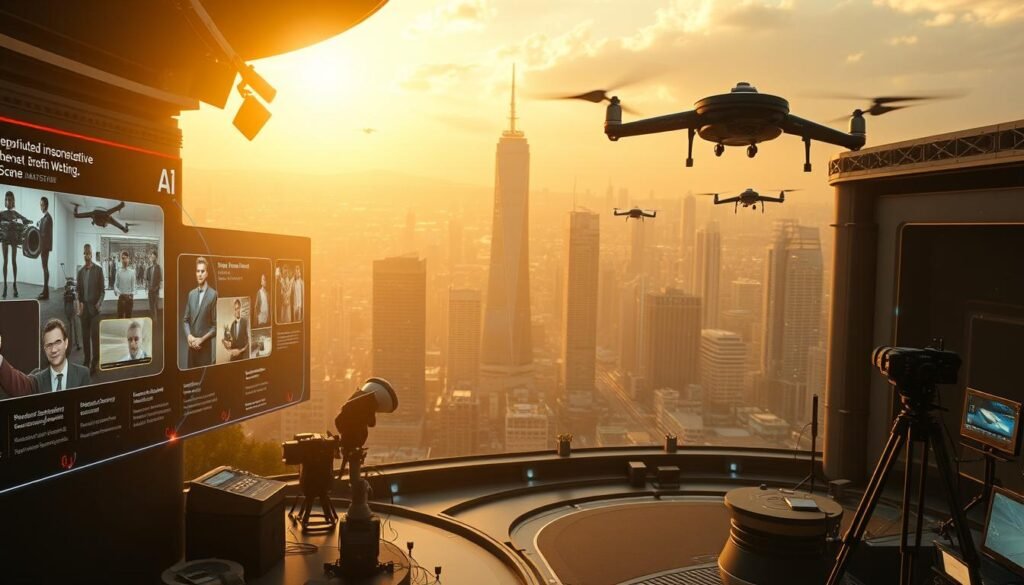
The pandemic made studios adopt AI tools faster. They needed AI for virtual production and editing. Now, Disney+ and Paramount+ use AI to predict trends and save money.
“AI isn’t replacing creativity—it’s expanding possibilities,” said a Disney tech lead in 2023. This change shows a future of entertainment where AI helps tell stories without taking over. AI’s mark is seen in every stage, from effects to distribution.
When Machines Tell Our Stories: Why You Should Be Scared of AI in Hollywood
AI is changing how we tell stories, and it’s not just science fiction anymore. Movies like “Sunspring” and ads for Coca-Cola show AI’s power. They mix ai new media formats in ways we can’t even imagine. But is this progress or a danger?
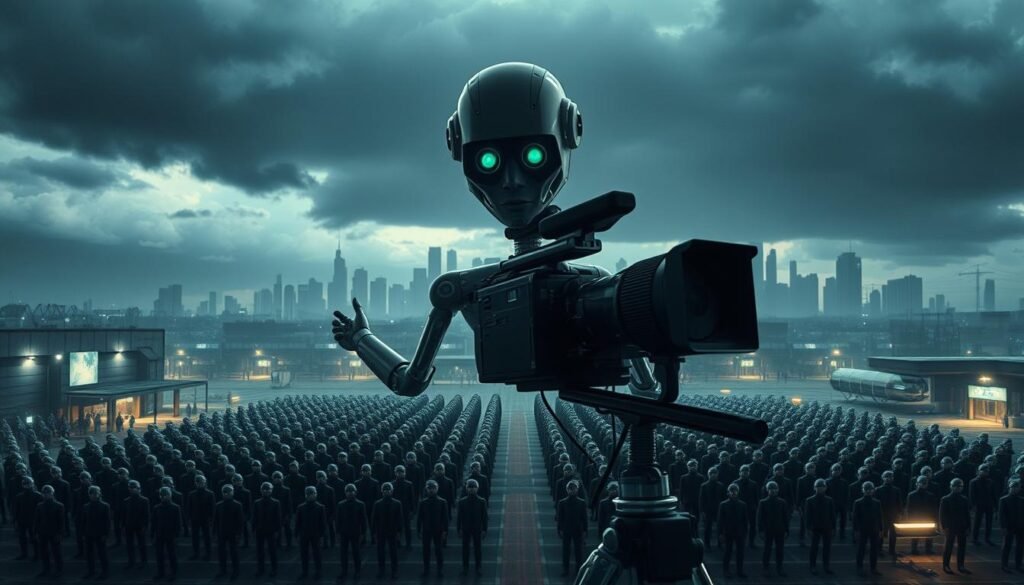
“AI gives me ideas I’d never think of—but the soul? That’s still mine.” — Director Ava Chen, who co-created an AI-assisted thriller, Code Echo
Tools like Runway ML and StoryFile let AI create plot twists and dialogues. Some filmmakers are amazed by the speed. But others are worried.
Human stories have cultural depth and emotional layers. AI, based on data, might repeat patterns or lack originality. A 2023 MIT study found AI scripts often lack character growth, sticking to familiar tropes.
Think about the ai future of movies: Will AI make blockbusters that follow trends over truth? Studios already use AI to guess box office hits. But using AI instead of human creativity might take away the heart of movies. Next time you watch a movie, wonder: Who’s really behind the story? The answer might change how we see art.
The Soul of Storytelling: Can Machines Capture Human Truth?
Storytelling shows us our deepest feelings and biggest wins. Think of Eternal Sunshine of the Spotless Mind and Charlie Kaufman’s deep grief. Or Viola Davis’s acting, full of family history and strength.
These stories touch us because they come from real feelings, not just code.
“A story without vulnerability is just a data set in motion,” noted filmmaker Ava DuVernay in a 2023 interview.
AI tries to understand stories by looking at patterns. It can make ai personalized entertainment that fits what we like. But it misses the deep human feelings found in classics like 12 Years a Slave or Parasite.
Algorithms can break down themes, but they can’t feel loss or hope. Imagine an AI writing a breakup scene. It might use common phrases, but it won’t capture the unique pain of heartbreak.
The ai future of creativity might make things faster, but it could make art too simple. AI can offer script ideas, but it can’t match a director like Greta Gerwig. She brings her own stories into her films.
Without real life, can AI’s work ever be truly original?
As tech gets better, we wonder: Does storytelling lose its heart when it’s made by machines? The answer could change how we see art in an AI world.
Behind the Camera: AI’s Growing Role in Film Production
AI is changing ai film production at every step, from script to screen. In the early stages, tools help plan timelines, budgets, and find locations. They use satellite data to do this.
Studios now use algorithms to plan shoots. This cuts weeks off the planning time.
On set, cameras with ai in visual effects software track actors. They adjust focus and lighting as they go. Films like The Irishman use AI for pre-visualization. This lets directors see scenes before they’re filmed.
During production, AI like Foundry’s Mocha Pro makes greenscreen work easier. It cuts manual labor by 40%.
In post-production, AI edits rough cuts based on emotions. Tools like Adobe Sensei auto-generate color grades and clean up audio. VFX artists use AI to paint out rigs or extend sets, saving hours.
“It’s like having a co-pilot guiding technical decisions,” said an Oscar-winning editor.
While ai impact on film makes things faster, some worry it might make things too simple. Cinematographers worry AI might limit unique directorial choices. Studios must find a balance between speed and the human touch that makes movies special.
Digital Actors and Synthetic Performances
From Furious 7‘s digital Paul Walker to The Mandalorian‘s young Luke Skywalker, AI-driven ai digital actors are changing Hollywood. Today’s tech can copy voices, movements, and faces very well. This makes it hard to tell real art from fake.
AI deepfakes actors are getting better than old CGI. For example, Roadrunner used Anthony Bourdain’s AI voice. This shows how ai celebrity voice cloning can be used. But, there are worries about fake celebrity videos and altered speeches.
Now, there are ai likeness rights debates. Who owns an actor’s digital look? Legal fights are starting over this.
| Traditional Film |
AI-Driven Film |
| Live stunt performers |
ai replacing stunt performers |
| Pay per scene |
ai actor compensation debates |
| Human creativity |
AI-generated faces/motions |
Stunt unions are worried ai replacing stunt performers could lose jobs. SAG-AFTRA wants ai actor compensation rules. Should Tom Cruise get money if his double is used in 2050?
“Actors’ likenesses shouldn’t be forever money makers for studios,” a union rep said in a 2023 Deadline interview.
“These tools can honor legacies or exploit them—it’s time for clear ethical guidelines.” — SAG-AFTRA spokesperson, 2023
As studios try to make money from AI clones, it’s getting serious. The question is: Who owns a performance? And when AI can copy anyone, what makes a role “acted”?
The Writers’ Room Revolution: How AI Is Changing Screenwriting
Screenwriters are learning to use new tools that change how they work. AI script writing software like Final Draft’s Beat Board and Scriptbook help with story structure, market analysis, and dialogue. They use data to guess what audiences like and make writing easier. But do they take away creativity or add to it?
- AI script generation creates plot outlines based on common formulas
- Tools like ChatGPT adjust tone to fit directors’ styles
- Real-time feedback systems help with pacing and character development
| Aspect |
AI-Generated Scripts |
Human-Written Scripts |
| Creativity |
Formulaic twists |
Unique perspectives |
| Emotional Depth |
Limited by data patterns |
Driven by lived experience |
| Originality |
Replicates popular trends |
Risks bold innovations |
Writers are now using AI collaboration with writers to brainstorm ideas quicker. But the ai impact on screenwriters is a big debate. Some writers mix AI drafts with their own work, while others worry about relying too much on AI. The 2023 WGA strike showed the push for clear rules on AI use, highlighting the balance between speed and creativity. AI can’t replace human touch, but it’s changing how stories are made.
Hollywood’s Job Market: Who’s at Risk?
AI is changing how we get into the movie business. Jobs like script readers and junior editors are now at risk. AI tools can check scripts for tone and how well they’ll do at the box office.
Platforms like StudioBinder use AI to look at thousands of scripts. This means fewer jobs for humans. Jobs like production assistants and data coordinators are also being cut down.
Even tech jobs are changing. Editing and sound work are now done with AI tools. For example, DaVinci Resolve’s Neural Engine helps with color and VFX. Sound engineers use iZotope’s AI to reduce noise.
A 2023 UCLA Labor Report says 34% of post-production jobs might be automated by 2027.
- Script analysts: 40% of first reads now AI-generated
- Colorists: 60% of routine grading tasks automated
- Assistant editors: 25% fewer hires since 2021
Creative jobs are also changing. Directors use AI to help write story outlines. This means they have less time to teach writers.
Casting directors use AI to guess what audiences will like. This makes traditional talent scouts less needed. A WGA economist says mid-level creatives are most at risk.
“The ai takeover hollywood isn’t a binary threat—it’s a shift toward hybrid roles requiring both tech literacy and artistry,” notes a Paramount strategist.
New jobs in AI and hybrid production are coming. But, workers need to learn to do both tech and creative work. This is hard, but it’s what audiences want.
The Ethics of Digital Creation in the Age of AI
AI is changing Hollywood, and ai ethical concerns movies are growing. Systems like MidJourney and DALL-E use big datasets. These datasets often come from movies and TV shows.
Lawsuits, like the one against Stability AI, show the issue of ownership. Filmmakers wonder if studios should pay creators for their work in AI systems.
“AI doesn’t just copy—it codifies biases into new stories,” says tech ethicist Dr. Emily Carter. “When algorithms learn from decades of Hollywood tropes, marginalized voices risk being erased again.”
There’s also a fight for transparency. Should movies say they were made with AI? A bill in California wants AI content warnings. This sparks debate.
Some say audiences should know when AI was used. Others worry it might scare people off new ideas.
- Biased training data risks reinforcing stereotypes
- Disputes over compensating original creators
- Lack of global cultural representation in AI datasets
Studios are caught in a tough spot. They can use AI for speed or face hollywood’s fears about ai. AI dialogue tests showed old gender roles, showing data problems.
Big names like Netflix and Disney are starting ethics panels. They’re tackling both creative and moral challenges.
Legal Battlegrounds: Copyright, Ownership, and AI
AI is changing Hollywood, leading to more legal fights over who owns what. The U.S. Copyright Office says AI-made content can’t be copyrighted. This means studios and writers must show how much human work is in their projects.
Contracts now have special clauses to deal with AI-made material. They help protect both creators and companies. This way, everyone knows who owns what.
Using old movies to train AI raises ai copyright issues film. Lawsuits between tech companies and studios show the risks. For example, using movie clips without permission could lead to legal trouble.
Writers and producers struggle to innovate while staying safe legally. They need to figure out how to protect their work with AI. Now, contracts include ai copyright protection writers clauses to make sure human work is recognized.
Actors also face legal challenges with AI. Digital avatars that look like them could be seen as copying. The Johnny Depp v. Amber Heard case shows what’s coming.
Courts around the world have different views on these issues:
| Country |
Key Issue |
| United States |
Human authorship required for copyright |
| EU |
Proposed rules for AI transparency and rights |
| Japan |
Focus on data usage and creator compensation |
Studios face big challenges as they work on projects for global audiences. Until laws change, the industry must balance creativity with caution.
Finding the Balance: Human-AI Creative Partnerships
Good partnerships between humans and AI happen when humans lead the creativity. Pixar uses ai collaboration with writers to make animation faster. This lets artists work more on the story.
Indie filmmakers save money by using AI for editing. But they still decide on the story’s pace and mood.
- Tools like Grammarly help with editing, not deciding the story.
- AI helps actors learn new dialects, easing ai and actors’ concerns about losing jobs.
- Contracts now make sure humans check AI-made content to keep the artist’s vision.
| Role |
AI as Tool |
AI as Collaborator |
| Screenwriting |
Plot analysis software |
AI suggests dialogue options |
| Production |
Lighting optimization |
AI drafts scene setups |
NYU Tisch School teaches students to use AI for research. But they focus on keeping creativity human. USC’s program trains directors to use AI for budgeting, not for casting or story.
When AI handles the details, humans can focus on the art. The secret is to use AI like a tool, not the creator.
Conclusion: Protecting Hollywood’s Human Heart
The future of movies with AI is about finding a balance. AI is helping in many ways, but we must not lose the human touch. There are big challenges ahead, like legal issues and ethics.
Recent agreements in the industry are a good sign. The 2023 WGA and SAG-AFTRA deals show we can work together. They make sure AI is used in a way that respects human creativity.
We need clear rules about AI in movies. This includes fair pay for creators and laws that protect their work. Also, audiences should ask for real stories and support projects that have a human touch.
At its core, movies reflect our lives. The future of AI in movies is about using technology to help us, not replace us. Keeping the heart of Hollywood human is what matters most as technology changes the screen.
FAQ
Q: How is AI transforming the film industry?
A: AI is changing the film industry in many ways. It helps with script analysis in pre-production. It also improves editing and visual effects in post-production.
Big studios use AI for scheduling and budgeting. They also automate tasks that used to need human help.
Q: What are some examples of AI-generated content in Hollywood?
A: AI has made short films and ads in Hollywood. It can write scripts and create complex stories. It even makes deepfake performances that look real.
Q: Are AI tools impacting job security in Hollywood?
A: Yes, AI is making some jobs less needed. Jobs like script readers and junior editors are being automated. This means fewer jobs for new people.
It could also change jobs for more experienced people as AI gets better.
Q: What ethical issues arise from AI in storytelling?
A: There are big ethical problems with AI in stories. Using AI without the creator’s okay is a big issue. There’s also the problem of AI content being biased.
Questions about fairness and transparency in making stories are also important. These issues affect how true and fair stories are.
Q: How are studios adapting to AI’s influence?
A: Studios are spending a lot on AI research. They partner with tech companies to use AI. They also make rules about who owns AI-made content.
Q: Can AI truly capture human emotions in storytelling?
A: AI can copy patterns in stories, but it can’t truly feel like humans do. It lacks the real-life experiences and emotions that humans bring to stories.
This makes people wonder if AI stories can really touch our hearts.
Q: What are the potential legal ramifications of AI in entertainment?
A: The law is still figuring out AI’s role in entertainment. It’s hard to say who owns content made by AI. This is true for copyrights and likeness rights.
Q: How can creators and AI collaborate effectively?
A: Creators and AI can work well together if AI is seen as a tool, not a replacement. Using AI to help, not replace, human creativity can lead to new stories. This way, both human and AI skills are used.
Q: What is the future of AI in Hollywood?
A: The future will mix human creativity with AI help. This will change how we make movies and TV. It’s important to keep the heart of storytelling while using new tech.

 Photo by ROMAN ODINTSOV
 Photo by Letícia Alvares