
Category: AI productivity tools

  • Ditch Vague Prompts: Unlock the 5 Elite Secrets of Engineers

    Ditch Vague Prompts: Unlock the 5 Elite Secrets of Engineers

    The Five Unspoken Laws of Elite AI Prompting (Stop Hoping, Start Engineering)

    If you’ve ever run the same prompt twice and gotten two very different levels of quality, you’ve felt the real problem: you’re not “using AI,” you’re managing ambiguity. That’s why you lose time polishing outputs that should’ve been solid on the first pass.

    The shift is simple. Stop collecting prompt hacks and start building intent architecture. You’re not asking for magic, you’re specifying a job, with requirements and acceptance tests.

    Vague prompt (hit or miss):
    “Write a LinkedIn post about our product.”

    Engineered prompt (repeatable):
    “Write a 140 to 170-word LinkedIn post for CTOs, focus on reduced incident response time, include one metric from the notes, end with a single question, no hashtags.”

    That difference is the gap between casual users and architects of intent. Here are The Five Unspoken Laws of Elite AI Prompting that close it.

    The transition from prompt hacks to intent architecture

    Copying “winning prompts” fails because models vary, tasks vary, and your context changes every week. Even within one tool, small input shifts can change what the model assumes. When assumptions change, quality swings.

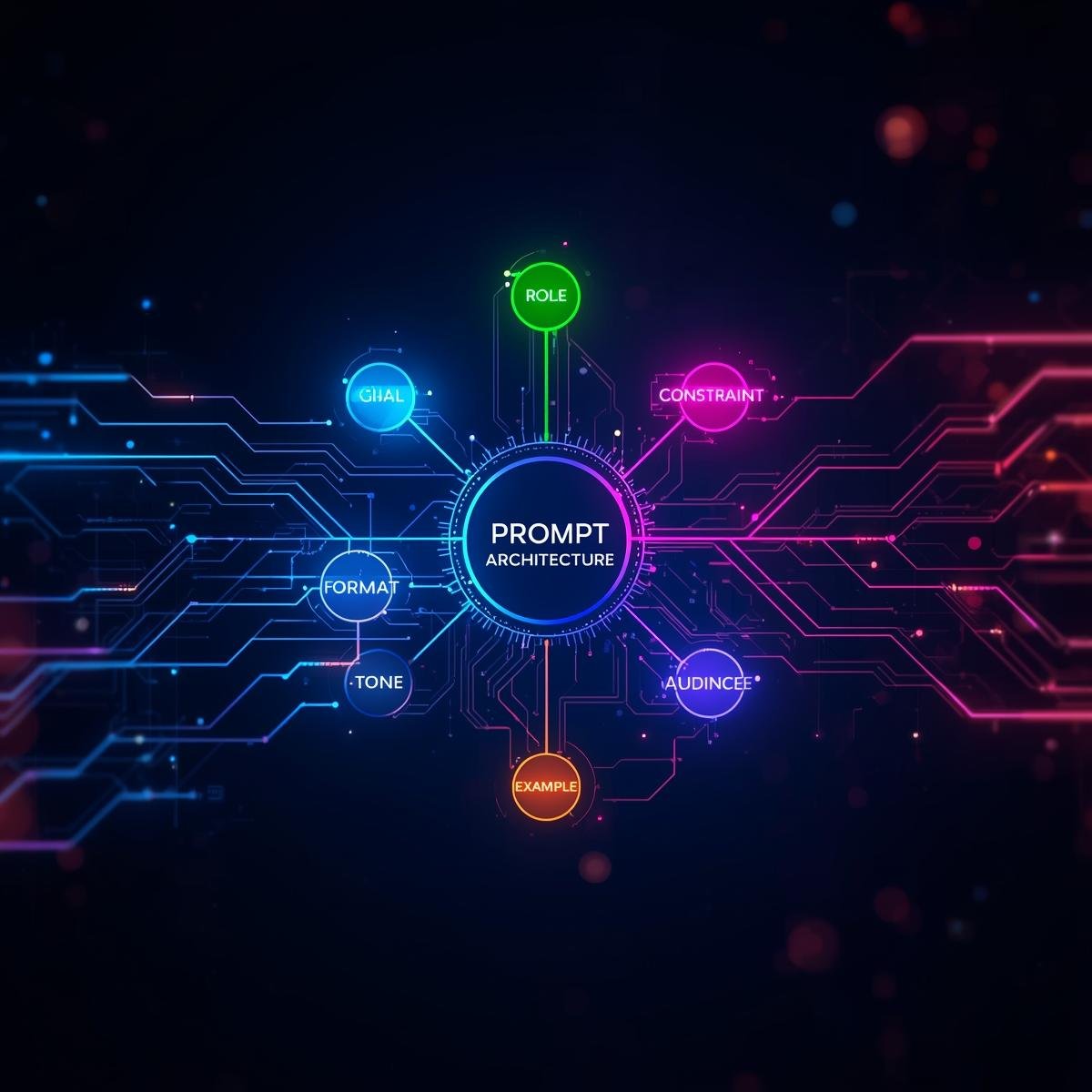
    Elite prompting treats each request like a system: inputs, rules, checks, then a loop. You define what matters, what’s allowed, and what “done” looks like. The result is consistency across writing, analysis, planning, and coding. Better yet, it scales across teams because the prompt becomes a reusable template, not a one-off message.

    If you want a baseline from a reputable source, OpenAI’s guidance on clear instructions and formats is a solid reference point, see OpenAI prompt engineering best practices.

    What casual users do (and why it keeps backfiring)

    Most prompting failures come from missing specs, not model limits. Common patterns look like this:

    • Asking for “a great answer” with no audience or purpose, which leads to generic tone.
    • Providing no source material, which pushes the model to fill gaps (and sometimes invent).
    • Skipping output format, which creates long, rambling responses.
    • Forgetting constraints like length, scope, or exclusions, so the model wanders.
    • Never defining “good,” which turns revisions into guesswork.

    The model isn’t being stubborn. It’s doing what it’s trained to do: complete the text in a plausible way.

    What elite users do instead, they reduce guesswork on purpose

    Elite users assume the model will fill blanks, then they remove the risky blanks. They front-load context, set constraints, and run a short refinement loop. This is less “talk to a chatbot” and more “write a spec.”

    Before: “Summarize this report.”
    After: “Summarize for a CFO in 6 bullets, each under 18 words, focus on budget impact and risk, quote only from the report text pasted below.”

    Same model, same report, very different outcome.

    Law 1: Contextual anchoring and semantic precision, make the AI stand on your facts

    When outputs feel fluffy, it’s usually because the prompt is built from adjectives instead of anchors. “Make it better” has no stable meaning. Concrete nouns do. Numbers do. Examples do.

    Contextual anchoring means you give the model a base to stand on: your facts, your definitions, your boundaries. Semantic precision means you choose words the model can’t reinterpret without getting caught.

    This is also where teams save the most time. The more shared context you bake into the prompt, the fewer back-and-forth messages you need.

    Anchor the task with “who, what, why, and what you already know”

    Keep it short. Five items is enough:

    Objective, Audience, Constraints, Inputs, Success criteria.

    Here’s a prompt skeleton you can reuse:

    Objective: Draft an email that confirms next steps after a sales call.
    Audience: IT director at a 500-person company.
    Inputs: Call notes (below) and pricing tier summary (below).
    Constraints: 120 to 160 words, friendly but direct, no buzzwords.
    Success criteria: Includes 3 next steps, one clear deadline, and a single CTA.

    When possible, paste real materials (notes, tables, policies, drafts). That’s how you stop “best guess” writing.

    Replace fuzzy words with testable meaning

    Translate vague language into targets the model can hit. A simple swap changes everything:

    Vague phrasePrecise replacement
    “Make it professional”“Write at an 8th to 9th-grade level, no slang, no hype”
    “High-level overview”“4 sections with headings, 1 paragraph each”
    “Optimize this”“Reduce to 220 to 260 words, keep all key claims, remove repetition”
    “Make it more engaging”“Add one analogy, one concrete example, and a clear takeaway”

    When “good” is measurable, first-pass accuracy jumps.

    Law 2: The strategic implementation of constraints, clarity is a force multiplier

    Constraints are not limitations, they’re guardrails. They keep the model from exploring paths you’ll reject anyway. Good constraints cut revision time because they reduce the model’s degrees of freedom.

    Use a few high-impact constraints, then prioritize them. Too many rules can conflict, and the model may satisfy the wrong ones. Pick the constraints that affect shipping: structure, length, scope, and tone.

    For a practical roundup of constraint styles and prompt patterns, see DigitalOcean’s prompt engineering best practices.

    Use output contracts: format, length, and structure that ships

    An output contract is a mini spec for the response. Three copy-ready examples:

    1. “Reply in bullets only, 7 bullets max, each under 14 words.”
    2. “Reply as a table with columns: Risk, Impact, Mitigation, Owner.”
    3. “Reply as a 7-day plan with daily time estimates and dependencies.”

    If the task depends on missing data, add: “If you lack info, call out assumptions and list what you’d need to confirm.”

    Add quality gates so the model checks itself before you do

    A quality gate is a short self-check instruction. Keep it plain:

    Ask it to (a) list assumptions, (b) flag missing info, (c) verify internal consistency, (d) avoid invented numbers, and (e) ask up to 3 questions if uncertain.

    This doesn’t eliminate errors, but it catches the obvious ones early, which is where most wasted time lives.

    Law 3: Persona synthesis and domain simulation, don’t ask for answers, borrow expert minds

    Personas are not theater. They set standards, vocabulary, and priorities. A “clear writing editor” persona will cut fluff. A “compliance reviewer” persona will spot risky claims. The trick is to choose personas that change the content, not just the voice.

    Use one persona for straightforward tasks. Use a small panel when the stakes are high or the problem is cross-functional.

    Pick personas that change the output, not just the tone

    A few that reliably improve business and technical work:

    • Skeptical CFO (catches weak ROI logic and vague metrics)
    • Staff engineer (catches hand-wavy technical claims)
    • Compliance reviewer (catches unprovable promises and risky wording)
    • Editor for clarity (cuts filler and improves structure)
    • Customer support lead (spots confusion points and missing steps)

    Each persona acts like a filter. You’re choosing which mistakes you want to prevent.

    Run a quick “expert panel” to surface blind spots fast

    Keep it to three voices to avoid noise:

    Act as three reviewers: skeptical CFO, staff engineer, and clarity editor.
    For each, list: (1) risks, (2) missing info, (3) best next step.
    Then produce a single reconciled final answer that addresses their points.

    This pattern turns one response into a mini review cycle, without scheduling a meeting.

    Law 4: Recursive refinement and the iterative loop, your first prompt is a draft

    Iteration isn’t babysitting. It’s planned refinement. You should expect 2 passes for most work, and 3 passes for high-risk output. The goal is controlled improvement, not endless chat.

    When accuracy matters, generate two or three options, pick the best base, then refine. That beats trying to force perfection from a single shot with a bloated prompt.

    Use the two-pass loop: draft, critique, rebuild

    A simple script:

    1. Produce v1 based on the output contract.
    2. Critique v1 against: clarity, completeness, correctness, tone match.
    3. Produce v2 with changes applied, keep the same constraints.

    This gives you structure without turning the process into a project.

    When accuracy matters, force the model to show its work safely

    You don’t need a long reasoning monologue. Ask for a brief checklist:

    “Before finalizing, list assumptions, then verify each claim is supported by the provided inputs.”

    Other safe patterns: “solve, then verify,” “generate 3 answers and compare,” and “state uncertainties clearly.” These reduce confident nonsense without bloating the output.

    Law 5: Turn prompts into reusable blueprints (so results survive model updates)

    The final law is the one most people skip: convert your best prompts into assets. A great prompt is a blueprint with slots, not a single message tied to one task.

    Save a template with labeled fields (Objective, Audience, Inputs, Constraints, Output contract, Quality gates, Persona, Refinement loop). Then version it. Run it on 5 to 10 similar tasks and adjust until it’s stable.

    If you want an example of thinking in systems rather than one-off prompts, see Casey West’s take on evolving prompts into system “masterpieces”. The point is not style, it’s repeatability.

    Conclusion

    The difference between luck and consistency is design. The Five Unspoken Laws of Elite AI Prompting boil down to: anchor with facts, constrain the output, borrow expert filters, iterate on purpose, then reuse what works. That’s how you get fewer revisions, a more consistent voice, and prompt templates your team can run without you. Build one prompt blueprint today, reuse it for your next 10 tasks, and watch how quickly “hit or miss” turns into “mostly right on the first pass.”

  • Mastering AI: The Ultimate Guide to Becoming a Prompt Engineer

    Mastering AI: The Ultimate Guide to Becoming a Prompt Engineer

    What Is an AI Prompt Engineer? A Practical Guide for 2026 and Beyond

    Prompt engineering is no longer a niche hobby; it is a foundational pillar of the 2026 digital economy. By mastering the ability to direct generative AI, you position yourself at the forefront of the next technological revolution. Whether you are looking to pivot careers or enhance your current professional workflow, the time to master the prompt is now.

    That’s why the ai prompt engineer role exists. A prompt is a short set of instructions and context you give an AI model so it can produce an output. Prompt engineering is the art and science of speaking ‘AI’ to maximize output quality and reliability.

    This guide keeps things calm and practical. You’ll learn what prompt engineers do (and don’t do), what skills matter most, how to read job posts without getting misled, the core techniques pros rely on, and how to stay valuable as tools and models change.

    What an ai prompt engineer actually does in 2026 (and what they don’t)

    An ai prompt engineer designs, tests, and maintains the instructions that make generative AI systems produce reliable results for a real business task. That can mean customer support replies that follow policy, summaries that fit a strict template, or data extraction that returns consistent fields.

    The key shift is this: prompts aren’t just chat messages. In many companies, prompts are product inputs. They sit next to code, UI copy, routing logic, and evaluation tests. A good prompt reduces risk and rework the same way good code does.

    Professional prompt engineering also looks different from casual prompting. Casual prompting is about getting a decent answer once. Professional work is about repeatability across many users, inputs, and edge cases. It includes testing, tracking changes, documenting decisions, and aligning outputs with business goals like accuracy, tone, and compliance.

    What prompt engineers usually don’t do is “find a magic phrase” that works forever. Models update, data changes, and the prompt that was perfect last month can drift. The job is closer to maintaining a living system than writing a one-time script.

    For a hiring-oriented view of the role’s scope, the Prompt Engineer job description is a useful baseline, even if real jobs vary a lot.

    A day in the life, testing prompts, adding context, and checking for errors

    Most days aren’t spent in a single chat window. They’re spent comparing outputs and tightening the process that produces them. Success in this field requires more than just a creative vocabulary. Key prompt engineering skills include a deep understanding of LLM architecture, linguistic analysis, and basic Python for automation. You must also possess strong critical thinking to identify model hallucinations and bias.

    A typical day can include writing prompt drafts, running batches of test inputs, and reviewing the outputs side by side. When results fail, the prompt engineer looks for the root cause: missing context, unclear constraints, conflicting instructions, or a formatting requirement the model keeps ignoring. The ability to iterate through experimentation is vital, as the best prompts are often the result of dozens of minor adjustments to tone, context, and constraints.

    Documentation matters more than people expect. Prompt engineers often keep a library of templates, notes on what changed and why, and examples of failures. That record helps teammates avoid repeating mistakes, and it helps explain output behavior when a stakeholder asks, “Why did it answer like that?”

    Quality checks also come up daily. You might flag hallucinations (confident wrong answers), tone issues, privacy risks, or biased phrasing. In many teams, you’ll also verify sources or require the model to respond with “not enough info” when the input doesn’t support a claim. A typical generative AI prompt engineer job description involves designing reusable prompt templates, testing model robustness against adversarial inputs, and collaborating with software developers to integrate AI into products.

    Where prompt engineers sit on a team, product, data, engineering, and legal

    Prompt engineering is cross-team work. A prompt engineer often starts by gathering requirements from product and support. What’s the user trying to do, what is “good,” and what’s unacceptable? Companies across finance, healthcare, and marketing are hiring for these roles to streamline workflows. These positions often command six-figure salaries because they require a unique intersection of domain expertise and AI fluency.

    From there, they translate that into success metrics. For a support assistant, it might be fewer escalations or faster resolution time. For an internal summarizer, it might be time saved per ticket and a drop in formatting errors.

    They also partner with engineering and data teams when prompts are part of an API workflow, when retrieval is needed, or when outputs feed downstream systems. If your model produces JSON that drives an automation, a single extra comma can break production.

    In regulated industries, legal and compliance join the loop. That can include privacy rules, customer data handling, or content boundaries. Prompt engineers help set guardrails so the model doesn’t accidentally generate disallowed advice or reveal sensitive info.

    Skills you need to master generative AI (no computer science degree required)

    You don’t need a computer science degree to become effective here. You do need strong written communication, comfort with testing, and enough technical fluency to work inside real systems.

    Think of the skill set in three buckets, each tied to a business outcome:

    Skill areaWhat it helps you doWhat improves in practice
    Clear writingGive the model unambiguous instructionsMore consistent tone, fewer off-topic answers
    Technical basicsRun prompts at scale and integrate into toolsFaster iteration, fewer production surprises
    EvaluationMeasure quality and catch regressionsFewer hallucinations, safer outputs

    If you want a broader primer on prompt engineering as a discipline, IBM’s guide to prompt engineering provides a solid map of common patterns and terms.

    Core language skills, clear instructions, constraints, tone, and format

    The most important skill is plain writing. Not poetic writing, not academic writing, but instructions that leave little room for guesswork.

    Pros get specific about audience, reading level, and what the output should look like. They don’t say, “Summarize this.” They say, “Summarize for a busy support manager, 6th to 8th grade reading level, 5 bullets max, each bullet under 18 words, include one ‘next step’ bullet.”

    Constraints do real work. Length limits, required sections, banned topics, and “do and don’t” rules reduce messy output. So does telling the model what to do when it lacks data. “If you can’t confirm from the provided text, say ‘Not stated.’” That one line can cut hallucinations fast.

    Role and goal also matter, when used with restraint. “You are a customer support agent” is useful. A long fictional backstory usually isn’t. The win is focus, not theatrics.

    Finally, always specify the output format. If a downstream tool expects headings, bullets, or fields, you must say so. Models don’t read your mind, and “make it neat” is not a format.

    Technical basics that make you hireable, LLM limits, Python, and APIs

    You don’t need to become a full-time engineer, but you should understand model limits.

    LLMs can sound certain while being wrong. They can miss details when context is long. They can also react strongly to small wording changes, which is why testing matters. If you treat one successful run as proof, you’ll ship surprises.

    Basic Python helps because it lets you run quick experiments: load a CSV of test inputs, call a model, save outputs, and compare versions. You can do this with simple scripts, not a complex app. Familiarity with APIs also helps because many prompt roles sit inside products, not just chat tools.

    You’ll also run into “prompt chains,” where one prompt cleans input, another generates a draft, and a final prompt checks policy or formatting. The bigger the workflow, the more technical comfort pays off.

    A close-up of a human hand with realistic skin texture typing on a sleek, transparent glass keyboard.

    How pros judge quality, accuracy checks, rubrics, and version control

    Professional prompting is judged by outcomes, not vibes.

    Teams often create a small evaluation set: 20 to 200 representative inputs, including edge cases. Then they define a rubric. Did it follow the format, stay within policy, avoid unsafe claims, and match the tone?

    Version control is a hidden superpower. Prompts change often, and model updates can shift behavior. Tracking versions like code helps you answer, “What changed?” and roll back if a new version makes things worse.

    Safety checks are part of quality, not an add-on. That includes biased phrasing, sensitive attributes, and personal data. A prompt engineer doesn’t just push for better answers, they push for fewer risky ones.

    For practical tactics that map well to software teams, LaunchDarkly’s prompt engineering best practices is a strong reference.

    How to read a prompt engineering job description without getting tricked

    Job posts for prompt engineering range from “write better prompts” to full AI product work. The same title can mean three different jobs.

    When you read a description, look for the real deliverables. Are you producing reusable templates? Building evaluation sets? Training teams? Owning production monitoring? The more a role touches measurement and deployment, the more senior it tends to be.

    Salary ranges also swing because the field is new and job sites measure pay differently. As of January 2026, US pay often lands roughly in the $93,000 to $147,000 range for many roles, with seniors sometimes much higher in top markets. Treat any single number as a snapshot, not a promise.

    For a high-level view of roles and pay data gathered from public sources, Coursera’s prompt engineering jobs guide is a helpful comparison point.

    Common responsibilities in job posts, prompt libraries, optimization, and team training

    A lot of postings list “optimize prompts,” but what they mean is “ship a system others can use.”

    In practice, that can include a prompt library with naming conventions, templates for common tasks, and system instructions that encode tone and safety rules. It can include writing internal docs so support, marketing, and ops teams can use AI without breaking policy.

    Many roles also include monitoring. If outputs are used in production, someone has to watch failure rates, route tricky cases to humans, and report quality trends. You may spend more time measuring and fixing than writing brand-new prompts.

    Training shows up too. Teams want workshops and playbooks because the fastest way to improve results is often to raise the baseline skill across the org, not to centralize every prompt request.

    What to put in a portfolio, before and after examples with measurable wins

    Hiring managers want proof you can improve outcomes, not just produce clever text. A strong portfolio shows a baseline, an improved version, and a way you measured the change.

    Good project ideas include a support chatbot that follows policy and tone, a strict-format sales email summarizer, a “safe content” generator that refuses disallowed requests, and a data extraction task that returns consistent JSON fields. Another strong piece is a mini test suite that catches common failures.

    Try to show numbers, even small ones. Time saved per task, drop in formatting errors, fewer human edits, higher pass rate on your rubric. Screenshots and write-ups beat claims.

    If you want inspiration for how teams describe the skill in 2026, Tredence’s prompt engineering career guide offers a useful snapshot of how the market talks about use cases and expectations.

    Prompt techniques that separate beginners from pros, from zero-shot to agent workflows

    Beginners often write one big prompt and hope it works. Pros choose a technique based on the task, then test it against realistic inputs.

    The progression is simple. Start with a direct instruction (zero-shot). Add examples when the format matters (few-shot). Break complex work into steps when accuracy matters. Then turn it into a workflow that can run the same way every time.

    The common mistake is adding more words instead of better structure. Long prompts can still be unclear. Tight prompts with good examples often win.

    Zero-shot and few-shot prompts, when examples beat long instructions

    A zero-shot prompt gives instructions without examples. It’s fast and often good enough for brainstorming, summarizing, and simple rewriting.

    Few-shot prompting adds a couple examples that match the exact output format you want. This is best when structure matters, like labeling tickets, generating a specific template, or rewriting in a precise voice.

    Choose examples carefully. Short is better than long. Match the same fields, same tone, and same edge cases you expect in real use. If your examples include a subtle mistake, models can copy it. If your examples skew toward one type of customer or scenario, you can accidentally bias the outputs.

    The goal is not to teach the model everything. It’s to show what “correct” looks like in your context.

    Chain-of-thought, tree-of-thoughts, and self-consistency for harder problems

    Some tasks need more reasoning, like comparing policy clauses, multi-step calculations, or deciding between options with tradeoffs.

    A common approach is to ask the model to think step by step, then provide a clean final answer. In many business settings you don’t want the reasoning shown, you want the result. You can request that explicitly: “Do your reasoning privately, then output only the final decision and a one-sentence justification.”

    For tough problems, reliability improves when you generate multiple candidate answers and pick the most consistent one. This “self-consistency” approach helps when one run is shaky, but patterns across runs reveal the stable answer.

    Tree-of-thoughts is a similar idea: explore a few paths, then choose the best. In practice, it often looks like “generate three approaches, critique each, then select one.”

    Role, context, and structure patterns that reduce messy outputs

    Messy outputs usually come from missing context, unclear priorities, or vague formatting.

    A simple standard can help teams scale: Context, Role, Action, Format, Tone. You provide the necessary facts, assign a sensible role, describe the task, define the exact output shape, and set voice rules.

    Structure is where teams get the biggest gain. If you need a table, say so. If you need fields, name them. If you need a refusal when info is missing, make that a rule. Prompts that read like a contract beat prompts that read like a conversation.

    Once you have a strong template, lock it down and reuse it. Then treat changes as versioned releases, with tests.

    How to future-proof your career as AI tools change

    The job title might shift, but the advantage stays the same: you can turn business intent into reliable machine output.

    Tools will keep moving toward workflows, monitoring, and safer deployment. Companies don’t just want someone who can get a good answer once. They want someone who can build a system that performs on Tuesday night with messy input and real users.

    This is also where domain knowledge matters. A prompt engineer who understands support ops, finance workflows, healthcare language, or security review will outperform a generalist, even with the same model access.

    The role is shifting from “prompt writer” to “AI workflow designer”

    Many teams now expect multi-step flows: retrieve relevant context, generate a draft, run a compliance check, and output a final result in a strict format.

    That shift pushes the role closer to product and engineering. You’re not only writing prompts, you’re designing the steps around them, including fallback behavior when the model is unsure.

    Multimodal work is growing too. Models can take text plus images, like screenshots, forms, or product photos. That creates new prompt problems: instructing the model what to look for, how to describe it, and how to avoid guessing when the image is unclear.

    A practical learning plan, practice projects, feedback loops, and credible signals

    A good learning plan looks like real work in a small box.

    Pick one business task you can measure. Build a prompt template with strict format rules. Create a small test set (at least 10 cases) and a scoring rubric. Run your tests, improve the prompt, then document what changed and why.

    Try to get feedback from humans who do the task today. If a support lead says, “This still reads too stiff,” that’s useful signal. If an analyst says, “Field B is missing half the time,” that’s a clear bug.

    Certs can help, but proof wins. A simple portfolio write-up with tests, failures, and improvements will carry more weight than a badge with no artifact.

    Conclusion

    An ai prompt engineer turns clear communication into dependable AI outputs. The skill stack is simple writing, basic technical fluency, and a testing mindset. Job posts make more sense when you read them as deliverables, not buzzwords, and the best techniques focus on structure, examples, and evaluation. Prompt engineering is no longer a niche hobby; it is a foundational pillar of the 2026 digital economy. By mastering the ability to direct generative AI, you position yourself at the forefront of the next technological revolution. Whether you are looking to pivot careers or enhance your current professional workflow, the time to master the prompt is now.

    This week, do three things:

    1. Build one reusable prompt template with strict output rules.
    2. Create 10 test cases and a simple pass-fail rubric.
    3. Publish a short portfolio write-up showing before and after results.

    The tools will change. The ability to make AI behave in a real workflow won’t.

    FAQ:

    Who Is an AI Prompt Engineer’s Supervisor?
    It depends on the organization, but you could report to a Head of Innovation, a Creative Director, or an AI Operations Manager.

    What Does It Take to Excel at This Job?
    You must be curious above all else. It’s less about coding in Python and more about understanding how to break complex problems into step-by-step instructions a machine can follow, and how to coax the desired output from the AI.

    How Can Someone Break Into This Field?
    No specific degree is required yet, as the field is so new, but this is changing as many schools and online programs develop curricula for this new area. For now, experts recommend building a portfolio of “Before and After” examples: show a basic prompt and the average result, then show your engineered prompt and the superior result.

  • Is Google Veo Better Than Sora? The Creative AI Battle

    Is Google Veo Better Than Sora? The Creative AI Battle

    Google Veo vs OpenAI Sora: Is Veo Better Than Sora in 2026?

    If you make videos for a living, this isn’t a fun side debate anymore. It’s a weekly decision that affects deadlines, budgets, and how many tools you have open at once. As of early 2026, Veo 3.1 and Sora 2 are two of the biggest names in generative video, and they’re pushing creators in different directions.

    I keep hearing the same question in marketing chats and creator Discords: Is Google Veo better than Sora? The honest answer is, it depends on what I need to ship this week, ads, social clips, story moments, or a repeatable workflow my team can follow.

    In this post, I’m doing a practical, creator-first comparison. No fanboy takes, no vague hype, just what matters when I’m trying to publish on time and keep quality high.

    The rise of generative video, from novelty clips to real production

    A year ago, most AI video felt like a proof of concept. It looked cool for a tweet, then fell apart when you tried to build a full sequence. In 2026, that’s changed. Motion is cleaner, shots hold together longer, and the big shift is that audio is now showing up inside the generators, not as a separate “fix it later” step.

    That matters because video production is usually death by a thousand handoffs. Script here, visuals there, voice somewhere else, then editing, then sound, then captions, then exports. When the generator can produce footage that’s already close to “publishable,” I’m saving time in the most expensive part of the process, revisions.

    What “good enough” means also shifted. I’m not asking these tools to replace a full crew for a brand film. I’m asking for fast turnaround and consistency: same character, same product, same vibe, without spending half a day patching mistakes in post. If the clip looks professional in a paid ad or a TikTok stitch, it’s doing its job.

    If you want a snapshot of where the current conversation sits, this head-to-head coverage from Tom’s Guide on Veo 3.1 vs Sora 2 lines up with what I’ve seen in creator circles: Veo tends to look more “polished” out of the gate, while Sora tends to move like it understands the real world.

    What “good” AI video means for marketers and creators in 2026

    When I test tools like this, I don’t start with brand claims. I start with a checklist that maps to actual work.

    Visual sharpness is first because compression is brutal on social platforms. If the source is mushy, the final upload is worse. Motion realism is next, especially for humans, hands, and fast camera moves. Then there’s character and object consistency, the thing that decides whether I can build a multi-shot sequence or just a single pretty clip.

    After that, I look at prompt control, including camera language (push-ins, pans, lens feel) and whether the model follows directions without improvising. Clip length and extend tools matter because short clips can still work, but only if stitching and continuity aren’t a nightmare.

    Finally, there’s audio quality and publishing fit. If audio is native but messy, I’m back to external tools. If export formats don’t match where my audience is (16:9 for YouTube, 9:16 for Reels), I’m losing time again.

    The tradeoff nobody says out loud, control vs surprise

    Here’s the tension I keep running into: some models feel like a directed shoot, others feel like a magic trick. The “magic” ones can surprise me with gorgeous moments, but they can also ignore brand rules or invent details I didn’t ask for.

    In client work, I usually need control. Consistent product color, consistent logo placement, consistent tone. Surprise is fun, but revisions are not. For weekly content, surprise can actually help because it sparks ideas and gives me something fresh to cut around.

    That’s why the Google Veo vs OpenAI Sora debate is really a workflow debate. Do I want predictable outputs I can systematize, or do I want a tool that might give me one clip that stops the scroll?

    Google Veo 3.1, sharp visuals, cinematic prompts, and a Google-first workflow

    Veo 3.1 feels like it was built for people who think in “shots.” When I write prompts, it responds well to director-style language: camera movement, framing, lighting cues, and transitions. In a marketing workflow, that’s gold because I can describe a product shot the way I’d brief a contractor editor.

    Recent comparisons and creator tests in January 2026 also highlight Veo’s editing and control features, including scene extension and first and last frame guidance. Some surfaces report high-resolution output options, while many creator-facing exports are commonly discussed around 1080p. What matters to me is the look: Veo often lands crisp textures and clean lighting that reads as ad-ready.

    Audio is a big deal here too. Veo can generate soundscapes, effects, and dialogue with lip sync in the same run. It’s not perfect, but it reduces the number of times I have to bounce between tools just to get a usable draft.

    Access is another practical win. Veo 3.1 is showing up through Google’s ecosystem (Flow, Gemini experiences, and developer paths), which usually means more creators can actually use it without waiting on an invite.

    For a deeper external breakdown of the feature set and tradeoffs people are reporting, I’ve cross-checked notes against this Sora 2 vs Veo 3.1 comparison guide, mainly to sanity-check where the community agrees and where it doesn’t.

    The Veo features that help me move faster from idea to publish

    When I’m trying to ship, these are the Veo-style advantages I feel right away:

    • Predictable multi-shot structure: I can prompt in beats (establishing shot, product close-up, end card feel) and get outputs that cut together with less fighting.
    • Extend and continuity tools: When I can guide first and last frames or extend a scene, I spend less time forcing a new generation to match the old one.
    • Clean, ad-ready polish: Lighting and texture often look “finished,” which helps when a client wants premium without premium time.
    • Audio in the same pass: Even if I replace it later, having dialogue and SFX early speeds up approvals because stakeholders can “feel” the spot.

    Where Veo still trips me up

    Veo isn’t a free pass. The biggest issue I still see is consistency across shots when the subject is a character or a specific product. I can get close, then a small detail drifts (a face shape changes, a pattern shifts, a logo warps). That’s the difference between “usable” and “client-safe.”

    Generation speed can also be a factor. If I’m iterating fast, waiting on multiple renders slows momentum. And daily caps or usage limits can become real on heavy production days, especially if I’m doing variations for A and B testing.

    My take: Veo is at its best when I treat it like a controlled shoot, not a slot machine.

    OpenAI Sora 2, lifelike motion, believable physics, and story-first clips

    Sora 2’s calling card is motion that feels natural. When it works, it looks like the scene has weight. People don’t glide, objects don’t float, and movement follows cause and effect in a way that sells the illusion.

    In creator discussions and recent comparisons, Sora 2 is often described as strong on temporal consistency and physical believability, especially for action and complex movement. Clip length is still a practical limit for many users. Commonly reported ranges are up to about 15 seconds for standard access, with higher limits for some tiers, then you stitch longer sequences.

    Access can also be tighter. Many people still describe full use as restricted or invite-gated, and there isn’t a public API in the way some teams want for production pipelines. On the upside, Sora’s placement inside the broader OpenAI ecosystem can make ideation fast, especially when you’re already writing scripts and concepts in the same environment.

    If you want another multi-tool comparison that includes Sora and Veo side-by-side, this Sora 2 vs Gen-3 vs Veo overview is useful for framing what each tool prioritizes.

    What Sora does best when I want wow-factor and natural movement

    When I’m chasing realism, I notice Sora’s strengths in scenes like:

    People walking through a space, with believable posture and timing. Hair and fabric reacting to motion instead of sticking to the body. Fast camera movement where the world holds together, not just the main subject. Animals moving in a way that doesn’t scream “animation.” Water, crowds, and busy backgrounds that still feel coherent. Simple action scenes where one event clearly causes the next.

    If I’m making a short, punchy clip meant to earn attention, that physical “truth” matters more than pixel-level sharpness.

    Where Sora can slow down a production workflow

    The friction shows up when I try to build a full sequence. If each generation is a great single shot, I still have to stitch multi-shot scenes together, match pacing, and keep continuity. That can become a lot of manual editing work.

    Audio can also be a mixed bag. Sora can produce strong synced sound for short clips, but I’ve seen creators mention unprompted music choices or sound layers that don’t match the brand tone, which means extra cleanup. Safety rules can limit certain concepts, and sometimes that’s the right call, but it can also block a perfectly normal ad idea that happens to look like a restricted category.

    If my team can’t get consistent access, that’s the biggest blocker. A tool isn’t part of my workflow if only one person can use it.

    The technical showdown, which one is better for my exact use case?

    This is the part most comparisons skip. “Better” isn’t a single score. It’s whether the tool matches the job.

    Across recent head-to-heads, a pattern shows up: Veo often wins on pro polish, prompt accuracy, and creator controls. Sora often wins on motion realism, physical believability, and that hard-to-fake feeling that a scene is “real.”

    I keep both mental buckets handy. If I’m building marketing assets that need to look consistent and on-brand, I favor the tool that behaves. If I’m trying to earn attention with movement and emotion, I favor the tool that moves like life.

    Side-by-side comparison I actually care about (quality, length, audio, control, access)

    Visual quality: If I need a crisp, ad-like finish, my pick is Veo. If I need the scene to feel alive, my pick is Sora.

    Clip length and extending: If I want a base clip plus extending and scene tools for longer sequences, my pick is Veo. If I only need short hero shots, my pick is Sora.

    Audio reliability: Both can generate native audio, dialogue, and effects. If I need short synced dialogue that lands fast, my pick is Sora. If I want audio inside a broader, edit-friendly workflow, my pick is Veo.

    Prompt control and camera language: If I’m writing prompts like a shot list (lens feel, pans, dolly-style movement), my pick is Veo.

    Consistency across shots: Neither is perfect, but Veo’s “ingredients” and editing-style tools make it easier for me to push toward consistency. My pick is Veo for structured campaigns.

    Speed and availability: If I’m blocked by access, the best model is the one I can actually use today. My pick is Veo for availability. My pick is Sora when I have access and only need a few high-impact renders.

    A broader comparison that also looks at other generators can be helpful when you’re choosing a stack. This Veo 3.1 vs Sora 2 comparison roundup is one example of how people are benchmarking across tools.

    My quick picks: ads, social content, product demos, and short films

    • Performance ads for a new app: I pick Veo because I can control product shots and keep the look consistent across variants.
    • UGC-style TikTok (talking to camera vibe): I pick Sora if I need natural human movement and believable micro-expressions.
    • Explainer with voiceover and b-roll: I pick Veo because it’s easier to produce a set of clean shots that cut well under VO.
    • Brand film mood piece (10 to 30 seconds stitched): I pick Veo when the priority is art direction and cohesive lighting, I pick Sora when the priority is lifelike motion in a few hero moments.
    • Storyboard animatic for a client pitch: I pick Veo for predictable shot planning and faster iteration with less chaos.
    • One-shot “wow” clip for social: I pick Sora because realism sells the moment.

    Looking ahead, Google Nano AI and what the next Veo vs Sora round could look like

    The next phase isn’t just “who makes prettier video.” It’s who reduces tool fatigue. That’s why I’m watching Google’s smaller, faster creation layers, often discussed as Nano AI (some communities even nickname it “Nano Banana”), and how those assets plug into Gemini and Google apps.

    If Google makes it easy to generate consistent images, layouts, and brand bits in the same place where work already happens (docs, slides, ads workflows), then video generation becomes one step in a connected pipeline. For a busy marketing team, that can matter more than a 5 percent quality bump.

    On the OpenAI side, I’m watching whether Sora becomes easier to use at scale, not just as a showcase tool. If Sora keeps its realism edge and adds stronger production controls, it becomes harder to ignore for serious work.

    How Nano AI hints at Google’s end-to-end creative stack

    I think the real Google advantage is integration. If my brand character, product packshot, and design templates live close to where I plan campaigns, then Veo can inherit those constraints. That’s how you get fewer off-brand outputs and fewer “fix it in Photoshop” moments.

    In practical terms, I’m looking for tighter loops: generate an image asset, approve it, push it into a video scene, extend it, then export in the right format for YouTube Shorts or paid social without juggling five subscriptions. Even if each step isn’t perfect, the time saved on exports and handoffs is huge.

    What I would watch for next from OpenAI

    Here’s what would push Sora from “amazing clips” to “daily driver” for me:

    • Broader access for teams, so I can build a repeatable process.
    • Longer clips with stable continuity, so story sequences require less stitching.
    • More predictable audio controls, so music and tone don’t get added without asking.
    • Better multi-shot editing tools, like shot locking and consistent characters across scenes.
    • Higher-resolution options, especially if Veo’s output keeps getting sharper in creator tools.
    Nano Banana AI and Veo integration chart

    Conclusion

    For my day-to-day work, Veo is often the better choice when I need polished marketing output and a workflow that stays organized. Sora is often the better choice when I need realistic motion and story moments that feel like they came from a camera, not a generator. The smartest way I’ve found to decide is simple: pick one project, run the same prompt in both, grade the results with a checklist, then commit for a month so I stop tool hopping. If you’re choosing between Google Veo vs OpenAI Sora, what are you making right now, ads or stories?

    FAQ:

    What is Google Mixboard?

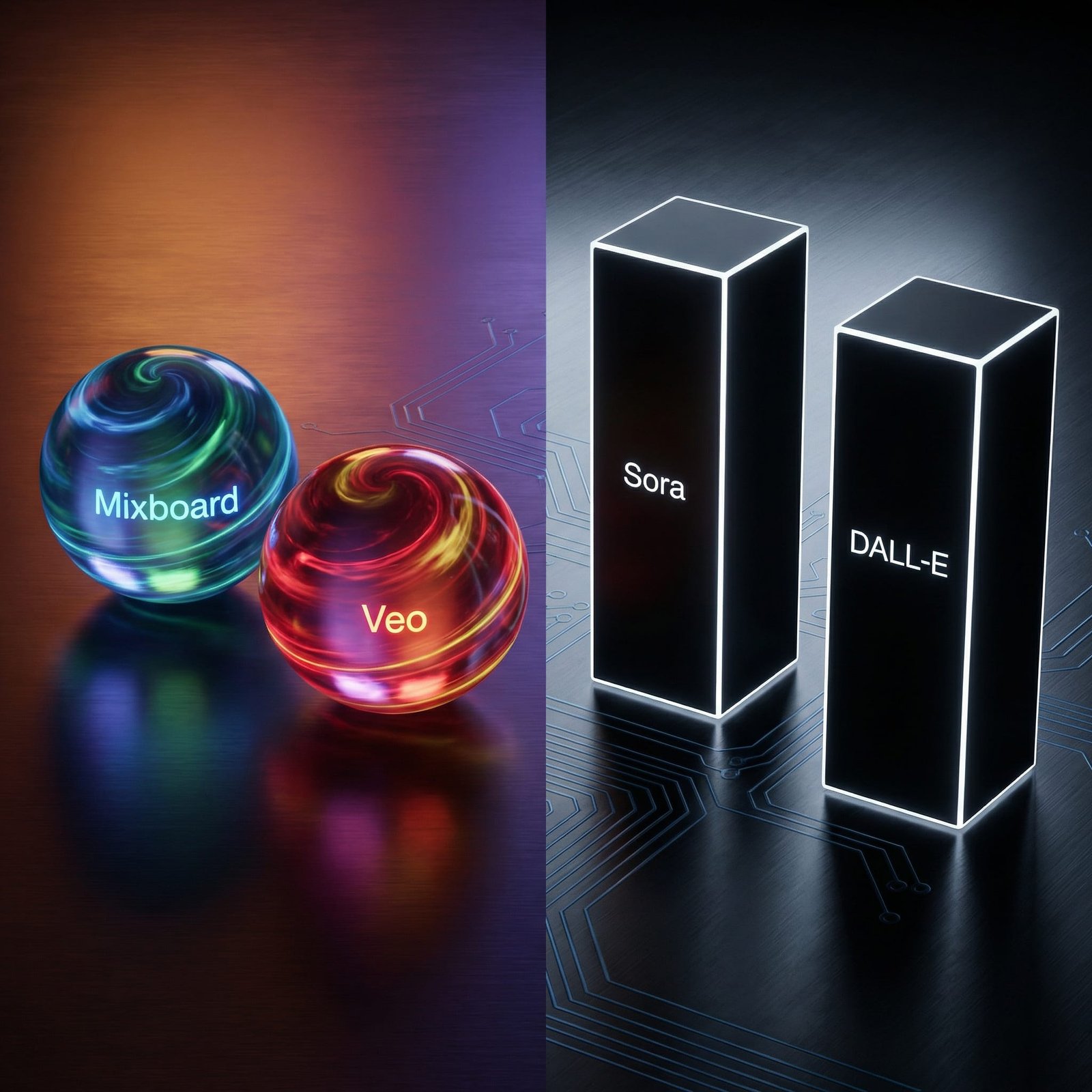
    Google Mixboard is an integration layer that glues various AI components like Veo and Nano Banana together for a seamless creative workflow.

    How does Sora 2 compare to Google Veo?

    While OpenAI’s Sora 2 focuses on high-quality specialized video generation, Google Veo emphasizes integration and consistency within the Google ecosystem.

  • Must-Try AI Prompts for Business Success in 2026

    Must-Try AI Prompts for Business Success in 2026

    Must-Try AI Productivity Prompts for Business Success (2026)

    In 2026, the biggest productivity boost often comes from how you talk to an LLM, not which app you buy. The difference is simple: vague inputs create vague outputs, then you spend your day correcting, re-prompting, and pasting things together like a tired editor.

    The right AI productivity prompts cut the back-and-forth. They protect your calendar and give you outputs you can actually use: a plan you can present, a draft you can ship, a process you can assign.

    Below are ready-to-copy prompts for strategic planning, marketing, and operations. Customize the bracketed parts like [industry], [goal], [customer], and [constraints] so the model has something real to work with. I am including 15 additional Highly Optimized Business productivity prompts at the end of this article…enjoy!

    Strategic planning and market analysis prompts that save hours

    Most “business prompts” fail because they don’t ask for decisions. They ask for ideas. Leaders don’t need more ideas, they need a clear path, trade-offs, and what to do next Monday.

    A solid strategy prompt has three parts:

    • Context: where the business is right now (and what’s broken).
    • Constraints: budget, headcount, timeline, compliance, tools.
    • Output format: tables, bullets, KPIs, and explicit next actions.

    If your team is experimenting with AI agents and automation, bake that into the prompt. You want the model to assume a 2026 pace: faster testing cycles, more automation options, and competitors who can change direction quickly. If you want more examples of 2026-oriented business prompt sets, skim a 2026 business prompt collection and notice how the best ones force structured outputs.

    One prompt to build a 12-month strategy, goals, risks, and KPIs

    Use this when you’re planning a new year, a new quarter, or a reset after a messy period. It’s designed to produce a plan you can paste into a memo or a deck with minimal edits.

    Copy-ready master prompt (CEO advisor mode):

    Act as my CEO advisor and operator. Build a 12-month strategy for a business in [industry].

    Context: We sell [product/service] to [customer type]. Our team size is [team size]. Our budget for growth is [budget]. Our current bottleneck is [current bottleneck]. Our biggest constraint is [constraint: time, compliance, cash, hiring, etc.].

    Assumptions: If you must assume anything, label it clearly as an assumption.

    Output format (plain language, bullets):

    1. 3 to 5 strategic priorities for the next 12 months (each with a one-sentence “why now”).
    2. A roadmap by quarter (Q1 to Q4) with the main initiatives and dependencies.
    3. A KPI list with targets (include leading and lagging indicators).
    4. The top 8 risks (market, execution, legal, tech, brand) and mitigation steps.
    5. A next 7 days action plan with owners (use roles, not names), time estimates, and what “done” looks like.

    Keep it realistic for 2026. Include where AI automation or agents could reduce manual work, but don’t propose anything that requires a full rebuild.

    One-line tip: Use it after you’ve written a messy brainstorm, it’s great at turning chaos into a clean plan.

    Market and competitor intel prompts that turn research into decisions

    Research is expensive because it’s sticky. Notes end up scattered across tabs, and nobody turns them into a move. These prompts force the model to summarize, label uncertainty, and recommend action.

    If you want inspiration for marketing and sales prompt structures that include test plans, the 2026 sales and marketing prompt guide is a good reference point for how prompts can demand usable outputs, not fluff.

    Prompt 1: Competitor deep dive (top 5)

    You are my competitive analyst. For [market], analyze the top 5 competitors to [our company] (include direct and “good enough” substitutes).

    For each competitor, provide:

    • Positioning in one sentence
    • Core offers and pricing model (flag unknowns)
    • Strengths and weaknesses
    • Distribution channels (where they win attention)
    • Recent news and likely strategic direction (label assumptions)

    End with:

    • A “sources to verify” list (what I should check manually)
    • 3 recommended moves we can make in the next 30 days
    • A one-paragraph summary I can send to my exec team

    One-line tip: Use it before budgeting, it helps you spend where the market is actually pulling.

    Prompt 2: 2026 customer trends and buyer personas

    Act as a customer insights lead for [industry]. Based on 2026 buyer behavior, generate 3 buyer personas for [product/service].

    For each persona include: job-to-be-done, triggers, objections, success metrics, buying committee (if any), and what makes them trust a vendor.

    Label assumptions, list “unknowns,” and give 3 messaging angles we should test first.

    One-line tip: Use it when your content sounds generic, it forces real-world objections.

    Prompt 3 (optional): Market alert for policy changes or seasonal shifts

    Monitor [topic: regulation, platform policy, supply chain, seasonal demand] that could impact [industry] in the next 90 days.

    Provide:

    • What might change (and why it matters)
    • Which parts of our funnel or ops are exposed
    • A “prepare vs panic” recommendation

    Label assumptions and end with 3 actions we should take now.

    One-line tip: Use it at the start of each month, it keeps surprises smaller.

    High-impact content and marketing prompts you can use every week

    Most AI-written marketing fails for the same reason bad meetings fail: nobody sets an agenda. If you don’t define audience, proof points, and tone, the model fills the space with shiny words that don’t convert.

    The fix is simple. Make the prompt carry your brand’s spine:

    • Who it’s for (one segment, not “everyone”)
    • What you can prove (results, data, demos, reviews)
    • What you want them to do next (one clear step)

    If you want a quick view of how marketers are structuring prompt packs this year, see Knack’s 2026 marketing prompt guide for examples of prompts that ask for multiple variants and specific formats.

    Content generator prompts for blogs, LinkedIn posts, and case studies

    Prompt 1: Blog outline plus first draft (ready to edit)

    You are a senior content strategist and editor. Write a blog post for [audience] promoting [offer] without hype.

    Topic: [topic]
    Goal: [lead gen, demo requests, newsletter sign-ups, product adoption]
    Brand voice: [direct, helpful, a bit casual, no buzzwords]
    Proof points to include: [2 to 5 facts, outcomes, customer quotes, data points]
    Constraints: short paragraphs (1 to 3 sentences), no fluff, avoid clichés, avoid exaggerated claims.

    Deliverables:

    1. A tight outline with H2 and H3 headings
    2. A first draft with a strong hook in the first 3 lines
    3. A short checklist at the end (5 bullets max)
    4. A CTA that fits [offer] and feels natural

    Write in plain US English, keep sentences short, and keep the tone practical.

    One-line tip: Use it when you have a topic but no time, it gets you to “editable draft” fast.

    Prompt 2: LinkedIn post pack (angles that don’t sound the same)

    Create 8 LinkedIn posts for [audience] about [topic] connected to [offer].

    Requirements:

    • Each post uses a different angle: story, data, lesson, mistake, checklist, myth-bust, behind-the-scenes, simple how-to
    • 120 to 220 words each
    • Short sentences, no hype, no generic “AI will change everything” claims
    • Include a soft CTA at the end (comment, DM, or read)

    Provide 3 alternate opening lines for the best 2 posts.

    One-line tip: Use it weekly, then save the strongest openings as your personal swipe file.

    Sales and campaign prompts for emails, landing pages, and A/B tests

    If your sales emails feel “AI-ish,” it’s usually missing two things: real context and a real next step. Your prompt should include the ICP, the offer, the proof, and what to cut.

    Prompt 1: 5-email sequence with follow-ups

    You are my outbound copywriter for [audience/ICP]. Create a 5-email sequence to promote [offer].

    Inputs:

    • Persona: [job title, industry, company size]
    • Pain: [top pain]
    • Proof: [case study, metric, review, credential]
    • Personalization fields: [first_name], [company], [relevant_trigger]
    • CTA: [book a 15-min call, reply with yes/no, start trial]

    Deliverables: subject line options (3 each), email copy, and follow-up logic if they don’t reply. Keep it human, short, and direct. End each email with one clear next step.

    One-line tip: Use it after you’ve defined proof, otherwise it will sound like a brochure.

    Prompt 2: Landing page draft with objections and FAQ

    Draft a landing page for [offer] aimed at [audience].

    Include:

    • 5 headline options
    • A simple “who it’s for, who it’s not” section
    • Benefits tied to outcomes (not features)
    • 6 common objections with answers
    • FAQ (6 questions)
    • A short section called “What we removed” where you cut fluff and explain why

    Keep the copy grounded, avoid buzzwords, and make the CTA obvious.

    One-line tip: Use it when your current landing page is long but still unclear.

    Prompt 3: A/B testing plan that prioritizes what matters

    You are my growth analyst. For [page/email/ad], generate 10 A/B test variations.

    Provide: emphasizes, audience fit, risk level, and estimated effort. Then recommend what to test first based on impact and speed.

    End with a one-week testing plan and what success metrics to watch.

    One-line tip: Use it when you’re stuck debating wording, it forces prioritization.

    Operational efficiency and internal docs hacks with AI productivity prompts

    Ops work expands to fill the week. Emails multiply, meetings sprawl, and “quick questions” turn into slow leaks.

    The best ops prompts do three things: they name owners, they set deadlines, and they produce a format you can paste into tools like Notion or Google Docs. They also acknowledge a 2026 reality: you can automate a lot without writing code, as long as you map the process cleanly first.

    For examples of prompt starter packs built for regulated work, see Thomson Reuters’ AI prompt starter pack. The most useful part is the structure: clear scope, clear outputs, and a “client-ready” bar.

    Ops automation prompts that map tasks, tools, and time saved

    Use this when your team keeps saying “we should automate that” but nothing happens.

    Copy-ready prompt: Weekly process audit and automation plan

    Act as my operations analyst. Audit our weekly processes for [team/department].

    Inputs:

    • Tools we use: [Google Workspace, Notion, Slack, HubSpot, Airtable, Zapier, Motion, etc.]
    • Work types: [sales ops, support, onboarding, billing, reporting]
    • Constraints: [security/compliance rules, approvals, budget]

    Output:

    1. List the top 10 repeat tasks (with frequency and who does them)
    2. An impact vs effort table (impact, effort, risk, time saved per week)
    3. Recommend what to automate first (top 3) and explain why
    4. A simple build plan using our tools (step-by-step, no code)
    5. Risk checks: data access, permissions, audit trail, approvals
    6. A 2-week rollout plan with owners, deadlines, and a rollback plan if it breaks

    One-line tip: Use it after you’ve tracked work for a week, even messy notes help.

    Documentation prompts for meetings, SOPs, and a searchable knowledge base

    Docs are boring until you need them. Then they’re gold.

    Prompt 1: Meeting transcript summary that people will read

    Summarize this meeting transcript for a busy team.

    Output format:

    • Decisions made (bullets)
    • Action items (owner, deadline, next step)
    • Open questions (who will answer, by when)
    • Risks or dependencies

    Keep terms consistent, use short paragraphs, and end with a “new hire version” summary in 5 bullets.

    One-line tip: Use it right after meetings, speed beats perfection.

    Prompt 2: SOP creation from messy notes

    Turn these notes into a clear SOP for [process].

    Requirements:

    • Step-by-step instructions with numbered steps
    • Screenshot placeholders like [Screenshot: …]
    • Edge cases and what to do
    • QA checklist (what to verify before marking done)
    • Owner and review cycle (monthly/quarterly)

    Use simple words, no long paragraphs, consistent terms.

    One-line tip: Use it when only one person “knows how it works.”

    Prompt 3: Clean, tagged knowledge base page

    Convert these messy notes into a knowledge base page for [team].

    Include: title, summary, tags, related pages (placeholders), and a quick “if you only read one thing” section. Keep it scannable and consistent with our terms.

    One-line tip: Use it before onboarding a new hire, it reduces repeat questions.

    Here are your bonus productivity prompts to copy and paste as needed!

    Productivity Prompts:
    1. Draft a comprehensive daily agenda for a project manager, prioritizing tasks based on urgency and impact, and allocating time blocks for meetings, deep work, and team check-ins.

    2. Generate a detailed outline for a business proposal aimed at securing funding for a new software product, including sections for executive summary, market analysis, financial projections, and team structure.

    3. Analyze the key takeaways from the provided transcript of a 30-minute team meeting, identifying action items, responsible parties, and deadlines for each.

    4. Compose a professional email to a prospective client introducing our services, highlighting three key benefits relevant to their industry, and suggesting a follow-up call.

    5. Brainstorm five innovative strategies for improving customer retention in a SaaS business, detailing the implementation steps and expected outcomes for each.

    6. Summarize a lengthy industry report (provided separately) into a concise executive brief, focusing on emerging trends, competitive landscape, and strategic recommendations.

    7. Create a project plan timeline for launching a new marketing campaign, breaking down tasks into phases, assigning estimated durations, and identifying potential dependencies.

    8. Develop a script for a 5-minute internal presentation explaining the benefits of adopting a new CRM system, targeting employees with varying technical proficiencies.

    9. Refine the tone and clarity of the attached draft press release to ensure it is professional, engaging, and effectively conveys our company’s recent achievement to a broad audience.

    10. Generate a list of 10 potential interview questions for a Senior Software Engineer role, focusing on technical skills, problem-solving abilities, and team collaboration experience.

    11. Outline a learning path for an employee looking to master data analytics, suggesting online courses, practical projects, and relevant certifications.

    12. Identify and categorize the common objections a sales team might encounter when selling a premium subscription service, and suggest effective rebuttals for each.

    13. Craft a compelling social media post (LinkedIn format) announcing a new product feature, emphasizing its value proposition and including a clear call to action.

    14. Provide a structured framework for conducting a SWOT analysis for a small e-commerce business, including specific questions to consider for each category.

    15. Develop a set of standardized responses for frequently asked customer support questions regarding product setup and troubleshooting.

    16. Analyze the attached competitor analysis report and identify three distinct competitive advantages our company can leverage in its next marketing campaign.

    17. Generate a checklist for onboarding new remote employees, covering essential tasks from IT setup to team introductions and initial project assignments.

    18. Explain the core concepts of ‘Agile methodology’ in project management to someone with no prior knowledge, using simple language and relatable examples.

    19. Formulate three different subject line options for an email announcing a company-wide policy change, ensuring they are clear, professional, and encourage opening.

    20. Propose a structured approach for conducting a quarterly business review (QBR), outlining key metrics to discuss, stakeholders to involve, and agenda items.

    Conclusion: a prompt checklist you’ll reuse all year

    Good prompts feel like handing someone a clear brief, not tossing them a vague task. Before you hit enter, run this quick checklist: role, goal, context, constraints, format, examples, and a clear quality bar.

    Start with one prompt per category, then improve it after each use. Save your best versions as shared templates so the whole team writes, plans, and documents the same way.

    Pick one prompt today, paste it into your LLM, and customize the brackets. You’ll feel the time come back fast.

    FAQ:


    What is the difference between generic and expert-level AI prompts?

    Generic prompts offer broad, often unusable advice, while expert-level instruction sets provide specific context, roles, and constraints to generate actionable business assets.

    How do AI prompts improve business productivity in 2026?

    By acting as shortcuts to complex tasks like strategic planning and marketing analysis, precision prompts allow leaders to focus on high-level decision-making rather than manual execution.

  • Unlock AI Profit With Nano-Banana Pro Prompts (25 High-Yield Themes)

    Unlock AI Profit With Nano-Banana Pro Prompts (25 High-Yield Themes)

    Top Prompts for Creators…

    Most people don’t need “better AI.” They need outputs they can ship: a landing page that converts, an email sequence that sells, a product image set that looks consistent, a proposal that wins the deal.

    That’s what Nano-Banana Pro Prompts are for. “Nano” is the mindset of small, efficient prompting, fewer tokens, more signal. “Banana” is a creative persona mode that pushes specificity, style, and bold choices, without slipping into sloppy or risky claims. Put them together and you get fast, repeatable work you can sell.

    If you want AI profit, these AI prompt themes are built for conversion-focused assets, not random idea dumps. Pick a theme, produce one deliverable, package it, repeat.

    The Nano-Banana method: small prompts, big signal, less fluff

    Nano-Banana works because it forces clarity. Instead of asking for “copy for my offer,” you define role, constraints, and the exact deliverable. You also stop the model from filling space with vague advice.

    Here are the core rules that keep outputs sharp:

    • Define the role (copy chief, performance marketer, e-commerce merchandiser, creative director).
    • Set constraints (length, reading level, tone, banned claims, required sections).
    • Provide inputs (offer, audience, price, proof, objections, brand voice).
    • Specify the output format (a wireframe, an email series, a checklist, a table).
    • Add acceptance criteria (must include one primary CTA, must include FAQs, must include 3 objections plus rebuttals).

    This is the main idea: your prompt should read like a mini-brief, not a chat message.

    “Done” is not “good ideas.” Done is a deliverable you can sell or ship today, like a 7-email welcome series, a landing page draft with FAQ, or a set of 12 ad variants.

    If you’re using Nano-Banana for visuals, the same rules apply. Visual work sells when it’s consistent. That’s why features like reliable text rendering and character consistency matter for business assets. Tools and guides in the Nano Banana ecosystem have put a lot of focus on brand-ready outputs such as consistent characters and readable text inside images, which is a big reason creators are selling visual packs and product images faster (see examples in Nano Banana Pro marketing prompts).

    A simple structure that keeps results consistent

    You don’t need a long prompt. You need a repeatable shape. Use labeled sections so you can swap inputs without rewriting everything.

    A clean structure looks like this:

    FieldWhat to includeExample detail
    ContextWhat you’re selling and why now“New bundle, limited-time bonus”
    TaskThe deliverable“Write a landing page wireframe + copy”
    InputsAudience, offer, proof, price“Freelance designers, $49”
    RulesConstraints and must-haves“No made-up stats, 8th-grade reading level”
    Output formatHow to present it“Headlines, sections, FAQs, CTA button text”
    Quality checksAcceptance criteria“Include 3 objections with rebuttals”

    One small trick: write your acceptance criteria like a checklist. It keeps the model from wandering, and it makes it easier to review work quickly.

    Safety, brand, and client-ready rules that prevent mistakes

    If you want approvals fast (and fewer revisions), add guardrails that match real client expectations:

    No made-up facts: If you didn’t provide numbers, require “proof placeholders” instead of invented stats.
    Flag uncertainty: If something is unknown, the output should say “needs confirmation” and list what to verify.
    Avoid trademark misuse: Ask for “inspired-by” language when needed, and avoid logos unless you have rights.
    Add disclaimers for finance and health: Simple, clear disclaimers reduce risk and back-and-forth.
    Keep one voice: Define tone and banned phrases, then require consistency across every asset.

    This isn’t about being cautious for its own sake. It’s about protecting your time. Fewer fixes equals more deliverables per week, which is how AI profit becomes real.

    For more inspiration on prompt patterns people share and reuse, scan a practical breakdown like viral Nano Banana prompt structures, then adapt those ideas into client-safe workflows.

    25 Nano-Banana prompt themes you can monetize this week

    Below are 25 AI prompt themes grouped by intent. Each one includes what it produces, who buys it, and how to package it so it feels like a product, not a random file.

    Offer and funnel builders (themes 1 to 9)

    1. Irresistible offer generator: Produces offer stack, bonuses, guarantee, urgency. Buyers: coaches, course creators. Package: “10 offer angles” bundle.
    2. Landing page wireframe plus copy: Produces section order, headlines, body copy, FAQ, CTA. Buyers: founders, agencies. Package: funnel-in-a-box draft.
    3. Upsell and order bump mapper: Produces order bump ideas, upsell sequence, price ladder. Buyers: e-commerce, info products. Package: “cart value booster” kit.
    4. Webinar or VSL script builder: Produces hook, big promise, story, proof, CTA loops. Buyers: educators, high-ticket sellers. Package: 20-minute VSL script plus outline.
    5. Lead magnet outline creator: Produces checklist, mini-guide, or email course outline. Buyers: newsletter operators. Package: 3 lead magnets, pick one.
    6. Email welcome sequence (5 to 7 emails): Produces subject lines, CTAs, segmentation tags. Buyers: SaaS, creators. Package: “Welcome Series + 2 resend variants.”
    7. Abandoned cart recovery set: Produces 3 emails plus 2 SMS drafts. Buyers: Shopify brands. Package: plug-and-play flows for one product line.
    8. Objection crusher pack: Produces top objections, rebuttals, proof ideas, risk-reversal lines. Buyers: anyone selling. Package: “10 objections, 3 rebuttals each.”
    9. Conversion audit checklist: Produces prioritized fixes for a page, with impact and effort notes. Buyers: agencies, solopreneurs. Package: monthly retainer audit.

    A lot of creators monetize this by being the “implementation specialist,” not the idea person. Real buyers pay for finished assets. For examples of monetizable Nano Banana business paths, see AI business models built around Nano Banana.

    Content that sells (themes 10 to 17)

    1. Short-form video script factory: Produces 15 to 45-second scripts with 5 hooks. Buyers: creators, local businesses. Package: 30 scripts per month.
    2. Carousel and thread builder: Produces swipeable structure, punchy lines, CTA slide. Buyers: LinkedIn and X creators. Package: “12 carousels, 4 threads.”
    3. SEO blog brief plus outline: Produces search intent, headings, FAQs, internal link ideas. Buyers: SaaS and affiliates. Package: content calendar + 4 briefs.
    4. Product-led storytelling posts: Produces case-study style posts with before/after and proof placeholders. Buyers: apps, service providers. Package: weekly story series.
    5. Authority positioning kit: Produces bio, founder story, talking points, podcast pitch angles. Buyers: consultants. Package: one-page brand doc + 10 talking points.
    6. Swipe file remixer (ethical): Produces original angles based on patterns, not copying. Buyers: marketers. Package: “20 fresh hooks from 5 reference ads.”
    7. Comment-to-DM conversion scripts: Produces polite, non-spammy replies that move to DM with consent. Buyers: social sellers. Package: script library by scenario.
    8. Repurposing map: Produces a plan to turn one video into 10 assets across platforms. Buyers: busy founders. Package: Notion board plus weekly map.

    This category is where bursty output pays off. You can generate variety fast, but still keep one voice by locking rules and acceptance criteria.

    Products, creative assets, and visuals (themes 18 to 25)

    1. E-commerce product listing pack: Produces title, bullets, description, FAQ, review response templates. Buyers: Amazon and Shopify sellers. Package: 10 listings, one niche.
    2. Product photography prompt blueprint: Produces consistent lighting, angles, backgrounds, and “do-not-change” rules. Buyers: e-commerce brands. Package: 20-shot list per product.
    3. Mockup and prototype visual prompts: Produces prompt sets for device mockups, packaging mockups, logo placement rules. Buyers: designers, agencies. Package: brand-ready mockup bundle.
    4. Ad creative variants: Produces 5 angles, 5 headlines, 5 visual directions, plus CTAs. Buyers: performance teams. Package: monthly ad refresh pack.
    5. Course slide deck outline: Produces lesson flow, slide-by-slide outline, quiz questions, workbook prompts. Buyers: educators. Package: “Module 1 complete” deliverable.
    6. Brand voice and style guide generator: Produces do and don’t list, words to use, words to avoid, sample paragraphs. Buyers: small brands. Package: voice guide + 10 examples.
    7. Localization and cultural rewrite kit: Produces US-to-UK or US-to-AU versions, simpler reading level, local terms. Buyers: SaaS, e-commerce. Package: 5 key pages localized.
    8. Client proposal and scope builder: Produces scope, timeline, deliverables, revision limits, and assumptions. Buyers: freelancers. Package: proposal template plus 3 scope tiers.

    If you want a deeper library of visual styles you can adapt into client-safe prompt packs, browse a catalog like Nano Banana image prompt styles and translate style names into brand guidelines your clients can approve.

    Turn prompt themes into paid “prompt packs” and services

    The biggest shift is mental: stop selling prompts as “cool tricks.” Sell them as repeatable production systems. Your buyer doesn’t want a prompt, they want a result with less time and fewer edits.

    Practical monetization paths that work without hype:

    Freelancing (asset delivery): You deliver the landing page, emails, ad set, or product visuals. Prompting stays behind the scenes.
    Productized services (fixed scope): “7-email welcome sequence in 72 hours” or “20 product images in 48 hours.”
    Template packs (DIY): Sell Nano-Banana Pro Prompts as a kit with brief forms, examples, and usage notes.
    Retainers: Monthly content packs, ad variants, or conversion audits.
    Bundles: Combine themes, like “Offer + Landing Page + Welcome Emails,” so the value feels obvious.

    Pricing gets easier when you anchor it to outcomes and time saved. A $300 prompt pack feels expensive. A $300 “Funnel Copy Starter Kit” that replaces a week of work feels cheap.

    If you need prompt inspiration for visual and marketing use cases, a curated collection like Nano Banana Pro prompt examples can help you see how others package consistent outputs, then you can write your own prompts in your own voice.

    Three easy packaging plays: done-for-you, done-with-you, DIY

    Done-for-you: You deliver final assets. Include an intake form, one round of revisions, and “proof placeholders” the client can fill.
    Done-with-you: A live session plus templates. Include a workshop agenda, the prompt set, and a shared doc where you run prompts together.
    DIY: Sell prompt packs. Include brief prompts, main prompts, QA checks, and example outputs so buyers don’t get stuck.

    The best part: you can build one theme once, then sell it in three formats.

    Quality checks that protect results and your reputation

    A simple QA checklist catches most problems before a client sees them:

    • Clear goal and one target audience
    • One primary CTA (not five)
    • Consistent voice across every asset
    • No false claims, no invented numbers
    • Proof placeholders where evidence is needed
    • Compliance notes for sensitive topics
    • Final formatting exactly as requested (headings, bullets, length)

    Keep a reusable “client intake” prompt too. Better inputs mean fewer reruns, which is the quiet engine behind steady AI profit.

    Conclusion

    Pick one of the 25 AI prompt themes and create one deliverable in the next 60 minutes. Keep it small, keep it structured, and make “done” look like something a buyer can use today.

    That’s the point of Nano-Banana Pro Prompts: small prompts, strong constraints, client-ready outputs. Start with one theme, package it, sell it, then expand into a full prompt pack that fits your niche.

    FAQ:


    What are “Nano-Banana” pro prompts?

    Nano-Banana prompts refer to highly efficient, low-token prompt engineering techniques (‘Nano’) combined with methods to achieve creative, unrestricted, or distinct AI outputs (‘Banana’), often bypassing generic responses and limitations.

    How do these prompts help unlock AI profit?

    By generating highly specific, conversion-focused, and unique content, these prompts enable users to create valuable AI-powered assets for marketing, sales, content creation, and more, leading to tangible business outcomes and increased profit margins.

    Are these high-yield prompts suitable for beginners in AI?

    While the article focuses on advanced, high-yield themes, many concepts can be adapted for beginners. However, professionals with some foundational prompt engineering experience will likely gain the most immediate and profound benefits.

    Where can I apply these Nano-Banana prompt themes?

    These themes can be applied across various AI models and platforms for diverse tasks such as copywriting, social media content, product descriptions, market research analysis, content outlines, generating unique creative narratives, and developing distinct AI personas.

  • Why Did They Name It “Nano-Banana Pro”?

    Why Did They Name It “Nano-Banana Pro”?

    Most tech names sound like license plates. A few letters, a number, maybe “v2,” and everyone moves on. That’s why “Nano-Banana Pro” sticks out. It sounds like a snack, not software, and yet it became a real label people use when talking about a serious image model.

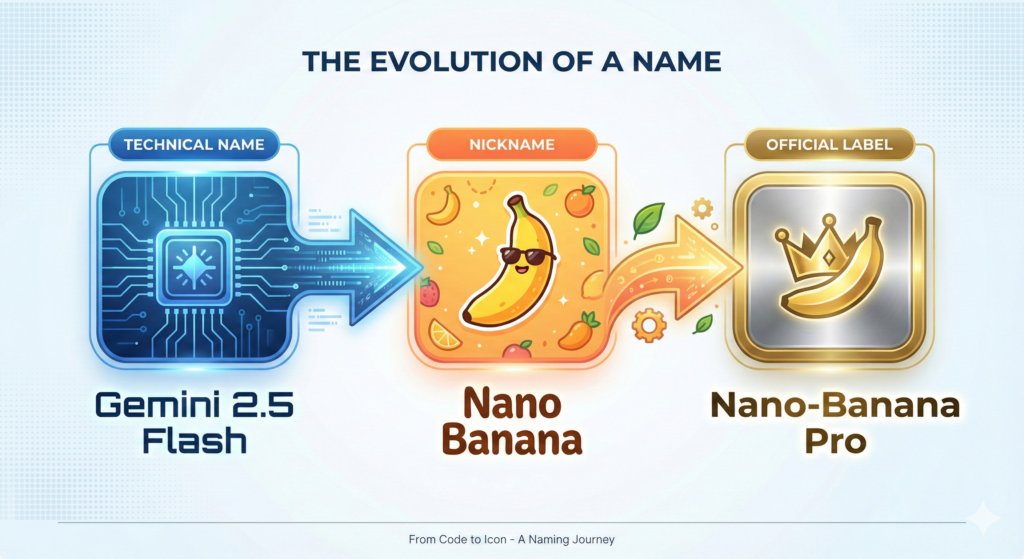
    In simple terms, Nano-Banana Pro is tied to the image model many people first met as “Nano Banana,” a nickname that circulated more widely than the technical name (often referenced as Gemini 2.5 Flash Image in developer conversations). This post explains the Nano Banana meaning, why is Nano Banana called that, and why the name later picked up a “Pro” tag.

    What “Nano-Banana Pro” refers to in plain English

    “Nano Banana” started as a human-friendly name for something that, on paper, reads like a spec sheet. In many technical references, the underlying model is associated with Gemini and its “Flash” family, which is meant to be quick and practical for day-to-day use. For background on the broader Gemini model family, see Gemini’s model overview [https://en.wikipedia.org/wiki/Gemini_(language_model)].

    So where does “Nano-Banana Pro” fit?

    • “Nano Banana” is the sticky nickname, the one people remember and repeat.
    • “Pro” usually signals a higher-tier option, like a more capable version, a premium mode inside an app, or a label that helps separate “the one everyone memes” from “the one teams build on.”

    The label also matches how people actually use these tools. The popular use cases are not abstract. They are practical, visual tasks that are easy to show in a screenshot:

    Image edits that don’t fall apart: Small changes like swapping a background, adjusting lighting, or changing an outfit without rewriting the whole scene.

    Consistent characters: Keeping the same person or mascot recognizable across multiple images, instead of getting a “new face” every time.

    Remixing photos: Turning a real photo into a poster, a comic style frame, or a cleaner restoration-like look.

    Readable text in images: Adding signs, labels, and short headlines that look intentional, not like scrambled letters.

    “Pro” fits because it signals expectation. People read it as “the version meant for heavier use,” even if the exact feature list depends on where it’s offered.

    Nano Banana meaning, “nano” plus “banana,” and why it sounds memorable

    At face value, the Nano Banana meaning is almost comically simple: nano suggests something tiny, lightweight, or fast, and banana is… a banana. It is silly on purpose.

    That silliness is the whole point. A name like “Gemini 2.5 Flash Image” is accurate, but it’s hard to repeat in a group chat. “Nano Banana” is short, rhythmic, and weird enough to stand out. It also avoids a common problem in AI naming: confusion. Many models sound the same, but nobody mixes up “Nano Banana” with anything else.

    It functions like a bright sticker on a plain box. The sticker does not explain everything inside, but people remember it.

    Why is Nano Banana called that, the short answer before the deeper story

    The short version is that “Nano Banana” began as a rushed codename used for blind testing, then it escaped into public talk because people liked both the results and the name. It wasn’t designed as a polished marketing brand first. The full story is more personal than most folks expect.

    The real origin story, a 2:30 a.m. codename made for LMArena

    The clearest explanation comes from Google itself. In Google’s account of the name’s origin, the codename was picked under pressure, late at night, because the team needed something to label a model for a public evaluation setting. That setting is often described as side-by-side testing, where models appear under hidden identities so users judge outputs without bias. In that kind of environment, a codename is a practical necessity, not a branding exercise.

    Google tells the story in How Nano Banana got its name [https://blog.google/products-and-platforms/products/gemini/how-nano-banana-got-its-name/]. The key point is simple: the name was born from the need to move fast, not from a long naming workshop.

    That timing mattered. The model’s performance started getting attention, and the name acted like a handle people could grab. When a model shows up in a testing arena and produces surprisingly good images, the community needs a quick label to compare notes. A catchy codename makes that easy.

    This is also where the “Pro” add-on makes sense later. Once a nickname becomes the common word people use, it’s hard to replace it with something bland. Over time, product naming tends to bend toward what users already say out loud.

    A mashup of personal nicknames, “Nano” plus “Naina Banana”

    The most human part of the story is that “Nano Banana” was not pulled from a random-word generator. It grew out of personal nicknames connected to Product Manager Naina Raisinghani, as Google describes in its write-up.

    Friends called her “Naina Banana,” and “Nano” was used as shorthand tied to her height and her love of computers. Put those together in a late-night sprint, and “Nano Banana” appears. It sounds like a joke because, in a way, it was. It just happened to be a joke that shipped.

    That’s also why the name feels oddly warm compared to standard AI labels. It has an inside-story vibe, like a scribble on a whiteboard that never got erased.

    Why “Nano” didn’t feel totally random for a “Flash” style model

    Even with the personal origin, “nano” also reads like it belongs in a technical family. “Nano” has long been used in tech to suggest smaller scale or lighter footprint, whether or not the model is literally tiny. For a “Flash” style model, which is framed around speed and practicality, “Nano” feels like a natural fit. It hints at quickness and efficiency, even if it started as a nickname first.

    So the name worked on two levels at once: personal and plausible. That combination is rare, and it helps explain why it stuck.

    How a placeholder name turned into the brand people actually use

    Viral names usually need two ingredients: something worth sharing, and a label that makes sharing effortless. “Nano Banana” had both.

    First, people were impressed by the outputs they could show immediately. Image models spread through examples, not through spec sheets. A single before-and-after edit or a consistent character across scenes tells the story faster than paragraphs ever could.

    Second, the name did the marketing work by itself. “Nano Banana” is easy to type, easy to remember, and funny without trying too hard. That makes it travel. A long technical name tends to get shortened anyway, and this one arrived pre-shortened.

    Coverage from January 2026 continued to amplify the story, including a recap of how the name was chosen and how widely it circulated after launch. PCMag’s reporting is one example, in here’s how the Nano Banana AI model got its name [https://au.pcmag.com/ai/115383/heres-how-googles-nano-banana-ai-model-got-its-name].

    Once a nickname becomes the default term, teams face a choice: fight it, or adopt it. Adoption often wins.

    The model’s edits got attention, the name made it easy to spread

    There is a simple pattern behind many tech nicknames. If the thing works, people talk about it. If the name is fun, more people join the conversation.

    In this case, users needed a quick label for comparisons, prompts, and shared results. “Nano Banana” became the shorthand for a specific “look” and behavior people recognized, even when the official references used more formal model names.

    That’s why the question “Why is Nano Banana called that” keeps coming up. The name sounds like a meme, but it points to a real tool people were actively using and discussing.

    “Pro” is the signal that it’s not just a meme anymore

    Adding “Pro” changes the tone. It tells users and buyers that this is meant to be taken seriously, even if the core name is playful.

    In product naming, “Pro” usually communicates one or more of these ideas:

    A higher tier: More capability, more control, or fewer limits than a base mode.

    A clearer lane: A way to separate casual use from creator or developer use.

    A stable label: Something that can become a line of products over time, not a one-off nickname.

    So “Nano-Banana Pro” reads like a bridge between two worlds: the internet’s favorite nickname, and a naming system that can live on pricing pages and in app menus.

    An infographic showing a clear flow from 'Technical Name (Gemini 2.5 Flash)' to 'Nano Banana (Nickname)' to 'Nano-Banana Pro (Official Label)', using playful yet professional graphics.

    Conclusion

    Nano-Banana Pro has a strange name for a straightforward reason. It started as a rushed codename for public testing, it came from personal nicknames, and it also happened to match the “fast and practical” feel people associate with Flash-style models. Once the model impressed users, the name spread because it was easy to repeat.

    The Nano Banana meaning is simple: small, fast energy plus a silly banana hook. And that answers the main question of why it’s called that. In AI, a name people remember can matter almost as much as the benchmarks, because memory is what turns a tool into a habit.

    FAQ:


    What exactly does “Nano-Banana Pro” refer to?

    Nano-Banana Pro is the human-friendly and widely recognized nickname for a specific, serious image model, technically associated with the Gemini 2.5 Flash family. It’s designed for quick and practical day-to-day use in image generation.

    Why was the name “Nano Banana” chosen initially?

    The name ‘Nano Banana’ emerged as a more accessible and memorable alternative to the complex technical specifications of the underlying AI model. It helped make the model relatable and easier to discuss among a broader audience.

    What does the ‘Pro’ addition signify in ‘Nano-Banana Pro’?

    The ‘Pro’ tag typically indicates an enhanced, professional, or more advanced version of the original ‘Nano Banana’ concept. It denotes improvements, specific features, or a refined iteration within the model’s development.

    Is Nano-Banana Pro related to Google’s Gemini AI?

    Yes, Nano-Banana Pro is directly tied to the Gemini model family, specifically within its ‘Flash’ series. This series is characterized by its efficiency and practicality for various image-related tasks.

  • Stop Prompting, Start Architecting: The 2026 Blueprint for AI Mastery

    Stop Prompting, Start Architecting: The 2026 Blueprint for AI Mastery

    If you are still trying to find the “perfect magic words” to make ChatGPT or Claude behave, you are living in 2024. Welcome to January 2026, where the game has fundamentally changed. We aren’t just “prompting” anymore; we are orchestrating intelligence.
    The “Prompt Engineer” job title that everyone obsessed over two years ago? It’s evolving into something much more powerful: the AI Behavior Architect. We’ve moved past the era of “acting as a professional copywriter” and entered the era of agentic workflows, perceptual anchoring, and self-healing systems.
    This week, the AI world was rocked by three massive shifts that redefine how you interact with silicon. If you want to stay ahead of the curve, you need to understand why your old “hacks” are failing and what the new 2026 standard looks like.

    1. The “Say What You See” Revolution: Google’s SWYS Breakthrough
      Just days ago, a technique dubbed SWYS (Say What You See) went viral across the developer community, promising—and delivering—a staggering 76% gain in LLM accuracy for complex reasoning tasks.
      For years, we thought the key to better output was more complex instructions. We wrote paragraphs of “Chain-of-Thought” logic, hoping the model wouldn’t hallucinate. But Google’s latest research suggests we were looking at the problem backward. Instead of telling the AI how to think, SWYS forces the AI to verbally anchor its perception before it attempts a task.
      The technique is deceptively simple: You ask the AI to describe every component of the input data in excruciating detail before asking for a solution. It’s the digital equivalent of a detective narrating everything they see at a crime scene before making a deduction.

    The SWYS Framework in Action


    Instead of: “Analyze this financial spreadsheet and find the three biggest risks.”
    The 2026 SWYS Prompt looks like:
    “First, identify every column header and row category in the provided data. Describe the data types and any visual outliers you notice. Once you have mapped the ‘landscape’ of the data, then—and only then—analyze the top three risks.”

    Why This Matters:
    It’s about latent signal activation. By forcing the model to “Say What It Sees,” you are activating multimodal training signals that stay dormant during standard text processing. This reduces “glance-over” errors—those annoying moments where the AI misses a line of text or a specific number right in front of its face. In the high-stakes world of 2026, where AI manages our medical records and legal contracts, a 76% accuracy jump isn’t just a “nice to have”—it’s the difference between a successful automation and a catastrophic failure.

    1. From “Prompting” to “Agentic Scaffolding”: The Claude Code Shift
      We’ve seen a massive shift in how Anthropic’s Claude handles complex tasks this month. The data from the latest Anthropic Economic Index shows that we have officially crossed the “Human-in-the-Loop” Rubicon.
      Six months ago, a tool like Claude Code could handle maybe 10 autonomous actions before it needed a human to nudge it. As of January 2026, that number has doubled to 21+ consecutive tool calls. What does that mean for you? It means “Prompt Engineering” is being replaced by Agentic Scaffolding.
      You are no longer writing a prompt for a chatbot; you are writing a Mission Briefing for an agent that can browse your files, run terminal commands, call APIs, and self-correct its own errors.
    human hand orchestrating multiple AI agents on a holographic interface

    The Shift in Strategy


    In 2026, the best “prompts” aren’t prose; they are environment definitions. You aren’t telling the AI what to write; you are telling the AI what tools it has access to and what the success criteria (Evals) look like.
    Key Term: Evals (Evaluations). In 2026, if you aren’t providing the AI with a way to “grade itself,” your prompt is incomplete. Modern architects use “Self-Correction Loops” where the prompt includes a step: “Run a validation check on your output against [Standard X] and if it fails, iterate until it passes.”

    Why This Matters:
    Efficiency is the new currency. Anthropic’s data shows that while we are delegating less of our total work, the complexity of what we delegate has skyrocketed. We are moving from “Help me write this email” to “Build and deploy this microservice.” If you don’t master Agentic Scaffolding, you will be stuck doing the “papercut” tasks while the AI-literate workforce is building entire ecosystems with a single command.

    1. The Rise of “Tree of Thoughts” (ToT) at Scale
      If you’ve been following the latest benchmarks, you know that Standard Prompting is currently sitting at a measly 7.3% success rate for highly complex, multi-variable problems. Meanwhile, Tree of Thoughts (ToT) is hitting 74%.
      ToT is the 2026 evolution of Chain-of-Thought. Instead of a single linear path of reasoning, the AI explores multiple “branches” of thought simultaneously, evaluates them, and “prunes” the ones that don’t lead to a solution.

    The “Expert Panel” Prompt Template
    To leverage this, viral strategists are using the Multi-Expert Persona approach.
    Instead of: “Give me a marketing strategy for my new app.”
    The ToT Prompt looks like:
    “Act as a panel of three experts: a Growth Hacker, a Brand Strategist, and a Financial Analyst.

    • Each expert proposes one distinct strategy.
    • The experts then critique each other’s strategies for flaws.
    • Based on the critique, synthesize the most robust, risk-mitigated plan.”
      Why This Matters
      We are seeing the end of “Single-Model Bias.” By forcing the AI to simulate internal conflict and debate, we bypass the “path of least resistance” that models often take. This is how you get System 2 thinking (slow, deliberate, logical) out of a system that defaults to System 1 (fast, intuitive, sometimes wrong).
    1. The 2026 Viral Prompting Cheat Sheet (The “Architect” Method)
      To help you dominate this new landscape, I’ve distilled the “hottest” 2026 techniques into a quick-reference guide. Stop using “Please” and “Thank you”—start using
    A vast digital landscape stretches toward a dark horizon, filled with thousands of floating blue geometric prisms representing data points. In the center of the frame, a pair of ethereal, translucent hands made of shimmering white light reach out to grasp a single, intensely glowing golden cube. The golden cube is labeled with the text 'GROUND TRUTH' in a clean, sans-serif font. The light from the cube casts a warm radiance across the translucent fingers of the AI hands, highlighting their intricate, circuit-like internal structures. The background features a faint, receding grid of cyan lines on a deep black floor. The scene is rendered in a sharp, cinematic 3D style with a shallow depth of field that keeps the focus on the moment of contact.

    Structural Constraints.


    Technique
    How to Use It 2026 Viral Power Level Verbal Anchoring

    • “List all facts in the source text before summarizing.”
      Negative Constraints
    • “Do NOT use corporate buzzwords, passive voice, or introductions.
    • “Dynamic JSON Output” Output the response strictly in a JSON schema for [App Name].
    • “Recursive Refinement”Rewrite your previous answer three times, making it 10% more concise each time.”Contextual Grounding”Access the [Project Archive] and use only verified data from the 2025 Q4 report.”
    1. The “Invisible” Prompt: AI Embedded in Everything
      Finally, we have to talk about the “Death of the Chat Window.” In 2026, the most successful prompt engineering is the kind the user never sees.
      With Google Workspace Studio and OpenAI’s ChatGPT Atlas, prompts are being baked into the UI. You aren’t typing into a box; you are clicking a “Refactor” button that triggers a 500-word meta-prompt in the background.
      The takeaway for you? If you are building tools or content, focus on Context Engineering. The real “moat” in 2026 isn’t the model you use; it’s the proprietary context you feed it. Whoever has the best-organized data wins, because the AI is finally smart enough to use it.

    Conclusion:
    The era of “guessing” what the AI wants is over. We have the frameworks, we have the agentic tools, and we have the benchmarks. The transition from Prompt Engineer to AI Behavior Architect is the most significant career pivot of the decade.
    Don’t just talk to the machine. Design its reality. Define its tools. Scaffold its thoughts. In 2026, the power belongs not to the one who speaks the loudest, but to the one who structures the most effectively.
    Are you ready to stop prompting and start architecting?

    FAQ:
    What is AI Behavior Architecture and how does it differ from traditional prompt engineering?

    AI Behavior Architecture is the evolved approach beyond simple prompting, focusing on designing and orchestrating complex agentic workflows, perceptual anchoring, and self-healing systems for AIs. Unlike traditional prompt engineering that seeks ‘magic words,’ behavior architecture aims to define how an AI thinks, perceives, and acts over time.

    What is Google’s ‘Say What You See’ (SWYS) technique and why is it a game-changer?

    SWYS (Say What You See) is a Google breakthrough that forces an AI to verbally describe every component of its input data in excruciating detail before attempting a task. This perceptual anchoring leads to a staggering 76% gain in LLM accuracy for complex reasoning by ensuring the AI fully ‘sees’ and processes all information before generating a solution.

    Why are my old AI ‘hacks’ and prompting strategies failing in 2026?

    Old prompting ‘hacks’ are failing because the AI landscape has fundamentally shifted by 2026. We’ve moved past single-turn interactions to agentic workflows, and AIs require more sophisticated methods like perceptual anchoring (e.g., SWYS) to ground their understanding and prevent hallucinations, making simplistic prompting obsolete.

    How can I start implementing AI Behavior Architecture and SWYS in my projects?

    To implement AI Behavior Architecture, begin by understanding agentic design patterns and breaking down complex tasks into manageable AI sub-tasks. For SWYS, integrate an initial step where the AI meticulously describes its input. Experiment with feedback loops to create self-healing systems and continuously refine your AI’s behavioral design.

    References

    • Google Research (Jan 13, 2026): “Say What You See: Unlocking 76% Accuracy in LLM Perception.”
    • Anthropic Economic Index (Jan 2026): “The Shift from Automation to Augmentation in the Global Workforce.”
    • OpenAI Developer Community: “Tree of Thoughts vs. Chain of Thought: The 2026 Performance Gap.”
    • VentureBeat: “The Rise of the AI Behavior Architect.”
  • What Makes a Great AI Prompt for New Coders (With Tips)

    What Makes a Great AI Prompt for New Coders (With Tips)

    AI can speed up your learning and cut stress when you code. ChatGPT explains concepts in plain terms, and GitHub Copilot suggests code as you type. Both help you try ideas faster, fix errors sooner, and keep moving. The catch is simple. Good prompts lead to good help.

    A great prompt tells the AI what you want, why you want it, and how you want it shown. It sets a role, gives context, and defines the output. It also breaks the task into steps. With that, you get code that fits your goal and explanations you can trust.

    This post shows what to include in a strong prompt, how to avoid common mistakes, and how to adapt your ask. You will see short examples you can use today. We will keep it practical and focused on your next line of code.

    You do not need to be an expert to write better prompts. Start clear and specific. Add the language, the goal, and the format. Say whether you want comments, tests, or plain text.

    Expect to iterate. Try a first prompt, then refine the parts that missed. Ask for smaller steps, a teacher’s voice, or a code sample with notes. Small edits can change the whole result.

    By the end, you will know how to guide the AI, not chase it. You will write prompts that deliver useful code and clear reasoning. Anyone can learn this with a bit of practice, and you will too.

    Key Components of a Strong AI Prompt

    A person uses ChatGPT on a smartphone outdoors, showcasing technology in daily life. Photo by Sanket Mishra

    Strong prompts set clear goals, reduce guesswork, and produce code you can trust. They include the task, context, and expected format. Think of them as a brief to a tutor. For more structure, see MIT’s overview of effective prompts. Always test outputs, then refine the prompt with small edits.

    Clarity and Specificity in Your Requests

    Vague prompts invite wrong answers. Specific prompts constrain the output and match your goal. Bad: “Write code.” Good: “Write Python code to check if a number is prime, include comments.” That single sentence sets the language, the task, and the style. New coders learn core patterns faster because the AI mirrors good habits. Tip: name the language, the function goal, inputs, outputs, and any style notes, such as comments or print statements.

    Adding Context to Guide the AI

    Context removes guesswork about tools, versions, and goals. Example: “In JavaScript, create a function to sort numbers ascending.” This phrase prevents language or library mix-ups and yields targeted examples. New coders benefit because each response fits the concepts they are learning that week. For a helpful frame, consider persona, task, context, and format from Atlassian’s guide on writing AI prompts.

    Keeping Prompts Concise Yet Complete

    Extra words blur the request and waste time. Aim for short, complete directions. Example: “Explain recursion with a Python factorial example. Show base case and one recursive step. Use comments.” This keeps scope tight while covering key parts. You get fewer tangents and clearer code. Tip: remove filler, keep one task per prompt, and state the required elements in one or two sentences.

    Using Structure for Complex Tasks

    For multi-step work, add structure with bullets or numbered steps. Example prompt for quicksort: “1) Write a Python function. 2) Choose a pivot. 3) Partition list. 4) Recur on sublists. 5) Add docstring and tests.” This breakdown guides the model through the algorithm and artifacts. New coders see how to plan before coding. Tip: structure first, then iterate after testing the first output.

    Common Pitfalls and How to Avoid Them

    New coders often write prompts that miss key details or include too much noise. The result is code that compiles but does not help you learn or ship. Avoid these frequent errors to get targeted code and clearer explanations.

    The Trap of Vague Instructions

    “Write a program” fails because it invites guesswork. The model cannot infer your language, inputs, outputs, or constraints. You may get JavaScript when you want Python, or a script with no comments when you need a walk-through. That wastes time and builds confusion for beginners.

    Fix it with concrete cues. Name the language, set the goal, and define the format. Example: “In Python, write a function that returns true if a number is prime. Use clear comments, a docstring, and two test cases.” This instructs the model to teach while coding, which helps you learn core patterns.

    Overlooking Necessary Background

    Missing context leads to wrong choices, such as the wrong language, framework, or version. You might get Node.js when your class uses browser JavaScript, or Python 3.12 features when your environment locks to 3.9. This gap slows progress and adds setup issues.

    State your background and goals. Mention your environment, constraints, and outcome. Example: “For a CS101 assignment in Python 3.9, write a CLI script to parse a CSV of students and print top 3 by GPA. Use only the standard library, include argument parsing, and add a short explanation.” For more practical guidance on common mistakes, see Great Learning’s overview of prompt engineering mistakes beginners make.

    Including Too Much Unneeded Info

    Long backstories bury the core ask. Extra details cause the model to chase side topics and produce bloated code. You get fewer tests, more fluff, and weaker explanations.

    Strip text that does not guide the output. Focus on the task, inputs, outputs, and constraints. Example, weak: “I am building an app for my cousin’s store and feel stuck…” Better: “In JavaScript for the browser, write a function to sort a list of product objects by price and name. Include comments and one usage example.” For more pitfalls and fixes, review this concise list of beginner prompt mistakes.

    Practical Examples and Advanced Tips for Beginners

    Smartphone showing OpenAI ChatGPT in focus, on top of an open book, highlighting technology and learning. Photo by Shantanu Kumar

    Use these prompt patterns to practice, compare results, and build reliable coding habits. Each example shows structure, clarity, and small iterations for better outcomes.

    Simple Prompts for ChatGPT

    Before: Explain recursion.
    After: Explain recursion in Python with a factorial example. Show base case, one recursive step, and a commented function.

    Prompt 1, prime check: In Python 3.10, write is_prime(n) that returns True for primes. Add a docstring and two tests.
    Benefits: You get a small, testable function and comments that guide review.

    Prompt 2, recursion: Act as a CS tutor. Explain recursion using factorial(n). Provide a clear base case, the recursive step, and a trace for n=4.
    Benefits: Structured steps improve mental models. For more context, see this walkthrough on learning recursion with ChatGPT.

    Using GitHub Copilot in Your Editor

    Comment-based prompts work well. In a Python file, type:

    Write a function sort_products(items) that sorts by price asc, then name asc. Include type hints and a docstring.

    Start the function signature and let Copilot suggest the body. Accept with Tab, then add one example call to steer later suggestions.

    Tips for VS Code:

    • Enable inline suggestions and the chat view.
    • Use small comments that state inputs and outputs.
    • Refine by editing your comment, then trigger a new suggestion.
      Review official Copilot tips and tricks for VS Code to improve suggestions and shortcuts.

    Trying Advanced Methods Like Step-by-Step Thinking

    Chain-of-thought style prompts help you debug. Avoid asking for full internal reasoning, and instead request visible steps.
    Before: Fix this bug.
    After: Diagnose this Python function. List likely faults, propose one hypothesis, test it with a small example, then show a minimal fix.

    Example prompt: You are a strict tutor. I will paste code with a failing test. First list three suspects, then show a one-line patch and a passing example. Keep steps numbered.

    Few-shot tip: Provide a tiny “good fix” example first, then your real bug. This helps new coders learn systematic debugging. Iterate until the steps feel routine.

    Conclusion

    Great prompts help new coders write better code with less guesswork. The core pieces are clear goals, the right context, and a concise format. Add small structure for complex tasks, such as numbered steps or a short checklist. Avoid vague asks, missing background, and long backstories that hide the real task. The examples in this post, from prime checks to step-by-step debugging, show how small edits produce stronger results.

    Start now. Pick a tiny task in your language, write a one or two sentence prompt, test the output, then iterate. Keep what works, trim what does not, and ask for one improvement per round. For guided practice, try Codecademy’s prompt engineering resources or browse PromptingGuide.AI for up-to-date patterns and exercises.

    If this helped, share one prompt you tried and the result you got. Your notes will help other beginners avoid dead ends. Thanks for reading, and keep refining your prompts until the AI feels like a reliable tutor. Good prompts make learning to code easier, faster, and far less stressful.

    FAQ Section

    What are the most common mistakes new coders make when using AI for coding?

    New coders often write prompts that are too vague, lack crucial context, or don’t specify the desired output format. Another common error is failing to iterate and refine their prompts after the initial AI response.

    How can I make my AI prompts more specific and effective for coding tasks?

    To enhance specificity, define the AI’s role (e.g., ‘expert Python developer’), provide clear context (what the code should achieve and why), specify the programming language, and detail the desired output format (e.g., ‘Python code with comments and a test case’).

    Can AI help me debug my code, and what’s the best way to prompt it for debugging?

    Yes, AI is excellent for debugging. Provide your problematic code, clearly explain what you expect it to do versus what it’s actually doing, and ask the AI to identify the error, explain its cause, and suggest a fix. You can also request alternative solutions.

    What’s the best strategy for iterating and refining an AI prompt to get better results?

    Start with a clear, concise prompt. If the output isn’t satisfactory, identify precisely what was missing or incorrect. Then, add more detail, refine constraints, change the AI’s persona, or break down the task into smaller, manageable steps in your subsequent prompts.

    Should I include code examples in my AI prompts, and when is it most beneficial?

    Including small, relevant code examples (known as few-shot prompting) can significantly improve AI output quality. This is especially beneficial when you want the AI to adhere to a specific coding style, formatting, or implement a particular pattern.

  • Boost AI Results with Easy Prompt Tricks

    Boost AI Results with Easy Prompt Tricks

    Maya stared at another bland AI reply, the kind that says a lot yet helps little. She had a deadline, a draft, and a prompt that sounded fine. The output missed context, tone, and depth. It felt like shouting into a fog.

    Here is the fix. Small tweaks to your prompt can flip vague answers into clear, useful results. In 2025, tools like GPT-4.1 and Claude 4 make this even easier. You do not need tech skills, just a smarter way to ask.

    This post shows simple prompt tricks that work right away. You will learn how to set a role, add a goal, and give one key constraint. You will see how to ask for a format, set a tone, and name your audience. You will also learn to include one example so the model copies the style, not just the idea.

    Expect quick wins. Think one-line upgrades, short templates, and repeatable patterns. You will go from “write about marketing” to “write a 120-word email for busy founders, friendly tone, short subject, two bullet points.” Better prompts, better AI results, less guesswork.

    If you have ten minutes, you can get sharper answers today. Ready to turn short prompts into strong output, with zero stress?

    Start Strong with Clear and Specific Prompts

    Small details change everything. Tell the AI the task, the format, the length, the tone, and the style, and you cut out guesswork. That means fewer rewrites and faster wins. For a deeper dive into why clarity matters, see this practical guide on prompt structure in How to Write Effective Prompts for ChatGPT.

    Close-up of a hand holding a smartphone displaying ChatGPT outdoors. Photo by Sanket Mishra

    • Task: what you want, in one line.
    • Format: bullets, table, outline, email, or steps.
    • Length: word count or range.
    • Tone: friendly, formal, upbeat, or neutral.
    • Style: simple, academic, persuasive, or playful.

    Short, clear prompts also work well in quick zero-shot asks, like, “List three dinner ideas, 15 minutes each.”

    Why Clarity Beats Vague Questions Every Time

    Vague prompts force the AI to guess. Guessing leads to fluff, tangents, and edits. Clarity gives the AI rails. You get focused answers that fit your goal.

    Job hunt example:

    • Vague prompt: “Help with my resume.”
    • Typical output: Long, generic tips with no structure.
    • Specific prompt: “Rewrite my resume summary for a marketing analyst role, 60 words, confident tone, highlight Excel, SQL, and A/B testing.”
    • Typical output: A tight, role-ready summary with the right keywords.

    Another quick win for students:

    • Vague prompt: “Summarize photosynthesis.”
    • Specific prompt: “Summarize photosynthesis for 9th graders in 5 bullet points, plain language, include the role of sunlight and chlorophyll.”
    • Result: Clear bullets you can study right away.

    This saves time, reduces back-and-forth, and delivers useful info fast. For more structure ideas, see this breakdown of prompt best practices in How to Write AI Prompts For ChatGPT and Gemini in 2025.

    Role-Play Your Way to Expert-Level Answers

    Assign a role to shape voice and depth without extra effort. It sets context, tone, and the level of detail.

    Try these:

    1. “Act as a career coach. Draft a 120-word cover letter for a junior data analyst, friendly tone, 3 short paragraphs, mention SQL and dashboards.” Output lands with hiring managers and fits the word count.
    2. “Act as a tutor. Explain the French Revolution to a 10th grader in 6 bullets, neutral tone, include causes and outcomes.” Output is clear, balanced, and age-appropriate.
    3. “Act as a chef. Plan a 3-night dinner plan for two people, 20 minutes per meal, include a single grocery list.” Output is practical and ready to use.

    Everyday use:

    • Email: “Act as a polite assistant. Write a 90-word follow-up email, warm tone, ask for a meeting, include two time options.”
    • Meal plan: “Act as a nutrition coach. Create a high-protein, vegetarian lunch plan for 5 days, under 500 calories, bullet points.”

    Level Up with Examples and Step-by-Step Thinking

    Small prompts win quick tasks. Tougher jobs need structure. Give the model a pattern to mimic, then ask it to think in steps. New models like GPT-4.1, Claude 4, and Gemini 2.5 Pro pick up patterns fast and reason more clearly when you guide them. You get fewer bland answers and more work you can ship.

    Close-up of hands using smartphone with ChatGPT app open on screen. Photo by Sanket Mishra

    Few-Shot Magic: Show, Don’t Just Tell

    Examples teach style, tone, and structure without long rules. You show the model what “good” looks like, then it mirrors the pattern. In 2025, in-context learning is stronger, so a few solid examples go a long way. For a quick refresher, see this short guide on Few-Shot Prompting.

    How to use it:

    • Use 2 to 4 examples that match your goal.
    • Keep each example short, clear, and labeled.
    • Stick to one pattern, like bullet length or sentence cadence.

    Product description prompt you can paste:

    • Role: You are a product copywriter for an online store.
    • Task: Write a 70–90 word description with 3 scan-friendly bullets.
    • Style: Friendly, crisp, benefits first.
    • Examples:
      1. “Travel Mug, 12 oz: Locks heat for 6 hours, fits cup holders, leak-resistant lid.”
      2. “Yoga Mat, 5 mm: No-slip grip, quick clean, rolls tight for small spaces.”
      3. “LED Desk Lamp: Soft light presets, tap dimmer, neck bends for focus work.”
    • Now write for: “Wireless Earbuds, 32-hour case, sweat-resistant, quick-charge 10 minutes for 3 hours.”

    Why it works:

    • The model matches phrasing, length, and rhythm.
    • It reduces guesswork on format and tone.
    • Too many examples create noise, so cap at four.

    For more context, this 2025 overview lists top prompt techniques, including few-shot patterns, in Prompt engineering techniques: Top 5 for 2025.

    Chain Your Thoughts for Smarter Solutions

    Step-by-step prompts invite the model to reason, not just answer. Ask it to show the steps, then give the final result. This feels more human and improves accuracy on planning, puzzles, and math. A deeper explainer is here: Chain-of-Thought (CoT) Prompting.

    Try these quick formats:

    • Puzzle: “Think step by step to find the missing number in this sequence. Show each check, then give the final number.”
    • Trip plan: “Plan a 3-day Tokyo visit. Outline goals, time blocks, travel time, then propose a schedule with reasons.”
    • Recipe tweak: “I have almond flour and no eggs. List constraints, test swaps, choose the best, then output the final recipe.”

    Why it works in 2025:

    • New models keep longer context, so they can walk through options.
    • They correct themselves mid-thought when you ask for steps first, answer second.

    Tip: Ask for steps, but request a short final answer. You get clarity without a wall of text.

    Polish and Perfect Your AI Outputs

    Great prompts start the work, polished outputs finish it. Shape the format, test a few runs, then pick and refine the best. Think like an editor with a clear brief and a sharp red pen.

    Demand Structure for Outputs That Wow

    Structure turns chaos into clarity. Ask for bullets, a table, or even short code when it fits. Scannable formats help you spot gaps fast and ship with confidence. For extra control, many tools also support structured outputs, as discussed in this practical thread on prompts for structured output.

    Try these copy-ready prompts:

    • Report: “Create a 1-page monthly SEO report. Use 5 bullets, each starts with a metric, include trend and action in 12 words or less.”
    • Comparison: “Compare three email tools in a table with headers: Feature, Cost, Templates, Ease. End with a 1-sentence pick and why.”
    • Code-style checklist: “Return a JSON-like checklist with keys task, owner, due, status. Include five items.”

    Quick example table for a feature choice:

    CriteriaOption AOption B
    Cost$$$
    Setup time1 hour1 day
    Best forSolo usersSmall teams

    Finish with a brief summary line, “Pick A if speed, B if depth.”

    Refine Through Trial and Smart Checks

    Iteration makes results reliable. Start simple, review the output, then tweak one element at a time, such as audience, length, or format.

    Self-consistency boosts trust. Run 3 to 5 versions, compare, and blend the strongest lines.

    • Story ideas, Version A: “A chef who loses taste, learns flavor by memory.”
    • Version B: “A courier who reads futures in street maps.”
    • Version C: “A gardener who grows plants that keep secrets.”

    Pick the best, then prompt, “Combine B’s hook with C’s stakes, 120 words, present tense.”

    Try a light Tree of Thoughts pass for complex tasks. Prompt, “List three paths, outline pros and cons, choose the winner.” A helpful primer on this approach is here: Beginner’s guide to Tree of Thoughts prompting.

    Keep a simple prompt journal:

    • Date and goal
    • What worked
    • Final prompt snippet
    • Example output slice

    Key takeaway: precision plus practice wins in 2025, so structure your asks, test fast, and trust the best version.

    Conclusion

    Small moves, big lift. Clear tasks, tight formats, and named roles turn fog into signal. Add a goal, one constraint, and the right tone, and your output snaps into focus. Show a short example, ask for steps, and close with a crisp final answer. Structure it, test a few runs, then blend the best lines.

    These tricks work today across GPT-4.1, Claude 4, and Gemini 2.5 Pro. Models keep changing in 2025, yet the habit stays gold. Clarity, pattern, and iteration keep your prompts sharp as tools evolve. Think of it as steady practice that pays every week.

    Try one upgrade now. Rewrite a task with role, length, and audience, then share your win in the comments. Have two minutes, write a few-shot example and watch the tone land. Thank you for reading and pushing for better work.

    Next step, experiment with prompts for work or fun. Draft emails, plan trips, test ideas, and ship faster. Better prompts, better results, less guesswork.

    FAQ:
    What are the easiest prompt tricks to start with?

    Begin by setting a clear role for the AI, defining a specific goal for its output, and adding one key constraint to guide its response.

    Do I need technical skills to improve my AI prompts?

    Absolutely not. The tricks shared in this guide focus on smarter communication, not coding or advanced technical knowledge. Anyone can apply them.

    How does providing an example help the AI?

    Including an example helps the AI understand the desired style, tone, and format, allowing it to mimic those elements in its own generated content, beyond just the core idea.

    Will these prompt tricks work with all AI models?

    While effectiveness can vary slightly, core principles like clarity, context, and examples are universal and significantly improve results across models like GPT-4.1, Claude 4, and similar LLMs.

    How quickly can I expect to see results from these prompt changes?

    You can expect quick wins. Many of these are one-line upgrades that yield immediate improvements in the quality and specificity of AI outputs.

  • 10 Best Free AI Prompt Libraries for Creators (2026)

    10 Best Free AI Prompt Libraries for Creators (2026)

    AI can boost what you make, not replace it. Writers, artists, and designers are hitting new highs by pairing their taste with smart tools. The right prompt turns a rough idea into a strong draft, a clean layout, or a striking image in minutes.

    AI prompt libraries are simple to use. They’re curated collections of ready‑made prompts for tools like ChatGPT, Claude, and Midjourney. Think of them as starter kits that help you ask better questions, so you get better results, faster.

    In 2025, creators need speed and consistency. A good library saves hours, kills the blank page, and keeps your voice on track. It also sparks fresh angles for briefs, scripts, mood boards, and client work, without guesswork.

    This guide spotlights the top 10 free options, based on recent tools and user feedback. You’ll find large community hubs, official prompt sets, and visual builders that suit different workflows. Each pick helps you get from idea to output with less friction and more control.

    If you want cleaner copy, tighter concepts, or sharper images, this list will help. Use these libraries to jumpstart drafts, test styles, and refine prompts that actually perform. Grab a few favorites, try them on a live project, and watch your creative process speed up.

    Why Free AI Prompt Libraries Boost Your Creative Work

    Free prompt libraries give you structure, speed, and fresh ideas. You get proven templates, clear formats, and real examples that cut guesswork. They help you move from a fuzzy thought to a strong prompt that delivers.

    Artistic depiction of a light bulb seated on a crescent moon amidst bookshelves.
    Photo by Pixabay

    Faster Starts, Better Results

    Blank pages slow you down. A free library gives you prompts you can reuse and tweak. You get clarity on tone, style, role, and steps. That leads to cleaner drafts and tighter images in less time. For a deeper take on how prompt libraries improve consistency and output, see this guide on the advantages of a well-stocked prompt library.

    Great for Beginners and Pros

    Beginners learn the basics fast. You see how to set context, goals, and constraints. You learn how to ask for format, voice, and length.

    Pros get refinement. You can A/B test prompt variants, stack instructions, and lock voice. You also build your own set from proven examples.

    Turn Vague Ideas Into Clear Requests

    A good library shows you the jump from rough to precise. Example:

    • Vague idea: “I need a product launch post.”
    • Clear prompt: “You are a senior copywriter. Write a 120-word LinkedIn post for a new eco water bottle. Use a confident, friendly tone. Include one stat, a soft CTA, and three hashtags. Output in two versions.”

    Idea Generation for Content, Art, and Design

    Use curated prompts to spark topics, angles, and styles:

    • Content: outlines, hooks, headlines, scripts.
    • Art: styles, moods, camera cues, lighting.
    • Design: layout prompts, color palettes, brand voice rules.

    Works With Popular AIs

    Most libraries include templates for ChatGPT, Claude, Midjourney, and similar tools. You can copy, paste, and adapt across platforms with small tweaks to syntax.

    Real Value Without the Price Tag

    Free sets cover most needs. You can ship client work, test formats, and build your voice at zero cost. If you ever outgrow them, compare options with this guide on free vs. paid AI prompts.

    Quick Tip: Start Small

    Pick three prompts. Run them on a live task. Tweak wording, save wins, and build a mini library you trust.

    Top 10 Free AI Prompt Libraries to Try Right Now

    You do not need to start from scratch. These free prompt libraries give you fast starts, clear structure, and solid examples you can copy and adapt. Use them to shape tone, format, and steps, then tweak for voice and context. Pick two or three, test on a real task, and save what works.

    1. The Prompt Index: Community Ideas for All AI Tools

    A large, free, community-driven library with prompts for ChatGPT, Claude, Midjourney, and more. It also teaches prompt engineering with clean patterns you can reuse.

    • Best for: writers, artists, and designers who want ready prompts they can adapt.
    • Key features: broad categories for writing, art, and design, practical examples, fast browsing.
    • Try this: “You are an editor. Rewrite this blog intro in 120 words, clear tone, short sentences, keep one stat, end with a soft CTA.”
      Explore it here: The Prompt Index.

    2. Claude 3 Prompt Library: Optimized Tips for Better AI Replies

    The official library for Claude 3 offers concise templates that improve clarity, structure, and output quality.

    • Best for: writers and content teams working in Claude.
    • Key features: business and personal task prompts, role prompts, formatting instructions.
    • Try this improvement: Instead of “Write a post,” use “You are a senior copywriter. Draft a 130-word LinkedIn post in a confident, friendly voice, include one data point, a single CTA, and three hashtags.”
      Browse the official set: Claude Prompt Library.

    3. AIPRM: Quick ChatGPT Prompts for Marketing and SEO

    A free Chrome extension with categorized templates for content, ads, and SEO tasks. Great for saving time when you need a prompt on demand.

    • Best for: marketers, bloggers, SEO specialists.
    • Key features: one-click prompt insertion, topic categories, community ratings.
    • Try this: “You are an SEO strategist. Create a content brief for ‘best running shoes for flat feet,’ include H2s, FAQs, and internal link ideas.”

    4. PromptHero: Free Prompts for Stunning AI Images

    A smartphone showing the Midjourney website on its screen against a gray textured surface.
    Photo by Sanket Mishra A broad gallery of free image prompts for Midjourney, Stable Diffusion, and DALL·E. Ideal for visual research and quick concept art.

    • Best for: artists, art directors, brand designers.
    • Key features: style tags, model-specific syntax, searchable references.
    • Sample prompt: “portrait, natural window light, 85mm look, Fujifilm Pro 400H, subtle film grain, shallow depth of field, relaxed candid pose.”

    5. EasyPrompt on GitHub: Open-Source Tools for Productivity

    An open-source collection for ChatGPT aimed at automation, brainstorming, and structured workflows.

    • Best for: developers and creators who like versioned, reusable prompts.
    • Key features: prompt templates in repos, task automation patterns, idea generation.
    • Try this: “You are a product strategist. Generate 10 feature ideas for a note app, group by user value, add effort score and risk notes.”

    6. Taskade AI Prompt Generator: Custom Prompts for Any Platform

    Build custom prompts for emails, blogs, analysis, and more, then paste into your AI of choice.

    • Best for: writers, managers, and teams that need consistent output.
    • Key features: fields for tone, audience, format, and steps, easy export.
    • Try this: “You are a newsletter editor. Write a 180-word weekly email, friendly tone, 2 insights, 1 stat, scannable bullets, and a single CTA.”

    7. Feedough AI Prompt Generator: Sharpen Your Own Prompt Ideas

    Refine rough prompts into clear, detailed versions that work in ChatGPT and Midjourney.

    • Best for: creators who struggle with phrasing or missing details.
    • Key features: prompt expansion, clarity checks, model-ready syntax.
    • Try this: Turn “make a logo prompt” into “Create a logo prompt for a minimalist coffee brand, warm palette, negative space mark, vector output, 3 variations.”

    8. PromptBuilder: Visual Way to Build Structured Prompts

    A drag-and-drop interface that turns complex asks into clean, modular prompts.

    • Best for: marketing and content teams, solo creators planning campaigns.
    • Key features: blocks for role, task, constraints, and format, easy sharing.
    • Try this: Stack blocks for purpose, audience, tone, and steps to build a reusable blog outline prompt.

    9. God of Prompt: Huge Collection for ChatGPT and Midjourney

    A massive library with over 30,000 free prompts across marketing, SEO, writing, and design.

    • Best for: business creators who need many options fast.
    • Key features: wide categories, quick copy-and-paste, multi-model support.
    • Try this: “You are an ecom copywriter. Write a 60-word product description, benefits first, one sensory detail, one social proof line, and a clear CTA.”

    10. Wharton Generative AI Labs Prompt Library: Customizable Use Cases

    A clean library organized by purpose, with shareable prompts for research and writing.

    • Best for: students, analysts, and writers who want clear structure.
    • Key features: use-case folders, editable templates, guidance on adapting prompts.
    • Try this: “You are a research assistant. Summarize five sources on remote work productivity, list claims, methods, sample sizes, and limits in a table.”

    How to Pick and Use These Libraries in Your Daily Routine

    Team working on laptops around a table with notebooks and coffee cups.
    Photo by fauxels

    You have strong free options. Now turn them into a daily habit that speeds work and keeps quality high. Start with your main output, add a simple test loop, and save what performs. Small, repeatable steps beat long setup.

    Match Libraries to Your Creative Needs

    Pick based on what you ship most days.

    • Text-first: Choose AIPRM or God of Prompt for briefs, outlines, and SEO. They cut setup time and push clear structure. Pair with the Claude 3 Prompt Library when you need crisp roles and formatting.
    • Image-first: Use PromptHero for styles and camera cues. Keep The Prompt Index handy for model syntax and quick variations.
    • Hybrid: Write in Claude or ChatGPT, then mirror the concept in PromptHero. This keeps story and visuals aligned.

    For stronger prompts across tools, review these practical prompting tips for 2025.

    Steps to Integrate Prompts Into Your Day

    Build a tight loop you can finish in 10 minutes.

    1. Search: Spend five minutes in one library that fits today’s task. Save two candidates.
    2. Test: Paste one prompt, run it, then tweak a single variable, like tone, length, or constraints.
    3. Lock: Save the better version with a clear name, like LI_post_130w_confident_stat_cta.
    4. Use: Start each session with your top three saved prompts. Warm up with one quick run.

    Example tweak: change “friendly tone” to “clear, confident tone,” set length to “120–140 words,” and add “one stat” for sharper posts.

    Combine Libraries for Stronger Results

    Stack strengths to get complete outputs.

    • Idea to outline: AIPRM for an SEO brief, then Wharton Labs for research notes and summary templates.
    • Rough to polished: Feedough to expand a vague ask, then Taskade to structure steps and format.

    Teams can go farther by curating shared winners. This guide on building a team prompt library outlines a simple system.

    Keep Up With 2025 AI Updates

    Models shift, syntax tightens, and context limits change. Schedule a monthly review, refresh your top prompts, and note model-specific tweaks. If you want a quick trend check with real examples, scan this 2025 workflow roundup on Medium, Mastering AI for Work in 2025. Small updates keep results sharp and stable.

    Conclusion

    Free prompt libraries turn ideas into clear asks, fast. They give you structure, ready templates, and model-aware syntax that reduce guesswork. You get cleaner drafts, stronger visuals, and more consistent results with less effort.

    Pick one from this list and use it today on a live task. Start with a single prompt, tweak tone or length, then save the version that works. Small wins stack, and soon you will have a personal set that fits your voice and workflow.

    These tools help creators move quicker in 2025 without losing quality. They cut the blank page, support A/B tests, and keep teams aligned across text and images. That means more time for taste, craft, and client goals.

    Try one library now, then tell us what you shipped. Share your best prompt in the comments, or bookmark this post for your next sprint. Your process gets faster when your prompts are clear, repeatable, and ready to run.

    FAQ:
    What are AI prompt libraries?

    AI prompt libraries are curated collections of pre-written prompts designed to guide AI tools like ChatGPT, Midjourney, and Claude. They act as starter kits, helping creators ask better questions to get more specific and high-quality outputs faster.

    How can free AI prompt libraries benefit creators?

    Free AI prompt libraries save creators significant time, eliminate writer’s block or creative inertia, provide consistent quality, spark new ideas for various projects, and allow for efficient experimentation with different styles and tones.

    Are these AI prompt libraries really free to use in 2026?

    Yes, the libraries highlighted in this guide are selected specifically for their free access to a substantial collection of prompts. While some platforms might offer premium features, their core prompt repositories are available at no cost.

    Can I use these prompts with any AI tool?

    Most prompts are designed to be versatile, but some libraries specialize in prompts for specific AI models (e.g., text-based for ChatGPT, image-based for Midjourney). The article will specify compatibility where relevant.