
Category: Business

  • How SaaS APIs Power the New AI Agent Revolution

    How SaaS APIs Power the New AI Agent Revolution

    SaaS API Infrastructure Is Rising as AI Agents Replace the Dashboard

    Traditional SaaS screens are no longer the main place where work gets done. More teams now ask an AI agent to pull a report, update a record, send a message, or start a workflow, and the agent handles the clicks.

    That shift changes what software companies are building. SaaS API infrastructure is becoming the durable layer, while the agent becomes the part users notice. For CTOs and product leaders, this is no longer a side bet. If your product still assumes a human will drive every task through a dashboard, you’re designing for less of the actual work.

    Why the classic SaaS interface is fading fast

    Dashboards still matter, but they matter less than they used to. Most business users already juggle too many tabs, too many alerts, and too many admin chores. As a result, software that waits for manual input loses ground to software that can act.

    Classic SaaS dashboards fade into background API networks with central foreground AI agent and glowing neural core.

    ### Why users are tired of managing software by hand

    Dashboard fatigue is easy to spot. Teams bounce between CRM, support, billing, analytics, and project tools just to finish one job. Each hop costs time because people must re-orient, remember context, and repeat actions.

    That friction feels small in isolation. Across a week, it becomes expensive. A sales ops lead doesn’t want to open four tools to approve a territory change. A support manager doesn’t want to build reports one filter at a time. They want the result.

    What headless SaaS looks like in practice

    Headless SaaS shifts value away from the screen and into the system. Data, actions, permissions, and workflow triggers move behind stable endpoints. The front end can still exist, but it no longer defines the product.

    This is why the new integration race matters. In this look at the changing integration model for B2B SaaS, the core argument is simple: if agents can connect outward and act across tools, the product with the best connectivity gains the advantage.

    Why AI agents are taking over simple operator tasks

    Routine operator work fits agents well because the work is repetitive and rules-based. Agents can create accounts, move data, trigger alerts, update fields, and draft responses without waiting for a human to open a portal.

    As of May 2026, that pattern is already visible across enterprise software. Vendors such as Salesforce, Cloudflare, and Stripe are exposing more agent-ready capabilities through APIs, so agents can perform work directly. The human stays in the loop for approval, exceptions, and judgment.

    What SaaS API infrastructure really means

    An API alone doesn’t make a SaaS product infrastructure. Real infrastructure is stable under load, predictable over time, secure by default, and clear enough for machines to use without guesswork.

    Transparent glass display shows modular API platforms and endpoints above blurred server stacks.

    ### From monolithic apps to modular, API-first platforms

    Older SaaS products often bundled everything into one app and one experience. Modern products are more decoupled. Identity, billing, records, search, notifications, and workflow logic can now operate as separate services.

    That modular setup works better for agentic workflows. An agent doesn’t need your whole app. It needs reliable actions it can call, chain, and verify. In practice, decoupled software is easier to orchestrate because each endpoint has a narrow job and a clear response.

    The difference between having an API and becoming infrastructure

    Many companies say they are API-first because they publish a developer page. That isn’t enough. Agents need endpoints that are consistent, versioned, well-scoped, and easy to discover. They also need clean error handling and predictable response formats.

    That is why agent-friendly API design has become a product issue, not only a developer issue. If an agent can’t trust your API, it won’t build a workflow on top of it.

    If agents are becoming active users, your API is now part product and part control plane.

    Security, limits, and control in machine-to-machine systems

    Machine-to-machine security gets more important as agents move from reading data to taking action. Permissions must narrow what an agent can do. OAuth flows need to support agent access. Rate limits need to prevent abuse without breaking normal automation.

    Audit trails matter too. When a non-human identity creates a user, changes a policy, or sends a message, teams need logs that explain what happened. Agent permissions, scoped tokens, and action history are no longer edge concerns. They are standard product requirements.

    How AI agents become the real product layer

    The user experience is shifting toward a language user interface, or LUI. Instead of learning a product’s menus, the user states intent. The agent maps that intent to software actions.

    Glowing neural core in foreground turns intent into chained API calls across backend tools on dark grid.

    ### How agents turn intent into API calls

    The flow is simple on the surface. A user says, “Create a new customer, send the contract, and notify finance.” The agent breaks that into steps, checks permissions, selects the right tools, and calls the needed APIs in sequence.

    Under the hood, this is orchestration. One request can touch identity, CRM, e-signature, billing, and messaging systems. The user sees one interaction. The system handles the choreography.

    Why LUI is replacing GUI for many workflows

    GUI is still better for deep analysis, setup, and edge-case review. However, LUI is better for repeatable work because it cuts navigation time. Voice and text also fit moments when a screen is slow, crowded, or unnecessary.

    For many operator tasks, the interface is becoming a thin approval layer. IBM’s view of APIs in an agentic era captures this change well: the API is no longer just data access, it is the means through which agents complete work.

    Real examples of agents bypassing the interface entirely

    The clearest examples are not flashy. An agent can open a support case, enrich the account record, draft a reply, and route the issue for approval without loading a dashboard. Another can launch cloud resources, buy a domain, or reconcile subscription data through API calls.

    The screen still has a place. It is where people inspect, override, and investigate. But it is no longer the primary product layer for routine work.

    How SaaS companies should adapt before the interface becomes obsolete

    If the dashboard stops being your main differentiator, product strategy has to shift. Teams need to treat the API, the workflow graph, and the trust model as first-class product surfaces.

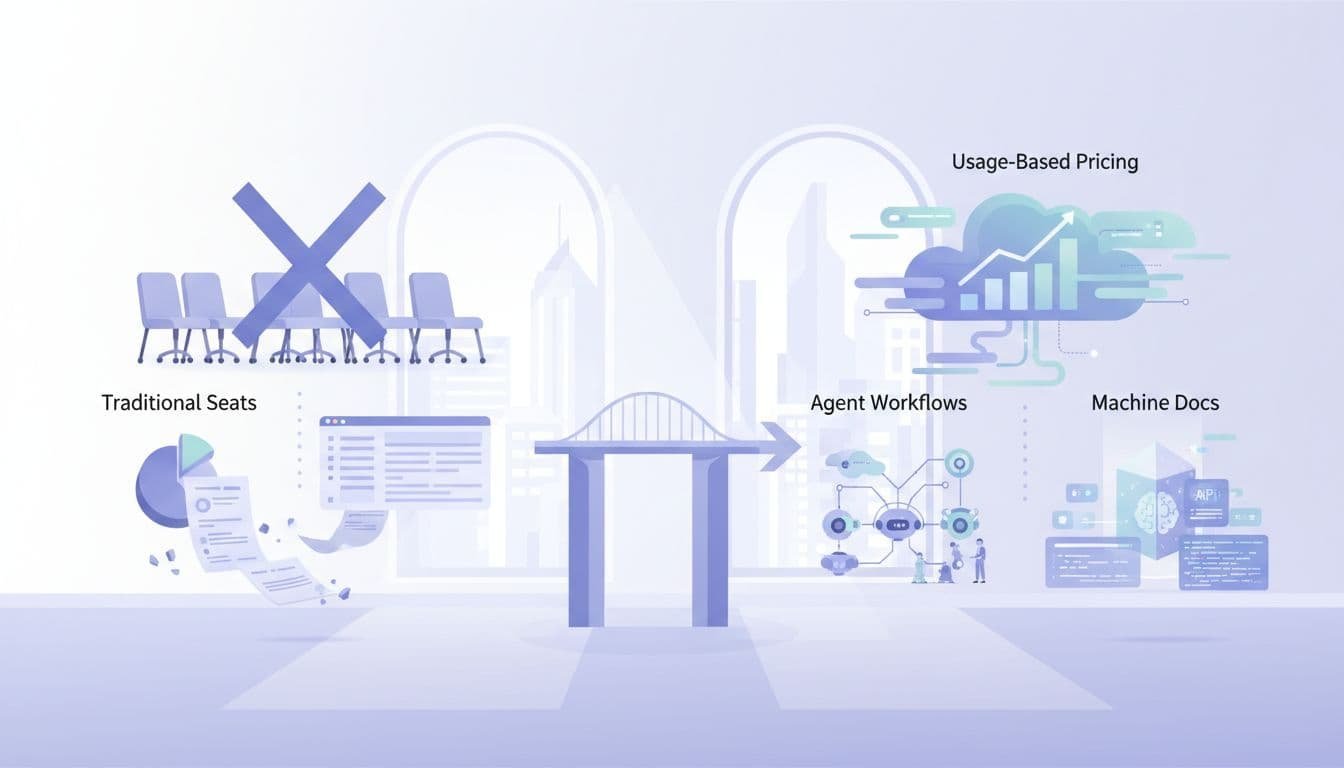
    Professional workspace displays SaaS shift from traditional seats to usage-based pricing, agent workflows, and machine docs with charts and API documents.

    ### Rethink pricing around usage, credits, and outcomes

    Per-seat pricing breaks when one agent can do the work of several operators. In that model, more automation can reduce seat count even while customer value rises. That is a bad incentive.

    This comparison shows where pricing is moving.

    ModelWorks best forMain weakness
    Per-seatHuman-driven workflowsPenalizes automation
    Usage-basedAPI calls, compute, data volumeCan feel noisy
    Outcome-basedCompleted tasks or business resultsHarder to define cleanly

    Recent Deloitte analysis on SaaS and AI agents points to hybrid models, where subscriptions, credits, and outcome pricing coexist. That fits agent-heavy products better because value comes from work completed, not seats occupied.

    Build documentation and workflows for machines, not just humans

    Docs used to teach developers. Now they also shape how models understand your product. That means better examples, tighter schemas, predictable naming, and fewer ambiguous actions.

    In practice, good documentation lowers support load and raises adoption. It also improves agent reliability because the model has less room to guess. If your docs read like marketing copy, they won’t help developers or machines.

    Defend your moat when the UI is no longer special

    A polished interface is easier to copy than trusted infrastructure. The moat now sits in workflow depth, proprietary data, compliance, uptime, integration quality, and control. Customers will favor the system that agents can use safely at scale.

    That shifts the product question. Instead of asking, “Is our UI nicer?” ask, “Are we the most dependable system for this job?” In an API economy, dependable wins more often than pretty.

    FAQ

    Will dashboards disappear?

    No. They will shrink in importance for repeatable work. People still need screens for setup, audit, exception handling, and analysis.

    What makes an API ready for AI agents?

    It needs stable endpoints, clear permissions, structured responses, version control, rate limits, and strong logs. Public access alone doesn’t make it agent-ready.

    Should every SaaS company build its own agent?

    Not always. Some should expose clean infrastructure first and let third-party agents do the orchestration. Others should build a native agent because the workflow is core to the product.

    How should leaders measure success in this shift?

    Track task completion, API consumption, error rates, recovery time, and outcome value. Seat growth alone will miss what agents are doing.

    Conclusion

    The center of gravity is moving. SaaS is becoming API infrastructure, and AI agents are becoming the layer where users express intent and get work done.

    That doesn’t kill the interface. It changes its role. The companies that win next won’t build only for human clicks. They’ll build systems that humans can trust and agents can use.

  • Stop Writing Syntax: The Founder’s Blueprint for 10x Vibe Coding

    Stop Writing Syntax: The Founder’s Blueprint for 10x Vibe Coding

    The Founder’s Guide to Vibe Coding: Building Full-Stack Apps with Natural Language

    For a couple of decades, the barrier to entry for building software was steep. If you had a million-dollar idea but couldn’t write code, you faced a dilemma: spend months learning Python or JavaScript, or spend tens of thousands of dollars hiring a development agency. That bottleneck is finally breaking with the new AI Vibe Coding trend.

    Welcome to the era of Vibe Coding.

    Vibe Coding isn’t about sloppy work; it’s about shifting your focus from syntax (the grammar of code) to intent (the goal of the software). It means describing what you want in natural language and letting AI handle the translation into functional applications. For lean startups and non-technical founders, this is a paradigm shift. It allows you to validate ideas in days rather than months. You don’t need to know how the engine works to drive the car, but you do need to know how to steer. This guide will teach you how to hold the wheel.

    What Is Vibe Coding? The Rise of AI-Assisted Development Definition and Origin

    Vibe Coding is a newer approach to software development that goes past basic autocomplete. Instead of only suggesting code line by line, it uses AI to turn a developer’s intent into working code.

    At its core, Vibe Coding shifts programming away from strict syntax and toward intent. In other words, the focus moves from writing every command by hand to describing what the software should do. This is why the idea is closely tied to Natural Language Programming.

    The term gained wide attention through Andrej Karpathy, who described a style of building software where developers guide AI with plain-language prompts and high-level direction. That idea spread quickly because it matched what many programmers were already starting to experience with modern AI tools.

    1. Step 1: Formulating the ‘Vibe’

    The biggest mistake founders make when using AI is being vague. If you tell an AI builder to “make a clone of Uber,” you will get a generic, broken shell. To succeed, you must act as a Product Manager, not just a dreamer. You need to translate your vision into a structured narrative that the AI can execute.

    Start by defining the User Flow. Describe the journey step-by-step. For example: “A user lands on the homepage, clicks ‘Sign Up,’ enters their email, and is immediately taken to a dashboard where they can upload a PDF.” Be specific about what happens next.

    Next, outline your Data Needs. Even without knowing database schema, you can describe relationships. Tell the AI: “Users need to have profiles. Each profile should store a history of their uploads and their subscription status.” This helps the AI structure the backend logic correctly.

    Finally, set the UI/UX Tone. Don’t just say “make it look nice.” Say, “Use a minimalist design with a dark mode option. The primary action buttons should be bright green, and the font should be modern sans-serif.” The more sensory details you provide, the closer the initial output will match your vision. Treat the AI like a brilliant junior developer who knows every coding language but knows nothing about your specific business logic.

    Inside the Process: How Natural Language Turns Into Running Code A technical guide for non-technical founders

    Large language models (AI Platforms) are the new compilers. They convert plain English into usable code, which is a core idea behind Vibe Coding. Context windows and ongoing prompt loops matter because they keep the model grounded in the task, the codebase, and the goal. Autonomous AI coding agents add another layer. They don’t just suggest code, they can plan steps, write files, test outputs, and keep moving through a build process with limited supervision.

    2. Step 2: Choosing Your AI Arsenal

    Not all tools are created equal. Some are designed for pure speed, while others offer more control. Here is how to choose the right platform for your vibe coding journey.

    • Replit Agent: This is arguably the most powerful all-in-one solution for beginners. It runs in your browser and handles everything from setting up the server to deploying the app. It’s ideal if you want a hands-off experience where the AI manages the environment for you.
    • Bolt.new & Lovable: These tools specialize in generating full-stack web applications instantly in the browser. They are fantastic for prototyping marketing sites or simple SaaS (Software as a Service) tools. They excel at creating beautiful frontends quickly.
    • Cursor with Vercel: If you want slightly more control and plan to eventually hand the code off to a human developer, use Cursor. It is an AI-powered code editor. You can write prompts to generate features, then deploy the result to Vercel (a hosting platform). This workflow creates standard code files that are easier to migrate later.

    The Strategy: Absolute beginners start with Replit or Bolt for your initial prototype to validate the idea quickly. If the product gains traction and you need complex custom logic, migrate to Cursor so you own the codebase directly. Don’t get bogged down choosing the perfect tool; pick one and start building. Many AI platforms such as, Claude, Open AI and Gemini and others offer vibe coding options that are competing but to really vibe-code with ultimate control is with a paid platform as above. Prices vary between each company.

    3. Step 3: The Reality Check (QA & Debugging)

    AI is incredibly capable, but it is not infallible. It can hallucinate features that don’t work or create security gaps. Once your app is generated, you must enter the Quality Assurance (QA) phase. Do not assume the first build is production-ready.

    Your job is to try to break the app. Click every button. Submit empty forms. Try to log in with incorrect passwords. When you find a bug, don’t try to fix the code yourself. Instead, describe the error to the AI in plain English.

    For example, instead of saying “Fix the null pointer exception,” say, “When I click submit without entering a name, the app crashes instead of showing an error message.” The AI can usually identify the logic error and patch it instantly.

    Keep a log of issues. If the AI fixes one thing but breaks another, revert to the previous version. Most of these platforms have version history. Remember, you are the gatekeeper of quality. The AI builds the house, but you must inspect the foundation before inviting guests over.

    4. Step 4: Beyond the MVP

    There comes a point where “vibe coding” hits a ceiling. This usually happens when you need complex integrations, high-scale performance, or strict security compliance. AI-generated code is often functional but not always optimized for scale. It might be messy or redundant under the hood.

    Once you have validated your MVP (Minimum Viable Product) and have paying customers, you need to plan for sustainability. This is the time to consider refactoring. You might keep using AI to add small features, but you should begin documenting how the system works.

    Crucially, know when to bring in a technical lead. If your user base grows to thousands, or if you are handling sensitive financial data, you need a human expert to audit the architecture. A technical lead can take your vibe-coded prototype and rebuild the core infrastructure to be robust and secure. There is no shame in this; you used AI to save money and time on validation, which allows you to invest wisely in engineering later. Use vibe coding to get to the starting line, not to win the marathon alone.

    Why Vibe Coding Matters for Solo Founders and Startups Business

    Vibe coding helps solo founders and startups build and launch an MVP in far less time. As a result, teams can test ideas sooner, gather feedback earlier, and move toward product-market fit without long development cycles.

    It also lowers the barrier for non-technical founders and domain experts. With tools powered by natural language processing, people can turn ideas into working products with simple prompts and clear direction, even without deep coding experience.

    Cost matters at the early stage, too. Instead of spending large agency budgets on initial builds, founders can shift that money toward validation, customer research, and growth. That makes Vibe coding a practical choice for startups that need speed, flexibility, and tighter control over early spending.

    The Founder’s Glossary

    To help you communicate effectively with your AI tools and future hires, here are five essential terms decoded.

    • Frontend vs. Backend: Think of a restaurant. The Frontend is the dining area—the menus, the decor, and where the customer sits (what users see in their browser). The Backend is the kitchen—where the food is cooked, ingredients are stored, and orders are managed (the server and database logic users don’t see).
    • API Integration: An API (Application Programming Interface) is like a waiter. It takes a request from the frontend (the customer) to the backend (the kitchen) and brings the response back. API Integration means connecting your app to external services, like telling your app to talk to Stripe for payments or Google Maps for location.
    • Deployment: This is the process of making your software available to the public. While you build on your local computer or a sandbox, Deployment pushes your code to a live server so anyone with an internet link can use it.
    • State Management: This refers to how your app remembers things. If a user adds an item to a cart, State Management ensures the cart icon updates to show ‘1 item’ even if the user navigates to a different page. It keeps the data consistent across the user’s session.
    • Environment Variables: These are secret settings kept separate from your main code. Think of them as the keys to your safe. You wouldn’t write your password on a sticky note on your monitor; similarly, Environment Variables store API keys and passwords securely so they aren’t exposed if your code is shared.

    The power to build is now in your hands. You no longer need permission to create. With the right vibe, the right tools, and a pragmatic approach to testing, you can turn abstract ideas into tangible products. Start small, test often, and let the AI handle the syntax while you focus on the vision. Your product awaits. To get you started, here is a few prompts to try:

    1. The DX-First Developer Experience Cheat Sheet
      Act as a senior developer advocate specializing in modern web ecosystems. Create a ‘Vibe Coding Tech Stack Cheat Sheet’ that focuses exclusively on Developer Experience (DX) and achieving ‘flow state.’ For each category (Frontend, Backend, Database, Auth, Deployment), select one ‘high-vibe’ tool known for low friction (e.g., Next.js, Supabase, Vercel, Tailwind). For each selection, provide: 1) The ‘Vibe’ (a 1-sentence aesthetic description), 2) Why it is ‘Vibe-heavy’ (focus on speed and lack of boilerplate), and 3) A ‘Pro-Tip’ for maximizing productivity. Tone: Professional, modern, and high-energy. Format: Markdown table followed by detailed bullet points. Audience: Full-stack developers who value rapid shipping.
    2. Minimalist Aesthetic Founder’s Stack Guide
      Create a curated ‘Vibe Coding’ cheat sheet tailored for a solo founder building a sleek, minimalist SaaS. The tone should be aspirational, concise, and sophisticated. Structure the guide into three tiers: ‘The Core’ (The essential language and framework), ‘The Polish’ (UI/UX and animation libraries like Framer Motion), and ‘The Infrastructure’ (Serverless and Edge computing). Limit descriptions to 20 words per tool. Emphasize tools that support ‘coding by intuition’ and ‘aesthetic-driven development.’ Target audience: Design-engineers and creative technologists. Total word count: Under 500 words.
    3. Viral Tech-Twitter Vibe Stack ThreadGenerate a witty and high-energy Twitter thread script (10-12 tweets) titled ‘The 2024 Vibe Coding Tech Stack Cheat Sheet.’ Use a mix of industry jargon and contemporary tech-culture slang (e.g., ‘shipping,’ ‘zero-config,’ ‘aura’). Each tweet should highlight a specific tool or workflow hack that defines the ‘vibe coding’ movement. Include a ‘hot take’ on why traditional enterprise stacks are ‘vibe killers.’ Use emojis strategically to enhance the visual appeal. Target audience: The Tech Twitter/X community and early-stage startup builders. Ensure the final tweet includes a call to action for users to share their own ‘vibe-heavy’ tools.

    Minimalist Aesthetic Founder’s Stack

    Curated for Vibe Coding

    For the design-engineer who sculpts digital experiences through intuition and taste. This is your stack.


    The Core

    Essential language, framework, and tools for coding by feeling.

    • Next.js — The edge-ready React framework with file-based routing that mirrors your mental model of the page.
    • TypeScript — Type safety that sharpens intent, embedding design constraints directly in the code.
    • Tailwind CSS — Utility classes that enable constraint-driven design, composing style at the speed of thought.
    • tRPC — End-to-end typesafe APIs that vanish glue code, letting you shape the experience unimpeded.
    • Cursor — The AI-native editor where you converse with your codebase, turning intuition into implementation.

    The Polish

    UI/UX and motion libraries for that signature feel.

    • shadcn/ui — Beautifully crafted, copy-paste components that give full control over the aesthetic.
    • Framer Motion — Declarative animations that turn intention into fluid motion with minimal code.
    • Lucide Icons — Crisp, consistent iconography that scales from outline to solid, always refined.
    • Vaul — A drawer component so smooth it feels native; perfect for mobile-first gestures.
    • Lenis — Buttery smooth scrolling with easing that makes every scroll a tactile delight.

    The Infrastructure

    Serverless and edge, so you can ship like a studio.

    • Vercel — Deploy with edge functions and analytics; the platform co-created by the Next.js team.
    • Neon — Serverless Postgres that branches like Git, empowering fearless experimentation.
    • Clerk — Authentication components so polished they feel like a design system, not a box-ticking exercise.
    • Stripe — Payments infrastructure that handles the complexity, leaving you with a clean checkout.
    • Resend — Transactional email that renders beautifully, matching your app’s minimalist soul.

    FAQ

    What is “Stop Writing Syntax: The Founder’s Blueprint for 10x Vibe Coding”?

    It’s a 2026 guide, presented as a developer-focused video blueprint, built around a simple shift: founders should stop writing code line by line and start directing AI with plain-language intent. The core promise is speed, because AI agents handle much of the syntax, scaffolding, and iteration. Based on the available source material, it’s positioned more as a practical method than a formal book release.

    What does “vibe coding” actually mean?

    Vibe coding means describing what you want software to do, then letting AI tools generate and revise the code. Instead of focusing on syntax first, you work at the level of product goals, flows, and constraints. In practice, that makes the founder or developer more of a decision-maker and editor, while AI handles much of the implementation.

    Who created it?

    The current source material doesn’t clearly name a single author. The concept appears in a 2026 developer guide video, and the framing draws on broader AI-assisted coding ideas, including what the source calls the “Karpathy Paradigm of Abductive Programming.” So, if you’re looking for a confirmed byline, there isn’t one in the cited material.

    Is vibe coding only for non-technical founders?

    No, although it’s especially appealing to founders who want to move fast without deep expertise in syntax. Technical builders can use the same approach to prototype, debug, refactor, and ship faster. The difference is that experienced developers are usually better at setting guardrails, reviewing outputs, and catching weak code early.

    Does vibe coding replace software engineering basics?

    It doesn’t remove the need for judgment. The current advice tied to this approach still includes planning before you build, using version control, writing tests, fixing errors methodically, documenting changes, and refactoring often. AI can speed up delivery, but product clarity, architecture choices, and code review still matter if you want reliable software.


  • Master Multi Agent Systems for Retail Supply Chains, Inventory Forecasting.

    Master Multi Agent Systems for Retail Supply Chains, Inventory Forecasting.

    AI Inventory Management With Forecasting Agents That Turn Chaos Into Growth

    Unpredictable demand doesn’t just create supply chain headaches. It creates missed revenue, wasted ad spend, frustrated shoppers, and too much cash sitting in the wrong products.

    That problem shows up everywhere, from ecommerce stores and retail chains to multichannel brands juggling marketplaces, stores, and direct-to-consumer sales. A product page can rank well, a campaign can pull clicks, and the business can still lose because inventory wasn’t where demand landed.

    This is why ai inventory management matters more now than it did even two years ago. By 2026, leading teams aren’t just using static forecasts. They’re moving toward agentic systems that update predictions with live signals, such as sales velocity, promotions, weather, events, and supplier delays. The result is practical, not flashy: operations, merchandising, and marketing start working from the same view of demand.

    The invisible ROI killer, when SEO traffic and inventory reality do not match

    A lot of growth teams focus on traffic first. That makes sense, until traffic hits pages tied to low stock, backorders, or items that are about to disappear.

    Picture a spring campaign for a trending sneaker. Organic traffic jumps 40 percent. Paid search adds another lift. Email clicks spike. Yet conversion drops because the top sizes sell out in three days, while support tickets rise and shoppers bounce to competitors. On paper, marketing performed. In the bank account, the campaign underdelivered.

    That mismatch is an invisible ROI killer. High-ranking category pages can drain budget when inventory planning lags behind demand. Marketing keeps sending shoppers to pages that can’t convert. Operations scrambles to explain shortages. Merchandising gets stuck reacting instead of planning.

    By the time the stockout becomes obvious, the damage is already wider than one lost sale. In many retail teams, that pain is pushing a shift toward agent-based operations, which is why current retail AI agent use cases in 2026 focus on business outcomes like margin, service levels, and faster decisions.

    How stockouts quietly weaken both revenue and customer trust

    A stockout rarely ends with a simple “come back later.” Shoppers compare tabs, find a similar product elsewhere, and may never return.

    That hurts lifetime value, not just today’s cart. It also chips away at trust. If a customer clicks from search, lands on your product page, and sees “unavailable” twice in one month, your brand starts to feel unreliable.

    Why overstock is just as costly as running out

    Running out gets attention. Overstock often hides in the background.

    Excess inventory ties up cash, increases storage fees, and forces markdowns later. It also slows inventory turns, which makes future buying decisions worse. So better forecasting protects margin on both sides. It helps you avoid empty shelves and dusty shelves.

    Introduction to AI inventory agents for marketing and operations teams

    An AI inventory forecasting agent is more than a model that predicts next month’s demand. It watches fresh data, updates the forecast, recommends actions, and can trigger workflows when risk rises.

    In plain English, it behaves more like a smart planner than a static report. It can notice that sales velocity is rising, a promotion starts Friday, rain is coming to the Northeast, and a supplier shipment is delayed. Then it can flag replenishment risk before the stockout happens.

    That matters because basic forecasting tools often stop at a number. An agent keeps going. It asks, “What should the business do next?” Research into LLM-based multi-agent inventory management points in this direction, where specialized agents coordinate around planning, stock levels, and supply chain decisions.

    Common inputs are familiar. Historical sales, seasonality, lead times, returns, channel mix, price changes, promotions, and supplier reliability all belong in the mix. Outside signals matter too, especially when demand changes fast.

    A supply chain analyst is caught mid-sentence, gesturing naturally toward a large, glowing digital wall display that shows intricate, fluctuating predictive AI stock curves. Standing slightly to the side, a colleague listens intently, creating a sense of authentic collaboration.

    What makes an agent different from a dashboard or spreadsheet

    A dashboard tells you what happened. A spreadsheet may help you estimate what comes next. An agent helps you decide what action to take.

    That’s the key difference.

    If a dashboard shows a fast-selling SKU has seven days of stock left, a planner still has to interpret the risk, check lead times, and notify marketing. An agent can spot the issue, estimate the stockout date, suggest a reorder, and tell the campaign team to shift demand to a substitute.

    How multi-agent systems help retail supply chains move faster

    In a retail setting, one agent may forecast demand at the SKU level. Another may watch supplier risk. A third may recommend replenishment moves, while a fourth updates product messaging when stock risk climbs.

    Think of it like a store team. One person handles buying, another tracks vendors, and another manages promotions. A plain-language look at multi-agent systems helps show why this works: specialists move faster when they share context.

    For retailers, that means fewer handoffs and better timing.

    Mapping high-volume search demand to predicted stock availability

    Marketing demand planning and inventory forecasting should live in the same conversation. Too often, they don’t.

    Your top traffic pages already tell you where demand is likely to land. Seasonal search trends, campaign calendars, social buzz, and marketplace behavior add more clues. When you connect those signals to SKU and category-level inventory predictions, you stop guessing which pages deserve attention.

    This is where ai inventory management becomes a growth tool, not just an operations tool. If one product line is trending but supply is shaky, you can support related pages with healthier stock. If a hero item will stay available, you can lean into it harder across search, email, and paid channels.

    Prompt:

    Strategic Guide: Integrating Search Demand with Inventory Forecasting

    Act as an expert E-commerce Growth Strategist and Supply Chain Consultant. Your task is to write a comprehensive whitepaper section titled ‘The Synergy of Demand: Mapping Search Volume to Inventory Availability.’ The content should target CMOs and COOs of mid-to-large scale retail enterprises. Structure the output into the following sections: 1. The Silo Problem: Explain why the disconnect between marketing demand and operations leads to missed revenue. 2. Signal Identification: Detail how to aggregate data from seasonal search trends, campaign calendars, social buzz, and marketplace behavior. 3. AI-Driven Orchestration: Describe how AI inventory management tools can predict SKU-level availability. 4. Dynamic Marketing Execution: Provide actionable strategies for shifting search, email, and paid channel focus based on stock health (e.g., pivoting from low-stock trending items to high-stock related categories). Maintain a professional, data-driven, and authoritative tone. Use bullet points for readability and ensure the conclusion highlights inventory as a strategic growth lever rather than just an operational necessity.

    In 2026, the strongest forecasts pull from live sales velocity, promotion plans, weather shifts, local events, channel demand, and supplier updates. Not every business needs all of that on day one. Still, most need more than last year’s spreadsheet.

    Which demand signals should feed the forecast first

    Start with the signals that are closest to revenue:

    • Recent sales velocity: It shows what’s moving now, not what moved last quarter.
    • Current on-hand inventory: Forecasts without stock reality are just pretty math.
    • Lead times and supplier reliability: These shape risk, not just demand.
    • Promotion calendar: A discount can distort demand overnight.
    • Returns by SKU: High returns can hide real sell-through.
    • Channel mix: Amazon, retail stores, and DTC often move differently.

    Clean and timely data beats endless data sources. A smaller, trusted set of signals is better than a messy lake of half-updated inputs.

    How to align content calendars with what will actually be in stock

    Content teams don’t need to stop promoting products. They need to promote the right products at the right time.

    If a forecast shows a likely stockout in 10 days, don’t build next week’s blog, email, and paid social around that SKU. Push the in-stock alternative, the stronger category page, or the bundle with safer supply. That simple shift protects conversion and lowers shopper frustration.

    How to automate out-of-stock SEO actions using predictive inventory data

    Predictive inventory data is useful only if it leads to action before the stockout hits.

    When an agent sees rising risk, the business can respond early. Product page copy can shift from hard-sell language to transparent restock messaging. Internal site recommendations can favor substitutes. Paid promotion can pause. Merchandising can raise visibility for similar items with healthy supply. Structured messaging can change to set better expectations.

    The point is timing. Most teams act after the shelf is already empty. A forecasting agent gives them a head start.

    Forecast first, automate second. Otherwise, you just make the wrong move faster.

    Prompt:

    Advanced SOP for SEO-Driven Inventory Automation

    Act as an expert E-commerce Strategist and Technical SEO Specialist. Your task is to develop a comprehensive Standard Operating Procedure (SOP) for automating inventory-based SEO actions. Use the following core steps as your framework: 1. Map Inventory to SEO Strategy: Define the logic for distinguishing seasonal items (using 302 redirects to category pages) versus staples (enabling ‘pre-order’ or ‘notify me’ buttons). 2. Set Up Predictive Triggers: Detail the configuration of supply chain platforms like GAINSystems to trigger SEO alerts 7-14 days before expected stockouts. 3. Audit and Monitor: Establish a workflow for tracking organic traffic to OOS pages and auditing redirect status codes to prevent premature 301 transitions. For each step, provide: A) Technical requirements and tool integrations. B) Specific ‘If-Then’ logic for automation rules. C) Key Performance Indicators (KPIs) to track. D) Common pitfalls and mitigation strategies. The final output should be a structured technical guide suitable for e-commerce managers and SEO leads, written in a professional and authoritative tone.

    A candid medium shot of a focused warehouse operations manager wearing a bright neon high-visibility safety vest. The manager is holding a sleek digital tablet, looking intently at the screen which displays a vibrant real-time inventory heatmap with glowing data visualizations.

    When to refresh a page, suggest alternatives, or pause promotion

    The best choice depends on three things: expected restock date, product importance, and substitute quality.

    If restock is close, keep the page live and update messaging. If the product is a hero item with strong branded demand, hold the page and show related options. If restock is far away and a close substitute exists, shift promotion early. Redirects should be rare and used only when the original item is gone for good or replaced cleanly.

    Simple guardrails that keep automation from hurting search performance

    Automation needs limits.

    Set review thresholds for major content changes. Require approval before noindex rules, redirects, or large internal link shifts. Keep exception rules for hero products, seasonal spikes, and short-term supply noise. Good guardrails help teams move fast without breaking pages that still matter.

    A simple automation blueprint for deploying an AI inventory forecasting agent

    Start small. That’s the safest way to build trust.

    Pick one category, one channel, or one business unit with obvious pain, maybe frequent stockouts or expensive overstock. Then connect the minimum data stack: ERP or WMS inventory data, sales history, lead times, promotion plans, and basic ecommerce performance.

    From there, set a forecast cadence. Daily is often enough for fast-moving retail. Weekly may work for slower categories. Next, define action workflows. What should happen when stockout risk crosses a threshold? Who gets notified? Which promotions pause? Which substitutes surface?

    Warehouse and operations teams are also moving toward shared AI coordination layers, and NVIDIA’s warehouse AI command layer overview shows how real-time signals can support faster decisions across physical operations.

    The data and systems you need before you automate anything

    Keep the first build simple. You need sales history, current inventory, lead times, supplier reliability, a promotion calendar, and return patterns.

    You also need one source of truth for product and stock status. If five teams use five different numbers, the agent will lose trust fast.

    How to roll out the agent without disrupting daily operations

    Use a phased launch. First, measure your baseline. Track stockout rate, conversion rate, inventory turns, carrying cost pressure, and revenue per visit.

    Next, run the agent in advisory mode. Let it recommend actions before it triggers them. Review those calls weekly with operations, merchandising, and marketing. Once the team sees that the signals hold up, automate the low-risk moves first.

    A candid photograph taken from a street-level perspective, looking through the glass window of a cozy boutique. Inside, the shop owner is seen cross-referencing AI-driven stock suggestions on her smartphone with the physical inventory on the shelves.

    Case study framework, how inventory-first planning can lift organic revenue

    A realistic model example helps here.

    Imagine an apparel brand with strong organic traffic to seasonal product pages. Before the change, content and inventory were out of sync. The SEO team kept pushing high-impression pages tied to products with weak stock depth. Traffic looked healthy, but conversion lagged. Stockouts hit promoted sizes, and slow-moving items piled up in nearby categories.

    Technical Architecture for Multi-Agent Logistics Orchestration

    Prompts:

    Technical Architecture for Multi-Agent Logistics Orchestration

    As a Senior Cloud Architect, design a detailed technical specification for an Inventory Forecasting Agent system using LangGraph. The system must feature three primary agents: 1) The ‘Data Analyst Agent’ for time-series forecasting and stockout prediction based on historical and real-time ERP data, 2) The ‘Procurement Agent’ for automated Purchase Order (PO) generation and supplier API integration, and 3) The ‘Manager Agent’ for state coordination and human-in-the-loop approvals. Describe the shared state management schema, the conditional edge logic for triggering POs based on confidence thresholds, and how the system scales for high-throughput logistics firms. Structure the output as a technical design document including system flow diagrams described in text, agent-specific system prompts, and error handling strategies for API failures.

    B2B Marketing Strategy for AI-Driven Supply Chain Resilience

    Act as a specialized B2B Marketing Consultant for the logistics industry. Write a comprehensive white paper titled ‘The Future of Zero-Latency Logistics: Scaling Predictive Stockout Prevention with Multi-Agent Systems’. The target audience is CTOs and Supply Chain Directors of global logistics firms. The content must explain the shift from reactive to proactive inventory management, the role of multi-agent collaboration in reducing manual overhead, and the ROI of automated PO integration. Use a professional, authoritative, and forward-thinking tone. Include a detailed section on scalability and the competitive advantage of utilizing state-of-the-art agentic frameworks. The final output should be structured with headings, sub-headings, and a call-to-action for a pilot program implementation.

    Scenario-Based Implementation Guide for Autonomous Procurement

    Create an engaging and instructional operational guide for logistics managers on implementing an ‘Inventory Forecasting Agent’. Explain the end-to-end workflow of a ‘Stockout-to-PO’ cycle through the lens of a hypothetical scenario involving a sudden 40% spike in demand for a core SKU. Detail how the multi-agent system responds: the Analyst Agent flags the risk, the Procurement Agent queries supplier lead times via API, and the Manager Agent prepares the auto-PO for human review. The guide should use a witty yet informative tone, incorporating bullet points for key steps, a ‘Troubleshooting’ section for edge cases like supplier stock shortages, and a clear list of ‘Human-in-the-loop’ checkpoints to build operational trust.

    B2B Marketing Strategy for AI-Driven Supply Chain Resilience

    Before, too much traffic to the wrong products

    This pattern is common. A few pages win rankings, marketing scales them, and operations pays the price.

    You see high impressions, soft conversion, more customer service contacts, and sudden markdown pressure elsewhere. The business attracts attention but wastes too many visits.

    After, content and inventory started working together

    Now change the workflow. A forecasting agent scores stock risk by SKU and category. Marketing shifts content toward pages with stronger projected availability. Merchandising boosts substitutes sooner. Paid campaigns pause when forecasted supply falls below a set threshold.

    Conclusion

    The gains won’t always look dramatic on every metric. Still, the right measures tend to move in the same direction: better conversion rate, lower stockout rate, healthier inventory turns, less carrying cost pressure, and higher revenue per organic visit.

    That is the real promise of ai inventory management. It doesn’t just predict demand. It helps the business send demand where it can actually be served.

    An AI inventory forecasting agent is more than a planning tool. It’s a way to connect supply chain decisions with revenue outcomes. If demand signals, inventory data, and automated actions work together, chaos starts to look a lot more like control. A smart next step is simple: audit where content demand and stock availability are out of sync, then pilot ai inventory management in one category where stockouts or overstock hurt the most.

  • 25 ‘Ready-to-deploy’ IT automation prompt workflows in Kore.ai Marketplace

    25 ‘Ready-to-deploy’ IT automation prompt workflows in Kore.ai Marketplace

    Kore.ai IT Automation for Service Desks: 25 Ready-to-Deploy Prompt Workflows from the Marketplace

    Service desks don’t usually fall behind because teams don’t care. They fall behind because the work never stops. The same password resets, access requests, and “VPN isn’t working” tickets keep coming, while MTTR creeps up and hiring stays tight. Meanwhile, manual steps create risk, because a tired tech at 2 a.m. can click the wrong thing.

    Kore.ai IT automation tackles that pressure with “ready-to-deploy prompt workflows” you can pull from a Marketplace and put into production quickly. In plain terms, these are pre-made automation recipes: prompts, decision steps, and tool connections that guide a request from intake to completion, with logging and guardrails.

    This post maps 25 practical workflows by category, what each one does, and how to roll them out from the Kore.ai Marketplace without turning automation into a new source of incidents.

    Why Kore.ai IT automation beats building every service desk workflow from scratch

    Building custom automations feels safe, because you control every line. In practice, it’s slow. A “simple” workflow often turns into weeks of meetings, edge cases, and rework once it hits real tickets. By the time it ships, the queue has already changed.

    Pre-built Marketplace workflows flip the timeline. Instead of designing everything, you start from a working pattern, then tailor it. That matters for a Senior IT Ops Manager because you’re measured on outcomes, like fewer escalations and faster restores, not on how elegant the flowchart looked.

    Here’s the business case that usually lands:

    • Faster time-to-value: start with high-volume L1 tasks and expand.
    • Fewer L1 and L2 touches: the workflow gathers details, runs checks, and only escalates when needed.
    • Consistent execution: the same steps happen every time, even on weekends.
    • Better auditability: actions can be logged back to tickets and change records.

    The hidden costs of manual work add up quickly: context switching between chat and tickets, copy-pasting error logs, missed fields that trigger re-triage, escalations that bounce between teams, and after-hours pages caused by “quick fixes” that weren’t tracked.

    If you want a vendor-level view of what Kore.ai positions as its workflow approach, see its overview of intelligent process automation.

    What “ready-to-deploy” really means in the Kore.ai Marketplace

    “Ready-to-deploy” shouldn’t mean “works in the demo.” In this context, it typically means the workflow already includes the pieces that take the longest to design:

    • Prompts and conversation paths that ask for the right details (device, error, urgency, impact).
    • Decision steps to route work based on policy (role, app, environment, change window).
    • Connector mappings to common enterprise systems (ITSM, IAM, cloud, security tools).
    • Basic guardrails, so risky actions don’t run without checks.

    Kore.ai also emphasizes multi-agent orchestration for IT work, where different agents can handle different task types, and route between them without the user feeling the handoff. In March 2026, Kore.ai also highlights pre-built templates at scale (it publicly references dozens of templates and broad enterprise integrations). For background, Kore.ai describes its library of pre-built process templates and how they speed up common automation patterns.

    You still customize, but you customize what matters: language, routing rules, approvals, and ticket fields, without turning every request into a mini software project.

    Governance and safety basics, so automation does not create new risk

    Automation that can change systems must behave like a careful engineer, not an eager intern. Start with a few basics that keep security and audit teams calm:

    • Role-based access control: only allow approved groups to run workflows that change state (restart services, isolate endpoints, scale storage).
    • Approvals for risky actions: especially for production changes and anything disruptive.
    • Audit logs: capture who requested what, what the bot did, and what it changed.
    • Environment limits: keep “do the thing” actions restricted to dev or staging until you explicitly allow prod.

    Human-in-the-loop (HITL) is the simplest safety net. The assistant prepares the action and the change summary, then a person confirms. That’s a clean way to enforce policies like least privilege, “ticket required for change,” and change-window rules.

    A useful rule: let the bot gather, verify, and propose by default. Allow it to execute only when policy and permissions make it low-risk.

    For more context on Kore.ai’s Marketplace positioning and how it packages enterprise-grade agents and templates, review the Kore.ai Marketplace overview.

    The 25 Kore.ai Marketplace workflows that deflect tickets and speed up resolution

    The workflows below are grouped the way most ops teams actually work: ITSM first, then stability, then identity, then security, then the “busywork” category that quietly drains senior engineers. Each workflow lists what it automates, likely triggers, common systems, and the outcome you can measure.

    ITSM and helpdesk quick wins, 5 workflows that shrink the queue first

    Modern IT service desk featuring an agent viewing workflow steps on screen for automated chat handling password reset request in softly lit professional office, exactly one person, realistic style.
    1. Password reset (self-service): Trigger chat portal, touches IAM directory, outcome is ticket deflection and fewer L1 calls.
    2. New ticket creation with smart fields: Trigger chat or email intake, touches ServiceNow or Jira Service Management, outcome is better routing and fewer back-and-forths.
    3. Account unlock: Trigger chat, touches AD or identity provider, outcome is faster restores and fewer escalations.
    4. Ticket status lookup and next update: Trigger chat, reads ITSM, outcome is fewer “any update?” tickets.
    5. Smart escalation with summarization: Trigger aging ticket or unhappy user signal, posts summary and steps tried to ITSM, outcome is faster L2 start and lower reopen rate.

    Best practice: verify identity before resets, capture device and error details up front, summarize what was attempted, and write actions back to the ticket. Those four habits alone can cut re-triage.

    If you want another deployment path beyond Kore.ai’s own Marketplace, Kore.ai also appears in enterprise catalogs like Microsoft AppSource for ITAssist, which can help procurement and approvals in Microsoft-heavy shops.

    Cloud and infrastructure stability, 5 workflows that reduce downtime

    Cloud infrastructure dashboard displaying automated VM provisioning workflow in progress, with server racks in the background and holographic status overlays, in a futuristic realistic tech style under natural lighting. 6. VM provisioning request: Trigger chat or catalog request, touches AWS, Azure, or GCP plus CMDB, outcome is faster delivery with standard tags.


    7. Automated backup verification: Trigger schedule, checks backup jobs and alerts on failures, outcome is fewer “we found out during restore” surprises.
    8. Restart service with pre-checks: Trigger alert or ticket, touches Kubernetes, systemd, or cloud runbooks, outcome is shorter incident time for known failure modes.
    9. Storage scaling request with approvals: Trigger ticket, touches cloud storage, outcome is fewer capacity pages and controlled growth.
    10. System health checks and daily digest: Trigger schedule, pulls health metrics and posts summary to ops channel, outcome is fewer blind spots.

    Safe defaults matter here. Restrict who can run scale actions, require approvals for production, and include rollback steps when possible. For restarts, add guardrails like “only restart once per X minutes” and “do not restart during maintenance freeze unless approved.”

    Identity and access at scale, 5 workflows that cut onboarding and access delays

    1. Employee onboarding checklist: Trigger HR event or ticket, touches Okta or Microsoft Entra ID, outcome is day-one readiness and fewer manual tasks.
    2. Offboarding and access removal: Trigger HR termination event, disables accounts and removes group access, outcome is lower security exposure and stronger audits.
    3. App access request with approvals: Trigger chat, routes to manager and app owner, outcome is faster access with policy-compliant approvals.
    4. MFA reset with identity proofing: Trigger chat, touches IAM, outcome is quick restores without social-engineering gaps.
    5. Role change request (least-privilege templates): Trigger ticket, maps to role bundles, outcome is fewer one-off entitlements and cleaner access reviews.

    Keep these workflows zero-trust minded: time-bound access where possible, manager approval, audit trails, and role templates instead of ad hoc group adds. When exceptions happen, force an explicit reason field so you can report on it later.

    For a sense of what Kore.ai says it’s releasing and improving around enterprise productivity and agents, its update posts can be helpful context, such as Kore.ai AI for Work feature updates.

    Security operations that move fast, 5 workflows for incident response support

    1. Phishing alert triage intake: Trigger user report in chat, collects headers and indicators, outcome is faster triage and fewer incomplete reports.
    2. Endpoint isolation request (HITL): Trigger SOC chat or incident ticket, proposes isolation, requires analyst approval, outcome is quicker containment with control.
    3. Vulnerability scan kickoff: Trigger schedule or change ticket, starts scan and posts results, outcome is tighter patch loops.
    4. Log retrieval for an incident ticket: Trigger incident workflow, pulls relevant logs and attaches them, outcome is less swivel-chair investigation.
    5. Mass incident notifications and status updates: Trigger major incident declaration, sends updates and keeps a timeline, outcome is fewer inbound pings and clearer comms.

    These flows should bridge to SIEM and SOAR tools at a high level, but keep destructive actions gated. A good design principle: the assistant can enrich and summarize freely, but it executes containment only with approvals.

    Network, asset, and software busywork, 5 workflows that free up engineer time

    1. Software deployment request intake and approvals: Trigger chat, routes to app owner, then triggers deployment tool, outcome is fewer manual installs.
    2. VPN troubleshooting guided flow: Trigger chat, runs checks (client version, auth, network), outcome is fewer escalations to networking.
    3. License audit reporting: Trigger schedule, reconciles users and licenses, outcome is fewer true-up surprises.
    4. Asset tracking updates: Trigger user self-report or warehouse scan event, updates asset system, outcome is cleaner inventory.
    5. Network diagnostics runbook: Trigger ticket or chat, runs ping, DNS checks, traceroute collection, outcome is faster isolation of “network vs app” issues.

    Think of this bucket as a conversational command center: one place to request actions and get answers, with every step logged. Also, Marketplace prompts should be treated as a starting point, then tailored to your naming, tools, and policies without weakening approvals and access controls.

    Deploy a Kore.ai Marketplace workflow in minutes, a practical rollout plan that sticks

    Fast deployment only matters if it stays live. The rollout that usually works is boring on purpose: pick one high-volume use case, ship it with guardrails, measure, then expand. That approach also helps with change management because agents and users can build trust one workflow at a time.

    An IT manager in a modern office deploys a Kore.ai Marketplace workflow on a laptop, with a step-by-step interface visible on the slightly angled screen, coffee mug on desk, and soft window light.

    Treat your first workflow like a product release. Assign an owner, set a success metric, and test in a safe environment. Then make the self-service entry point obvious, such as Teams, Slack, a portal widget, or the ITSM catalog.

    If your org prefers buying through cloud marketplaces, Kore.ai also lists offerings in places like the AWS Marketplace AI for Service listing, which can simplify procurement in some enterprises.

    From selection to go-live, a clear checklist for first deployment

    • Pick one high-volume use case (password reset, unlock, ticket intake).
    • Define one success metric (deflection rate or handle time).
    • Confirm data sources (knowledge articles, policy docs, ticket fields).
    • Connect your ITSM (ServiceNow, Jira Service Management, or Zendesk).
    • Configure auth securely (scoped tokens, least privilege, rotation plan).
    • Map fields and outputs (summary, category, CI, impact, resolution notes).
    • Set approval rules for risky steps (prod changes, access grants, isolation).
    • Run test tickets in a sandbox and capture failure patterns.
    • Pilot with one team for one to two weeks, then expand.
    • Train agents and announce self-service, and keep a clear fallback path to a human.

    How to measure ROI in the first 30 days without fancy math

    Skip complex models. Use simple, defensible metrics you can explain in a staff meeting:

    • Ticket deflection rate: how many requests ended without an agent touching the ticket.
    • Average handle time (AHT): how long agents spend per ticket when they do engage.
    • Time-to-first-response: especially important for chat-based intake.
    • MTTR: best for incident workflows and restarts.
    • Reopen rate: catches “quick fix, wrong fix” automation.
    • Escalation rate: shows whether intake and summaries improved.
    • After-hours pages: a practical signal that stability workflows are working.

    Set a weekly review cadence: top failure reasons, prompt tweaks, routing tweaks, and knowledge gaps to fix. Include an audit and compliance spot-check in that review so your controls don’t drift over time.

    FAQ (Frequently Asked Questions From Readers)

    Do I need to automate everything to see results?

    No. Start with one workflow that represents a big slice of volume, like password resets or ticket intake. Then expand once metrics prove it.

    Will automation frustrate users if the bot gets it wrong?

    It can, so design for graceful exits. Make it easy to route to a human with a clean summary, not a blank handoff.

    How do approvals work for risky actions?

    Use HITL for disruptive actions, like endpoint isolation or production scaling. The assistant proposes the action and a person confirms.

    Where does knowledge come from for troubleshooting flows?

    Good workflows pull from your internal docs and ticket history patterns. Keep the source set small at first, then broaden after you see consistent answers.

    What’s the fastest place to begin in Kore.ai IT automation?

    Begin with an ITSM workflow that collects better details and logs actions back to tickets. That improves outcomes even before you automate “doer” actions.

    Conclusion

    If your service desk feels like a treadmill that keeps speeding up, you don’t need a year-long rebuild. Pick one or two ITSM quick wins, deploy them with approvals and audit logs, and measure impact for 30 days. After that, expand into IAM and cloud stability, where small delays and manual steps often create the biggest risk.

    The practical promise of Kore.ai IT automation is simple: faster time-to-value using ready-to-deploy Marketplace workflows, less manual work, and more consistent support. Choose a workflow tied to a real pain point, run a focused proof-of-concept, and let the results decide what you automate next.

  • Streamline Onboarding With Top HR Automation Tools for New Hires

    Streamline Onboarding With Top HR Automation Tools for New Hires

    Revolutionize the First 90 Days Onboarding With These HR Automation Tools

    Onboarding can feel like trying to run a relay race while the baton keeps changing hands. HR sends forms, IT waits for approvals, managers assume “someone else” is handling access, and the new hire is stuck watching the calendar.

    Those first weeks matter more than most teams admit. The first 90 days shape retention, speed to productivity, and trust. When basics slip, like payroll, logins, or training, people notice. They also remember.

    HR automation tools are simply software systems that auto-send forms, route approvals, assign tasks, and track progress across teams. The goal is practical: less admin work, fewer errors, and a more confident employee from offer letter through day 90.

    The evolution of onboarding, moving beyond paperwork and “checklist theater”

    Classic onboarding was paperwork plus a quick orientation. Then HR called it done. That approach breaks down in 2026 because work is more distributed, apps are everywhere, and compliance is stricter. Also, “paperwork done” doesn’t mean the employee can do the job.

    Modern onboarding is an end-to-end setup. It covers culture, role clarity, tools, access, and coaching. When you get it right, you reduce avoidable mistakes, shorten ramp time, and lower early turnover. When you miss it, you pay for it in rework, support tickets, and awkward first impressions.

    If you want a sense of how broad onboarding software has become, review roundups like onboarding software comparisons for 2026. The key takeaway is not “pick the biggest tool.” It’s that onboarding now sits at the center of HR, IT, payroll, and the manager’s week-to-week habits.

    A checklist that isn’t connected to real owners and real systems is just theater. Automation turns the list into actions.

    What modern onboarding needs to cover (people, process, and systems)

    Think of onboarding like moving into a new apartment. The lease matters, but so do the keys, the utilities, and knowing where the breaker box is. In practical terms, modern onboarding should cover:

    • Identity and work authorization steps (including I-9 workflows where applicable, and remote verification steps where allowed)
    • Policy sign-offs and version tracking (handbook, security, harassment prevention)
    • Payroll setup (W-4, direct deposit) and benefits enrollment timing
    • Device delivery, app access, and role-based permissions
    • Role-based training, plus proof of completion
    • Introductions, buddy assignments, and manager first-week goals

    Where HR automation tools save the most time in the first 90 days

    Automation pays off most where humans otherwise chase status. High-impact areas include e-signatures, task assignment, reminders, and data sync between systems. Instead of retyping the same name and start date in five places, the signed offer can create or update the employee record, kick off provisioning, and notify the manager.

    That also clears up the “who owns this?” problem. A good workflow assigns each task to a person or team, tracks deadlines, and escalates when something stalls.

    Accelerate hiring handoff with recruitment automation, so day one starts strong

    Many onboarding problems start before onboarding “officially” begins. The offer gets accepted, then momentum fades. Candidates go quiet. Details get lost in email. Managers assume HR has it. HR assumes IT has it.

    Recruiting automation helps you protect the handoff. It keeps the candidate warm, reduces data entry, and turns acceptance into action. You don’t need a fancy setup to see results. Even basic routing and templated communication can cut days off your timeline.

    If you’re exploring how onboarding platforms overlap with broader work management, it helps to look at employee onboarding software platform examples. Not every company needs a full suite, but most companies need fewer handoffs and fewer “please resend that form” emails.

    Automation starts at the offer letter (and keeps momentum high)

    The offer letter is the first moment you can remove friction. A modern flow usually includes:

    Offer templates with role-based fields, approval routing for comp and headcount, e-signature, and automatic next steps once signed. Those next steps may include background screening, reference checks, and pre-boarding forms. Most importantly, the system should store the signed offer in the employee record without manual uploading.

    Speed matters here, but so does confidence. A clean, consistent process tells candidates your company is organized. That feeling carries into day one.

    Clean data in, clean data out, stop retyping the same info everywhere

    Every time someone re-enters employee data, you create a chance for errors. HR automation tools reduce duplicate entry by syncing key fields across ATS, HRIS, payroll, and IT tickets.

    Here’s what “bad data” can cost in the first 90 days:

    • Payroll mistakes (wrong rate, missing tax form)
    • Wrong title or department (confusing training assignments)
    • Missing compliance docs (audit risk)
    • Incorrect access permissions (security risk, or blocked work)

    Even small teams feel this pain. One wrong start date can mean a laptop arrives late, accounts get created too soon, or benefits deadlines get missed.

    sleek white tablet showing a simple progress bar at 100 percent next to a single green succulent plant.

    Streamline pre-boarding with HR automation tools, so everything is ready before day one

    Pre-boarding is where HR earns back time. It’s also where the new hire decides if they made a good choice. If they can’t complete forms on a phone, don’t know where to go on day one, or wait a week for access, they’ll assume the job will feel the same.

    The best approach is workflow orchestration. When the start date and role are set, the tool triggers tasks across HR, IT, finance, and the manager. It assigns owners, due dates, and reminders automatically. That’s how you avoid the “I thought you ordered the laptop” moment.

    If you want to see how orchestration-focused vendors describe the problem, read about onboarding automation tools for cross-team handoffs. The marketing is one thing, but the operational point is solid: onboarding often fails between systems, not inside them.

    Pre-boarding workflows that remove friction (forms, accounts, equipment, and training)

    A simple rule helps: automate anything that looks like chasing. In pre-boarding, that usually means:

    • Welcome message sequence with clear next steps
    • Document collection and e-signatures (tax forms, direct deposit, handbook acknowledgements)
    • Benefits previews and enrollment reminders tied to eligibility dates
    • IT provisioning requests based on role (email, SSO, core apps)
    • Device ordering, shipping, and return logistics for remote hires
    • Building access, parking, and badge steps for onsite hires
    • First-week training assignments with due dates

    Keep every step mobile-friendly. New hires often do pre-boarding from a personal phone between other obligations. When forms break on mobile, completion drops fast.

    To make the idea concrete, here’s how automation maps to outcomes:

    Onboarding momentManual riskAutomation outcome
    Offer acceptedStalled approvalsAuto-routing and instant kickoff
    Pre-boarding formsMissing fields, reworkValidations, e-sign, reminders
    IT access“Waiting on HR” loopAuto-provisioning triggers and escalations
    First-week trainingUnclear expectationsRole-based assignments and tracking
    Day 30 check-inForgotten 1:1Scheduled prompts and surveys

    The pattern is consistent: remove guesswork, and people move faster.

    Role-based automation that prevents security and compliance gaps

    Role-based automation means the workflow changes based on the job. For example, if the hire is remote, the system triggers laptop shipping and remote setup steps. If the hire manages people, it assigns manager training and approval access.

    This also supports least-privilege access in plain terms: give people only what they need, then expand later if required. When access is assigned by role, you reduce accidental over-permissioning and lower the chance of a data leak.

    Audit trails matter, too. The best HR automation tools keep proof of completion, track policy versions, and show who approved what and when. If someone misses a required step, automated reminders keep it from disappearing into someone’s inbox.

    Make the first 90 days measurable, with automated milestones and real feedback

    Setup is only half the job. The other half is knowing whether onboarding worked. That’s where automated 30, 60, and 90 day milestones pay off. They create visibility without turning the experience into a corporate script.

    Milestones help HR managers answer basic questions quickly: Are new hires getting access on time? Are managers meeting with them? Are training steps finishing? Are people stuck, frustrated, or unsure?

    Also, automation can trigger social connection at scale. A buddy intro, a team welcome post, or a reminder to schedule a coffee chat may seem small. Yet those moments build belonging and psychological safety, especially for remote hires.

    A candid, side-profile photograph of an HR manager sitting in an ergonomic chair, holding a ceramic mug and looking relaxed.

    Simple 30, 60, 90 day check-ins you can automate without feeling “corporate”

    Think “light structure,” not “forms for the sake of forms.” A good cadence looks like this:

    At day 30, capture role clarity, tool access, and immediate blockers. At day 60, check progress toward goals and training, plus relationship health with the manager and team. By day 90, focus on confidence, performance expectations, and whether the job matches what was sold.

    Automation should prompt the conversation, not replace it. Manager nudges, short surveys, and task reminders work best when they’re short and easy to act on.

    For engagement-style automation ideas, see examples in AI onboarding tool guidance for 2026, especially around nudges and personalized journeys.

    Dashboards that spot problems early (before the employee quits)

    Dashboards are only useful when they trigger action. The most helpful onboarding dashboard signals are simple:

    Incomplete tasks, delayed equipment delivery, app access not provisioned, missed manager 1:1s, training gaps, and low early engagement.

    Set thresholds that match your reality. For example, if equipment won’t arrive by day minus two, escalate to IT and notify the manager. If security training is overdue by day seven, auto-remind and alert HR. When signals are tied to owners, problems get fixed while they’re still small.

    The future landscape of automated HR ecosystems, what to plan for in 2026 and beyond

    In 2026, buyers are pushing for fewer systems and fewer logins. At the same time, privacy expectations are rising. Employees want self-service, but they also want to know their data is handled with care.

    AI features are becoming common, yet not all “AI onboarding” is the same. Some tools offer smart drafting and help center answers. Others predict risk or recommend actions. Your goal should be practical outcomes: fewer tickets, faster access, and clearer accountability.

    If you’re curious about vendors focused on orchestration across high-volume steps, explore platforms positioning themselves as a system of action, like AI-first workforce orchestration approaches. Even if you don’t buy that category, the concept is useful when you design your workflows.

    AI agents, unified HR and IT, and no-code workflows are becoming the default

    Three changes show up in most serious tool evaluations this year:

    AI helpers answer common new hire questions, draft welcome content, and suggest next steps when tasks stall. Unified HR plus IT platforms connect the employee record to provisioning, device management, and permissions. No-code workflow builders let HR teams adjust steps without waiting on engineering.

    Use cases are already practical: auto-creating accounts after a signed offer, routing exceptions when a background check flags, and generating a role-based onboarding plan that includes manager actions and training.

    How to choose HR automation tools without overspending

    Avoid buying based on features you won’t use. Instead, choose based on your process complexity and integration needs:

    Team size, number of roles, remote versus onsite mix, required integrations (ATS, payroll, HRIS, identity), reporting needs, security controls, and implementation time.

    A simple pilot plan keeps spending under control:

    Start with pre-boarding workflows and e-sign. Next, add 30/60/90 check-ins and dashboards. Then expand to the full employee lifecycle once the foundation works.

    If you can’t explain your onboarding workflow on one page, automation won’t fix it. Start by tightening the steps, then automate.

    FAQ (Readers Questions…)

    Do HR automation tools replace HR staff?

    No. They reduce repetitive admin work, like chasing forms or re-entering data. HR still owns judgment calls, employee support, and sensitive situations. Automation handles the busywork so people can focus on people.

    What’s the fastest onboarding workflow to automate first?

    Pre-boarding is usually the quickest win. Automate offer signatures, form collection, and IT ticket creation. That alone can remove days of back-and-forth.

    How do I keep automation from feeling cold to new hires?

    Use automation for timing and consistency, not for “robot talk.” Send short messages, use plain language, and trigger human moments, like buddy intros and manager reminders. The system should prompt connection, not replace it.

    What integrations matter most in the first 90 days?

    Most teams see the biggest payoff when ATS, HRIS, payroll, and identity or IT provisioning are connected. That reduces duplicate entry and speeds up access. If your tools can’t integrate, plan for a staged rollout with clear ownership.

    How do I measure ROI without fancy analytics?

    Track three numbers for 60 days: HR hours spent per new hire, time-to-access for core apps, and new hire satisfaction at day 30. If those improve, you’ll usually see fewer tickets and faster ramp right after.

    A high-speed cinematic shot of a retro-futuristic sports car driving down a glowing neon grid highway, symbolizing the first 90 days of employment.

    Conclusion

    The first 90 days decide whether a new hire feels confident or lost. Start automation at the offer letter so momentum stays high. Then orchestrate pre-boarding across HR, IT, finance, and managers so day one works the way it should. Finally, use automated 30/60/90 milestones to improve retention with real data, and trigger social connection so belonging scales.

    Audit your current onboarding for manual handoffs this month, pick one workflow to automate, and measure time saved plus new hire satisfaction. The results show up faster than most teams expect.

  • The Zero-Waste Sales Stack: Integrating AI Agents into Salesforce and HubSpot

    The Zero-Waste Sales Stack: Integrating AI Agents into Salesforce and HubSpot

    The Zero-Waste Sales Stack: Building a Sales Lead Qualification Agent for Salesforce and HubSpot

    Sales reps spend less than 30 percent of their day actually selling. The rest gets buried in CRM updates, manual follow-ups, and lead routing. That’s not “admin work,” it’s a tax your funnel pays on every lead.

    A zero-waste sales stack flips the script. Instead of humans copying fields between HubSpot and Salesforce, AI agents capture, clean, and route data automatically, then write back what happened. The goal is simple: stop creating garbage data faster.

    This technical walkthrough gives a step-by-step blueprint for building a sales lead qualification agent plus the workflows around it. You’ll move through five parts: an audit, agent architecture, enrichment, intent-based nurture, and proof with metrics.

    Audit your funnel like an engineer, find every place data gets retyped, dropped, or guessed

    Most “automation” projects fail for one reason: they automate the mess. Before you build an agent, map the real path from first touch in HubSpot to SQL and Opportunity in Salesforce. You’re hunting for waste, meaning duplicate entry, missing fields, delayed routing, and fuzzy definitions.

    Start with one lead source (for example, demo requests). Trace it end to end, then repeat for the next source. If your HubSpot and Salesforce sync is already in place, document it anyway, because the agent will amplify whatever rules exist today. If you need a quick refresher on common integration patterns, see HubSpot and Salesforce integration methods.

    Copy this short checklist into a doc and fill it in as you go:

    • Where does the lead start (form, chat, inbound email, list import)?
    • What fields arrive on day one (email, company, domain, job title, region)?
    • Where does enrichment happen (if at all), and what overwrites what?
    • Who owns routing (HubSpot workflow, Salesforce assignment rules, or a human)?
    • When does lifecycle change (MQL to SQL), and who triggers it?
    • What breaks reporting (duplicates, lead conversion timing, stage mismatches)?

    If you can’t describe the handoff in one page, your agent can’t “fix it.” It will only move the confusion faster.

    Make a one-page handoff map from HubSpot to Salesforce (and back)

    Keep the map boring on purpose. List objects, key fields, owners, and the source of truth at each step. For most B2B teams, the core objects are HubSpot Contact and Company, then Salesforce Lead, Contact, Account, and Opportunity (plus HubSpot Deal if you use it).

    Call out breakpoints you already know hurt you:

    • Lifecycle stage mismatches: HubSpot says SQL, Salesforce still says Open.
    • Lead vs. contact logic: You route in one system, then convert in the other.
    • Lead conversion timing: Conversion happens too early, then attribution and reporting drift.

    Define the minimum fields required for reliable routing and reporting. A practical baseline is: email, company name, website domain, country or state, segment, lead source, and a clean owner field. If those fields aren’t stable, everything downstream gets noisy.

    Score the manual entry tax with 3 numbers you can measure this week

    You don’t need a data warehouse to quantify pain. Pull a small sample (25 to 50 recent inbound leads) and measure three numbers:

    1. Touches per lead: How many times someone typed, pasted, or edited fields.
    2. Time-to-first-action: Minutes from creation to first outbound email or call.
    3. Field completeness at stage change: Percent of required fields filled when moving to MQL, SQL, or Opportunity.

    Get touches per lead by looking at field history tracking (Salesforce) or property history (HubSpot), then spot-check with your call and email logs. For time-to-first-action, compare created date vs first activity timestamp. These metrics define your agent’s job, and they give you a before-and-after story.

    The AI agent architecture that keeps Salesforce and HubSpot in sync without breaking data trust

    A sales lead qualification agent isn’t just a text box that “decides.” It’s a loop that listens for events, pulls context, reasons over rules, takes actions, then logs every change.

    In March 2026, Salesforce continues to push agent-based workflows through Agentforce, including Spring ’26 updates that position “Agentforce Sales” as the umbrella for AI-driven selling tasks. Salesforce’s own overview of agent types helps frame what these systems can do (and what they should not do) in production, see Salesforce’s guide to AI sales agents.

    Architecture, in plain steps:

    • Triggers: new HubSpot form submit, inbound email, meeting booked, or page intent.
    • Data layer: CRM records plus enrichment sources, with field-level rules.
    • Agent reasoning: deterministic checks first, AI judgment second.
    • Tool actions: update fields, create tasks, route owners, start nurture.
    • Write-back and audit: reason codes, timestamps, and an explanation field.

    Guardrails matter more than model choice. Use least-privilege permissions, respect field-level security, and treat PII as radioactive. If an update could change ownership, lifecycle stage, or revenue reporting, add an approval step or run in shadow mode first.

    Pick the control plane: native tools first, connectors second, custom APIs last

    Control plane means: where the “truth” of automation lives, and who can support it at 2 a.m. In most teams, the best default is native tools for native actions, then a connector for cross-system steps, then custom code only when you must.

    Here’s a simple decision table.

    OptionUse it whenWatch-outs
    Salesforce Flow plus Agentforce actionsThe action lives in Salesforce (status, owner, tasks, conversion)Admin ownership, field security, audit needs
    HubSpot Workflows plus AI featuresThe action lives in HubSpot (nurture, lists, lifecycle properties)Property overwrite risk, sync timing
    Connector (native sync, iPaaS, Zapier)You need cross-system steps with logsRate limits, retries, split ownership
    Custom API serviceYou need complex logic, high volume, or strict controlsBuild time, monitoring, on-call burden

    If latency and audit logs matter, favor tools with strong error handling. Also pick one team to own each layer. When “Marketing Ops owns HubSpot” and “Sales Ops owns Salesforce” but nobody owns the connector, your agent will end up as a ghost in the machine.

    A high-tech sales control center with transparent screens displaying automated lead qualification metrics, cinematic lighting, 8k resolution.

    Build the sales lead qualification agent as a loop: trigger, enrich, decide, act, and log

    Use this blueprint loop and keep it consistent across lead sources:

    1. Trigger on a new HubSpot form submission (or inbound email).
    2. Pull context: company, recent page views, form answers, prior deals, suppression lists.
    3. Enrich: firmographics, domain validity, region, and high-signal intent markers.
    4. Decide: fit, intent, urgency, plus routing rules (territory, segment, named accounts).
    5. Act: set lifecycle stage, assign owner, create Salesforce tasks, start HubSpot nurture.
    6. Log everything with reason codes and an “agent explanation” field.

    Keep decisions grounded. Start with deterministic rules like “free email domain equals nurture” and “US enterprise segment equals AE queue.” Then allow AI judgment for fuzzy inputs, like interpreting a messy job title or summarizing intent from page history.

    For HubSpot-specific qualification behaviors, it helps to align your goals and criteria with HubSpot’s own framework, see HubSpot’s guidance on qualifying leads with agent goals.

    Automate lead enrichment before the first call, so reps stop doing research in tabs

    A rep with 12 browser tabs isn’t doing “discovery,” they’re compensating for missing data. Enrichment should happen before the first human touch, and it should write back cleanly so routing and personalization improve without extra typing.

    Keep enrichment tool-agnostic. Your workflow can call a data provider, a connector step, or an internal service. The important part is how you store results:

    • Save raw values in dedicated fields.
    • Save sources and timestamps alongside them.
    • Save a confidence score (even if it’s your own).
    • Never overwrite “trusted” fields (like manually verified phone) without a rule.

    Besides firmographics, add SEO-aware enrichment that helps qualification. A company’s site and search footprint can hint at maturity, urgency, and fit. You’re not judging “marketing grade,” you’re spotting signals that change next actions.

    Enrich for fit and intent, not vanity, what fields actually change qualification decisions

    Focus on fields that cause a different workflow outcome. Group them by purpose so the agent can reason cleanly.

    Routing fields:

    • Region, state, time zone, segment, territory, named-account flag.

    Qualification fields:

    • Industry, employee band, revenue band (if you have a source), ICP match score.

    Personalization fields:

    • Top pages viewed, primary use case theme, last conversion asset.

    Risk fields:

    • Free email domain flag, disposable domain flag, competitor domain match, “student” keywords in title.

    SEO context fields:

    • A simple authority proxy (any consistent metric you trust), plus 3 to 5 keyword gap themes written in plain language.

    The test is easy: if the field doesn’t change ownership, stage, nurture track, or next task, it probably doesn’t belong in your first-pass agent.

    Step-by-step: compute domain authority signals and keyword gap themes, then write back safely

    This workflow reduces research time without turning your CRM into a junk drawer.

    1. Validate the domain (strip tracking params, reject public suffixes, reject blanks).
    2. Fetch authority-like signals from your chosen provider, store the raw metric and provider name.
    3. Fetch organic keyword themes (broad categories are enough), then summarize into 3 to 5 “keyword gap themes.”
    4. Write back raw metrics into locked fields (for reporting), and write the summary into a notes-style field.
    5. Attach source plus timestamp (for example, Enrichment Source and Enrichment Updated At).
    6. Apply safety rules: don’t overwrite verified fields, keep prior values, flag low confidence for review.

    Store the summary as plain language, like “ranking for payroll basics, missing benefits administration terms.” That format helps SDRs personalize quickly, and it gives your agent a stable input for intent tracks.

    Set up autonomous nurture triggers based on SEO intent, without spamming or losing track

    Intent-based nurture fails when it floods inboxes and scrambles lifecycle stages. Fix that by separating “message actions” (HubSpot) from “system of record actions” (Salesforce), then tying them together with clean logging.

    Use intent signals that map to real buying behavior:

    • Visits to high-intent pages (pricing, integrations, security, case studies)
    • Repeat sessions from the same domain within a short window
    • Keyword gap themes that match your core product category
    • Form responses that reveal timeline or use case

    Then set rules for when the agent nurtures, when it routes to sales, and when it does both. For teams that want more examples of integration pitfalls and guardrails, this practical overview helps, see best practices for a smooth HubSpot Salesforce integration.

    Turn intent signals into simple tracks: research, comparison, and ready-to-talk

    Three tracks are enough for most funnels, and they stay explainable.

    Research track: light education sequence in HubSpot, create a Salesforce reminder task for 7 days out, and keep lifecycle at Lead or Subscriber.

    Comparison track: send one case study, notify SDR in Salesforce, and set a “needs-human-review” flag if data confidence is low.

    Ready-to-talk track: assign an owner, create a Salesforce Lead or Opportunity (based on your model), add an immediate task, and stop all nurture.

    Guardrails keep this from becoming spam:

    • Cap frequency (for example, no more than 2 automated sends per week).
    • Use suppression lists (existing customers, open opportunities, unsubscribed).
    • Stop nurture on reply, meeting booked, or manual stage change.
    photograph of a tech-savvy worker sitting at a minimalist wooden outdoor table, captured from a side angle. They are mid-sip of coffee, looking away from their tablet which shows a HubSpot interface.

    Close the loop with clean write-backs: lifecycle stages, tasks, and timelines that match reality

    Write-backs are where trust is won or lost. Decide exactly what the agent writes in each system.

    In HubSpot, write:

    • Lifecycle stage, lead status, last agent action, last agent decision reason.

    In Salesforce, write:

    • Lead status, lead source detail, qualification reason code, next step, owner, tasks, and activity logging.

    Log every automated email or task to the correct record. If your connector fails, don’t “try again forever.” Use a lightweight error pattern: a retry queue for transient errors, a dead-letter list for bad payloads, and an admin alert when a record can’t sync after N attempts.

    Prove it worked: the metrics that show less busywork, faster response, and a shorter sales cycle

    If you can’t measure it, you can’t defend it during planning season. Tie metrics back to your audit so the story is clear: fewer touches, faster first action, higher completeness, better conversion.

    Roll out in three phases:

    • Pilot with one lead source and one team.
    • Shadow mode where the agent decides but doesn’t write back.
    • Write-back mode with protected fields and approvals for risky updates.

    Track productivity gains in hours, not feelings

    Use operational metrics that connect to labor and speed:

    • Manual field edits per lead (before vs after)
    • Time saved per rep per week (from reduced touches)
    • Time-to-first-touch for inbound leads
    • Meetings booked per qualified lead
    • First-pass routing accuracy (correct owner on the first assignment)

    Pull these from CRM reports plus your automation logs. Attribute changes to the agent by tagging every agent action with an ID and timestamp.

    Measure CRM accuracy and sales cycle impact with a few high-signal dashboards

    Build dashboards that reveal harm early, not six months later:

    • Field completeness by stage
    • Duplicate rate, plus merge volume
    • Bounce-back rate and invalid domain rate
    • Lead-to-SQL conversion by intent band
    • Median days from first touch to opportunity

    Also add two safety monitors: overwrite rate on protected fields, and a weekly sample audit of 20 agent decisions. When errors happen, the goal is fast diagnosis, not blame.

    FAQ (Readers Questions…)

    Can I run a sales lead qualification agent without changing my lifecycle stages?

    Yes, but don’t. Agents need stable definitions. If stages are messy, keep stages read-only at first, then tighten definitions before you allow automated stage changes.

    Should the agent write to HubSpot or Salesforce first?

    Write first to the system that owns the action. Nurture actions belong in HubSpot. Ownership, tasks, and opportunity work usually belong in Salesforce. Sync fields after the write, not before.

    How do I avoid the agent creating duplicates?

    Make dedupe part of the loop. Use email as a key for contacts, domain plus company name for companies, and block record creation when confidence is low. Then route to a review queue.

    What’s the safest “first” use case?

    New inbound demo leads. They’re time-sensitive, easy to trigger, and measurable. Start in shadow mode for a week, then allow write-backs with protected fields.

    Do I need Agentforce to do this?

    No. You can build the loop with HubSpot workflows, Salesforce Flow, and a connector. Agentforce can help when you want deeper in-Salesforce actions and governed agent tooling, but the blueprint stays the same.

    A futuristic, 3D isometric visualization of an AI neural network connecting to a HubSpot logo, glowing blue and silver, professional tech aesthetic.

    Conclusion

    A zero-waste sales stack comes down to discipline: audit where data breaks, design the agent loop, enrich leads automatically, trigger intent-based nurture, then prove results with metrics. The fastest next step is to pick one leak point, run the agent in shadow mode for a week, and review decision logs with your ops team. After that, turn on write-backs with guardrails and protected fields. Done right, you’ll cut manual entry fatigue and raise CRM accuracy while qualification speed improves week over week.

  • 5 AI Automation Hacks Your Competitors Are Using to Scale Right Now

    5 AI Automation Hacks Your Competitors Are Using to Scale Right Now

    5 AI Automation Hacks Your Competitors Use to Scale Business With AI Right Now

    Your inbox is full. A lead asks for pricing, a customer wants an update, and someone replies to last week’s proposal with one new detail. You copy, paste, tag, and forward, then open the CRM and type the same info again. It feels productive, but it’s slow work.

    Meanwhile, your competitors aren’t “better at email.” They’ve wired AI into the boring parts, so every customer signal gets routed, tagged, and acted on within minutes. No missed follow-ups. No messy spreadsheets. No “we’ll circle back” that never happens.

    That gap turns into real money. Slower response times reduce close rates. Manual SEO work limits how much you can publish. Small errors add up, and your team pays for it with late nights.

    Here are five less-talked-about automation moves that help you scale business with AI without hiring a bigger team. You’ll walk away with:

    • A clean workflow for intent-based keyword clustering
    • A safe way to publish at scale with programmatic SEO
    • Internal linking rules that compound rankings over time
    • Bulk metadata and technical fixes that lift clicks
    • A closed-loop system that routes leads and follow-ups on autopilot

    Hack 1: Cluster keywords by meaning so you stop guessing what to publish next

    Traditional keyword lists fail for one reason: they’re literal. You end up with 500 rows that “look different,” but they map to the same search intent. As a result, teams publish duplicate pages, split authority, and wonder why rankings stall.

    Semantic clustering fixes that. Instead of grouping by matching words, you group by meaning and intent. In plain English, you’re sorting queries by what the searcher wants: to learn, compare, or buy.

    The workflow is simple:

    1. Export keywords from Google Search Console and your paid tools.
    2. Cluster by intent, not by shared terms.
    3. Choose one “main page” per cluster.
    4. Assign supporting articles that answer side questions.

    A lot of teams start with tool lists and never build a map. If you want a quick scan of what’s popular right now, this roundup of keyword clustering tools in 2026 is useful context. The goal isn’t the tool, it’s the outcome: one cluster equals one primary URL, with clear support content around it.

    A simple intent map that turns one messy list into a publish plan

    Here’s what a single theme can look like once it’s clustered:

    Cluster themeSearcher intentPrimary page typeSupporting content examples
    AI CRM automationCompare and buy“Best tools” pagePricing guide, setup checklist, templates
    AI CRM automationLearn“How to” guideWorkflows by industry, pitfalls, examples
    AI CRM automationEvaluate“X vs Y” comparisonAlternatives, feature matrix, migration tips
    AI CRM automationDo it nowTemplatesEmail triage rules, CRM field mapping

    A quick way to keep this tight is to set three rules: label intent, assign one primary URL, and score priority (impact versus effort). The most common mistake is publishing two pages that answer the same question with different titles. That’s content cannibalization with extra steps.

    The competitor move most teams miss: build clusters from real SERP patterns

    Competitors don’t cluster in a vacuum. They look at what already ranks and mirror Google’s current grouping.

    Try this first: grab 20 to 50 competitor URLs that rank for your core offers, then feed those pages into your clustering process. Extract headings and repeated subtopics, then merge that with your keyword list. You’ll spot gaps fast, especially “comparison” and “pricing” intents that teams skip because they feel too close to sales.

    The win is alignment. When your content map matches the SERP’s natural buckets, you spend less time guessing and more time shipping.

    Hack 2: Programmatic SEO that ships thousands of pages without sounding like a robot

    Programmatic SEO is not “publish 10,000 AI pages.” It’s a template system fueled by structured data, where each page targets a real, repeatable need.

    Think of page types like:

    • “[Service] in [city]” pages for agencies
    • “[Tool] alternatives” pages for SaaS
    • “Best [category] for [industry]” pages
    • Integration directories and partner pages

    Competitors scale this because the template does the heavy lifting and the dataset keeps each page grounded in specifics. If you want a practical reference point for the tooling and common setups, this guide on programmatic SEO tools lays out the categories teams use in 2026.

    A safe pipeline looks like this:

    1. Pick one repeatable page type tied to revenue.
    2. Build a dataset (sheet or CSV) with real fields.
    3. Write a page blueprint with strict section rules.
    4. Generate drafts with AI, then review a sample set.
    5. Publish in batches, measure, and iterate.

    This is how you scale business with AI while keeping headcount flat.

    The “template plus dataset” formula that makes pages feel custom

    A template only works when each page has “fresh air” in it. Require unique fields per page, such as local examples, integration steps, pricing notes, common objections, and FAQs.

    One simple outline for a “[city] + service” page:

    • Who the service is for in that city
    • Common problems and typical timelines
    • Local proof points (industries served, constraints, compliance)
    • A short process section (3 to 5 steps)
    • FAQs tailored to that city
    • One clear next step (call, quote, audit)

    Guardrails matter. Ban filler phrases. Require at least two page-specific facts from your dataset. Add a validation step before bulk publishing.

    Quality control at scale: how to prevent thin pages and duplicate content

    Competitors avoid penalties by treating QA like a production line. Start with deduping titles and meta descriptions. Next, run a similarity check across drafts. If pages look too close, hold them back.

    A simple rule works well: if a page doesn’t target one clear intent cluster, it doesn’t ship. Also, don’t be afraid to noindex weak pages until they meet your standard. That’s better than flooding your site with near-duplicates that hurt trust.

    a tech entrepreneur in a sunlit, glass-walled modern office, captured mid-laugh as they point at a glowing laptop screen.

    Hack 3: Automated semantic internal linking that pushes your best pages up

    Internal links are your site’s road signs. They tell Google what matters and help people find the next answer without bouncing back to search.

    Manual internal linking breaks as your site grows. People forget older posts, link to whatever they remember, and over-link the same “money page” with the same anchor text. Competitors automate link suggestions based on meaning, not exact words.

    That semantic layer is the difference. You can link “CRM auto-tagging” to “lead routing rules” even when the keywords don’t match.

    If you’re evaluating tooling, this write-up on AI internal linking tools is a good overview of what’s available in 2026. The main point is the workflow: clusters first, hubs second, then automated suggestions with human approval.

    A safe linking rule set your team can apply in under an hour

    Keep it boring and consistent:

    • Add 2 to 5 contextual links per article.
    • Link up to the hub page, then sideways to sibling pages.
    • Vary anchor text naturally, based on the sentence.
    • Don’t force links where the reader wouldn’t click.
    • Link to the best next answer, not the page you want to rank.

    Measure impact in plain metrics: crawl frequency, time on page, and hub rankings. If hubs rise and new pages index faster, it’s working.

    The overlooked win: post-publish link audits that compound results

    The compounding effect comes from one habit: every new page should strengthen older pages.

    Set a monthly routine. Scan new content, add missing cluster links, fix broken links, and update anchors that no longer match the target page’s purpose. Also, keep key pages within a few clicks of the homepage by adding hub pages that act like category rails.

    You don’t need perfection. You need repetition.

    Hack 4: Bulk metadata and technical SEO fixes that raise clicks without extra traffic

    Your title tag and meta description are your search ad. Even if you rank, weak metadata can bleed clicks to competitors.

    Doing this manually is a trap. Teams tweak one page, then forget the other 500. Competitors generate metadata in bulk, but they do it with intent-based patterns.

    They separate rules for:

    • How-to pages (promise a clear outcome)
    • Pricing pages (make it obvious what’s included)
    • Comparisons (help the reader choose)
    • Alternatives (name who it’s for and why)

    On the technical side, they also automate checks for broken links, redirect chains, canonical mistakes, sitemap issues, and schema errors. For a sense of what modern “AI-assisted technical SEO” tooling looks like, this overview on AI tools for technical SEO captures the direction the market is moving.

    Write titles that match what the searcher wants, not what you want to say

    Here are simple formulas that work because they’re clear:

    • Best X for Y (2026)
    • X Pricing, Plans, and What It Includes
    • X vs Y: What to Choose
    • How to X (Steps, Time, Cost)

    A quick check before you publish: does the title say what the page delivers, in plain words? If not, fix it. Clarity beats cleverness.

    Automate technical checks so small issues do not quietly kill growth

    Set lightweight alerts for the stuff that actually hurts:

    • Index coverage changes
    • Sudden traffic drops by page group
    • Duplicate canonicals
    • Slow templates after site updates
    • Schema errors after plugin changes

    Use a simple cadence: weekly alerts, monthly deep audit, then a “fix first” list. Start with indexing, then cannibalization, then speed, then schema. This order keeps you focused on the biggest constraints.

    A professional executive in a tailored suit standing in a modern, high-ceiling glass office overlooking a digital city. The executive is interacting with a clean, semi-transparent holographic interface that displays exponential growth charts and AI workflow icons.

    Hack 5: Plug AI into the whole marketing lifecycle so nothing falls through the cracks

    SEO automation is only half the story. The real advantage comes when content, leads, and follow-up run as one system.

    Competitors build a closed loop:

    1. Intent research drives content plans.
    2. Content drives form fills and inbound emails.
    3. AI classifies intent and creates clean CRM records.
    4. Follow-ups trigger automatically, with human review.
    5. Outcomes feed back into what to publish next.

    That’s how they scale business with AI without adding layers of coordinators.

    If you’re comparing platforms that bake AI into CRM workflows, this list of AI CRM software for 2026 is a solid starting point. The key is not the brand name. It’s the behavior: faster routing, cleaner fields, and fewer dropped balls.

    A “closed loop” workflow from search intent to booked calls

    Here’s an end-to-end example you can implement without heavy engineering:

    A visitor lands on a comparison page and fills out a form. AI reads the message and labels it (pricing, support, enterprise, or partner). Then it extracts fields like company size, timeline, budget range, and the product they mentioned. Next, it creates or updates the CRM record, assigns an owner, and drafts a reply that matches the intent. Finally, it schedules a follow-up task if the lead doesn’t respond.

    Track three KPIs for proof: time to first response, lead-to-meeting rate, and cost per published page. When response time drops, meeting rates usually rise.

    If a lead waits 24 hours, you’re competing on luck. If they get a tailored reply in 5 minutes, you’re competing on process.

    Start small: one automation per week that saves real hours

    A simple rollout plan keeps momentum:

    1. Week 1: Build your intent-based keyword cluster map.
    2. Week 2: Launch one programmatic template, publish 50 pages.
    3. Week 3: Apply semantic internal linking rules, run a link audit.
    4. Week 4: Refresh metadata in bulk for your top pages.
    5. Week 5: Automate lead routing from email and forms into your CRM.

    One caution: don’t automate a broken process. Standardize the steps first, even if it’s just a one-page SOP.

    FAQ

    Are these automations only for big teams?

    No. Smaller teams benefit more because they feel the time savings faster. Start with one workflow, prove it, then expand.

    Will programmatic SEO get my site penalized?

    It can if you publish thin, duplicate pages. Use a real dataset, strict templates, and a sample QA review before bulk publishing.

    Do I need to replace my writers or SEO team?

    You need to shift their work. Let AI handle clustering, drafts, linking suggestions, and bulk metadata. Keep humans on strategy, editing, and proof.

    What’s the fastest hack to implement this week?

    Keyword clustering by intent. It removes guesswork and stops you from writing duplicate content.

    How do I know automation is paying off?

    Watch cycle time. Content production speed, indexation speed, and lead response time all move quickly when the system works.

    Close-up candid shot of a focused professional in a minimalist home office during the blue hour, illuminated primarily by the cool glow of a large monitor displaying automation workflows.

    Conclusion

    These five hacks all point to the same outcome: speed with fewer errors. Semantic clustering gives you a publish plan, programmatic SEO multiplies output safely, internal linking compounds authority, bulk metadata boosts clicks, and closed-loop lead routing keeps revenue moving. Your competitors aren’t smarter, they’re just automated.

    If you want to keep pace, pick one hack and implement it this week. Then sign up for the weekly newsletter for practical AI marketing updates, and download the “AI Automation Blueprint” to get the exact tools and workflows to scale.

  • Master Customer Support Escalation with High-Impact AI Prompts

    Master Customer Support Escalation with High-Impact AI Prompts

    Master Customer Support Escalation With High-Impact AI Prompts (Agentic Workflow Bundles for 2026)

    A client emails at 7:12 a.m., “Our traffic is down 38%. What did you change?” Meanwhile, chat pings nonstop, phones light up, and a dashboard alert shows an outage in reporting. Emotions rise fast, and your team has to respond the same way every time, even when you’re short staffed.

    That’s where customer support escalation prompts earn their keep. In plain terms, they’re ready-to-use instructions that tell an AI agent (or a human) what to say and do next, when to keep troubleshooting, and when to hand off to a specialist. Good prompts don’t just generate a reply. They guide a safe workflow. Grab your bonus 25 prompt starter kit below to get you started!

    This post shares a simple framework, the most requested prompt bundle types for agentic workflows in 2026, and a two-week rollout plan. The goal is practical: lower time-to-resolution, higher CSAT, fewer policy mistakes, and calmer clients, especially when SEO results swing and retention is on the line.

    Why AI-driven escalation workflows help keep clients from churning (especially in SEO)

    In SEO, clients judge you by outcomes they can see. Rankings move, traffic shifts, and suddenly your support queue becomes a pressure cooker. When your team answers those tickets with mixed tone and mixed facts, clients don’t just get annoyed, they lose trust.

    Mishandled escalations create quiet costs:

    • Refund demands that didn’t need to happen
    • Chargebacks and contract disputes
    • Negative reviews that hit pipeline
    • Lost renewals because “support felt chaotic”
    • Team burnout from repeated back-and-forth

    Manual responses fail under stress because people skip steps. Someone forgets to ask for dates. Someone else guesses a cause. A third person promises a timeline they can’t control.

    Agentic workflows fix this by turning escalations into a repeatable path. The prompts tell the AI to (1) check facts from the ticket and account, (2) ask the right missing questions, (3) follow policy, then (4) escalate with a clean summary when needed. If you’re building the rules from scratch, it helps to review common escalation triggers and handoff patterns, like the ones outlined in AI escalation rules and handoff triggers.

    The “calm, clarify, commit” loop that keeps anxious clients engaged

    Think of anxious clients like passengers during turbulence. They don’t need a speech, they need a steady voice and a plan.

    Calm means naming the emotion without arguing with it.
    Example lines for SEO panic tickets:

    • “I hear how urgent this feels, especially with leads on the line.”
    • “Thanks for flagging this quickly. I’m going to get the right details first.”

    Clarify means separating facts from guesses.

    • “What date and time did you first notice the drop?”
    • “Which pages or landing pages are most affected?”
    • “Did anything change on your site, ads, or tracking last week?”

    Commit means next steps with timelines, without overpromising.

    • “Here’s what I can confirm now, and what needs investigation.”
    • “You’ll get an update by 2 p.m. ET, even if the update is ‘still investigating.’”

    That loop buys you time and protects trust.

    When AI should escalate right away vs. keep troubleshooting

    Not every tough ticket needs a human. Still, some do, and waiting too long makes the handoff worse.

    Here’s a simple decision guide you can bake into your prompts:

    SignalKeep troubleshootingEscalate now
    Customer toneNeutral, confusedAngry, abusive, or caps-heavy
    Risk levelLow business impactVIP account, launch day, or high revenue
    Policy pressureSimple billing questionRefund demand beyond policy, chargeback threat
    ConfidenceHigh, facts availableLow confidence, missing access, unclear root cause
    SafetyNo privacy riskLegal, security, data loss, or compliance concern

    One hard rule for SEO cases: the AI must not invent causes for ranking drops or promise recovery dates. If the customer asks, “Will we be back by Friday?”, the safe answer is a committed investigation timeline, not a prediction.

    The prompt bundle types support leaders ask for most in 2026

    Support leaders don’t want one magic prompt. They want bundles that match real workflows: respond, verify, troubleshoot, and hand off with context. If you’re mapping an agentic setup, it helps to see how support teams structure multi-step AI workflows, like the patterns described in agentic AI workflows for support leaders.

    Each bundle below should specify three things:

    • Inputs (what the AI must read first): ticket history, account tier, policy, incident status, recent changes
    • Outputs (what the AI must produce): next-best action, response draft, and an escalation brief when needed
    • Boundaries (what the AI must never do): guess root cause, promise refunds, share internal tools, or skip privacy checks

    Damage control prompts for ranking drops, traffic loss, and “what did you change?” emails

    What it’s for: turning a panic message into a controlled investigation.
    Inputs needed: affected pages, dates, GA/GSC access status, last known deploy, recent content changes, tracking changes.
    Outputs required: a customer-facing message, an internal checklist, and an escalation note to the SEO lead.

    The response prompt should force categories, not conclusions. For example: algorithm update, technical change, content change, tracking issue, or external factor. It should also require one sentence that protects trust: “I don’t want to guess at a cause before we verify the data.”

    Technical delay explainer prompts that make complex SEO work easy to understand

    What it’s for: explaining why crawl, index, migrations, hreflang, canonicals, log analysis, and Core Web Vitals take time.
    Inputs needed: current stage, blockers, what’s already complete, and what’s waiting on third parties.
    Outputs required: a simple explanation with a timeline that labels uncertainty.

    Require the AI to use three labels in the timeline: confirmed, likely, unknown. Then add a teach-back question: “Can you reply with your top priority page or goal, so I confirm we’re aligned?”

    Policy-safe billing and refund escalation prompts that reduce back-and-forth

    What it’s for: billing disputes that can turn hostile fast.
    Inputs needed: invoice ID, plan, renewal date, prior credits, refund policy, identity checks.
    Outputs required: a policy-safe reply plus a clean escalation summary if the ask is out of bounds.

    Make the workflow restate the charge, then offer only allowed options (credit, partial refund, plan change). Include a required line that prevents accidental promises: “I can’t confirm a refund until billing reviews your account details.”

    For more on where AI agents fit across support teams (and where they struggle), see AI agents for customer support teams.

    Outage and incident prompts that switch the team into status mode fast

    What it’s for: downtime, bugs, data delays, reporting outages, or API incidents.
    Inputs needed: current incident status, impacted features, affected regions, workaround options, last update time.
    Outputs required: a customer message plus an internal incident note with severity and business impact.

    Prompts should forbid unverified ETAs. Instead, they set a next update time. Escalation triggers should include “no ETA available,” repeated follow-ups, threats to cancel, and high-impact accounts.

    a sleek futuristic highway made of glowing blue neon lines ascending towards a towering digital skyscraper representing peak support resolution.

    Tone control and de-escalation prompts for angry customers and public review threats

    What it’s for: keeping your brand calm while holding boundaries.
    Inputs needed: message history, sentiment level, previous offers, policy limits.
    Outputs required: a de-escalation reply, one-sentence summary, and “what I can do right now.”

    Add a special path for review threats. The AI should acknowledge, offer a clear next step, and escalate with urgency. If you want a cautionary view on how chat can quietly damage CX when handoffs fail, read AI chat agents risks and buyer guidance.

    A good escalation prompt doesn’t “win” an argument. It reduces heat, protects facts, and moves the ticket forward.

    Soft CTA: If you want a ready-made starting point, offer a PDF download called “Swipe File of 25+ Customer Support Escalation Prompts” in exchange for an email. Keep it optional, and position it as a time-saver for your next busy week.

    The Escalation Neutralization Framework to prevent mistakes and hallucinations

    When tickets get tense, the AI’s biggest risk is simple: sounding confident while being wrong. Your framework should make “I don’t know yet” acceptable, as long as it comes with a plan.

    The safest approach is consistent empathy, strict facts, and fast handoffs. That means your prompts must inject context in a controlled way, such as ticket history, account tier, the last action taken, and the exact policy text that applies. Anything else stays labeled as unknown.

    To tighten handoffs, many teams formalize a hybrid model where the AI does triage and drafting, then humans handle high-risk judgment calls. This breakdown is explained well in a hybrid AI-human handoff framework.

    A simple workflow: detect risk, gather facts, choose a safe path, then hand off with a brief

    Build every escalation bundle around four phases:

    1. Detect risk: label sentiment (calm, stressed, angry) and risk (low, medium, high).
    2. Gather facts: ask only for missing info, and avoid repeat questions.
    3. Choose a safe path: recommend a resolution path with a confidence tag (high, medium, low).
    4. Hand off with a brief: produce an escalation packet a specialist can act on quickly.

    That escalation packet should always include: issue summary, timeline, account details, steps tried, exact customer ask, sentiment, and the recommended next action.

    Guardrails that keep the AI honest in high-stakes tickets

    Guardrails stop small mistakes from turning into big promises. Add rules like these:

    • Name the source of any claim (policy text, status update, account data).
    • Never guess root cause for rankings, outages, or data loss.
    • Never promise refunds or recovery dates.
    • Don’t mention internal tools or private processes.
    • Always offer a human option, especially when emotion is high.
    • Run privacy checks before sharing account details.

    Red flags that should force escalation: legal threats, security concerns, data exposure, safety issues, or claims of financial harm.

    Step-by-step rollout guide for support teams (from swipe file to daily use)

    A prompt library doesn’t work if it lives in someone’s docs folder. It needs structure, ownership, and a short feedback loop.

    Start small. Pick a few high-volume escalation types, pilot them, and score outcomes. Then expand. Track metrics that show real impact: CSAT after escalation, time-to-resolution, recontact rate, containment rate, policy compliance, and an escalation quality score (did the brief include what Tier 2 needed?).

    Build a shared prompt library that matches your brand voice and escalation rules

    Organize your library by scenario and tier (Tier 1, Tier 2, Tier 3). Each prompt bundle should have a clear name and required fields for inputs.

    Also add a brand voice layer:

    • Approved phrases your team likes
    • Banned phrases that sound defensive
    • A tone rule for conflict (calm, direct, no blame)

    When new hires join, they don’t “learn vibes.” They follow the same playbook.

    A close-up view of a high-tech console with glowing mechanical keyboards and holographic floating UI windows displaying digital code and customer chat logs.

    Launch in two weeks with testing, coaching, and scorecards

    A simple 14-day plan works well:

    • Days 1 to 3: pick 3 escalation types (billing, outage, ranking drop).
    • Days 4 to 7: pilot with a small group, then review transcripts daily.
    • Days 8 to 10: tune prompts based on misses (missing questions, policy slips, tone issues).
    • Days 11 to 14: expand to more agents and add a weekly calibration.

    Use a scorecard with five items: empathy, clarity, policy safety, next steps, handoff quality.

    Change management matters. Involve senior agents early, create quick references, and set a clear human override process so nobody feels trapped by the AI.

    FAQ

    What are customer support escalation prompts, in simple terms?

    They’re instructions that guide what to say, what to check, and when to hand off. The best ones produce both a customer reply and an internal brief.

    Do escalation prompts replace Tier 2 or Tier 3?

    No. They reduce noise and improve handoffs. Specialists still handle judgment, edge cases, and high-risk situations.

    How do you stop the AI from making things up during SEO scares?

    Force “facts first.” Require sources (GSC data, incident status, account notes), label unknowns, and ban root-cause guesses and date promises.

    What should the AI include in every escalation handoff?

    Issue summary, timeline, steps tried, exact customer request, account tier, sentiment level, and a recommended next action.

    Which metrics show the rollout is working?

    Watch CSAT after escalations, recontact rate within 7 days, time-to-resolution, and policy compliance. Also audit the quality of escalation briefs.

    A high-detail synthwave hero graphic featuring a glowing digital human brain made of neon fiber optics at the center.

    Conclusion

    When ticket volume spikes and emotions run hot, the best customer support escalation prompts work as agentic workflows, not one-off scripts. They detect risk, gather facts, respond with empathy, and escalate with a clean brief that saves everyone time.

    If you want a fast start, offer the “Swipe File of 25+ Customer Support Escalation Prompts” PDF as an optional download. Then, when you’re ready, invite stakeholders to book a demo of your AI-powered support platform so they can see the workflows in real tickets. Attached below is a swipe file of 25 prompts to get you started. You can use these or change them to work how you want…

    SWIPE FILE:

    Prompt engineering for business: 25 Prompts to copy and paste
    Classifies queries, routes to specialized agents (e.g., tech vs. billing), summarizes cases with context, and escalates only edge cases:

    1. Develop a simulation scenario for the Master Triage and Routing Orchestrator: A customer reports a persistent login error on their subscription service, stating they have tried all troubleshooting steps and are extremely frustrated. Provide the exact input query and predict the orchestrator’s complete JSON output, including classification, sentiment, summary, and routing decision, ensuring high frustration leads to escalation.

      2. Generate a set of 10 diverse customer inquiries specifically tailored to train the Master Triage and Routing Orchestrator in accurately identifying ‘Billing/Account’ related issues. Include examples of payment failures, subscription cancellations, and refund requests, with varying sentiment levels.

      3. Draft a comprehensive prompt for configuring the Master Triage and Routing Orchestrator to recognize and prioritize queries originating from specific enterprise clients. If a query contains a designated ‘Enterprise_Client_Tag’, it should be automatically routed as an ‘EDGE_CASE’ regardless of initial sentiment, ensuring rapid human intervention.

      4. Construct a test case for the orchestrator: A user reports that their recently purchased digital asset is corrupt, making it unusable. They also mention that their previous support ticket for a similar issue was never resolved. Design the input query to reflect this complexity and high frustration, then outline the expected JSON output with a focus on ‘escalation_required’.

      5. Create a prompt instructing the Master Triage and Routing Orchestrator to expand its intent classification capabilities. Add ‘Feature Request’ and ‘Product Feedback’ as new categories, and provide initial keyword lists and example queries for each to aid in accurate classification.

      6. Develop a prompt for the orchestrator to process incoming feedback from public review platforms (e.g., App Store, Google Play). The orchestrator should extract key sentiment, identify common technical issues or feature gaps, and route these insights as ‘General Inquiry’ or ‘Technical Support’ for product team review.

      7. Design a comparative analysis prompt for the orchestrator: Provide two distinct customer queries, one describing a ‘General Inquiry’ about product functionality and another detailing a ‘Technical Support’ issue with the same feature. The orchestrator should highlight the differentiating factors in its classification and routing decisions.

      8. Formulate a prompt for the Master Triage and Routing Orchestrator to perform a meta-analysis on a sequence of five related customer interactions over a week. The goal is to identify the overarching problem, consolidate the core issues into a single summary, and propose a definitive routing decision or ‘EDGE_CASE’ if the situation remains unresolved.

      9. Generate a prompt to enhance the orchestrator’s filtering capabilities. Instruct it to identify and categorize irrelevant or spam-like inputs as ‘Junk/Spam’, routing them to a dedicated queue and ensuring these do not negatively impact sentiment analysis or trigger false escalations.

      10. Create a prompt for the orchestrator to compile a daily performance summary. This report should detail the volume of queries per category, the average sentiment score for each, and the total count of ‘EDGE_CASE’ escalations, presented in a structured format suitable for management review.

      11. Simulate a complex customer query for the orchestrator: A user requests a partial refund for a digital course they couldn’t complete due to persistent platform errors, which they detail extensively. This involves both ‘Billing/Account’ and ‘Technical Support’ elements. Predict the orchestrator’s routing and escalation decision.

      12. Craft a prompt for the orchestrator to handle a highly urgent ‘Technical Support’ query: A user reports critical service downtime impacting their business operations, expressing extreme urgency and frustration. The prompt should ensure immediate identification of high sentiment and mandatory ‘EDGE_CASE’ escalation.

      13. Develop a prompt to configure a new rule for the Master Triage and Routing Orchestrator: Implement an auto-escalation trigger for any query containing the keywords ‘critical outage’, ‘data loss’, or ‘legal dispute’, assigning an automatic sentiment score of 9 and routing as ‘EDGE_CASE’ regardless of other factors.

      14. Generate a prompt to test the Master Triage and Routing Orchestrator’s multilingual processing capabilities. Provide a customer query in a non-English language (e.g., German or French) concerning a ‘Technical Support’ issue, and verify that the orchestrator accurately performs all triage steps.

      15. Formulate a prompt for the orchestrator to identify and appropriately route queries related to data privacy requests, such as GDPR or CCPA inquiries. These should be categorized as ‘General Inquiry’ but also flagged as ‘EDGE_CASE’ for review by a specialized ‘Legal/Compliance’ department due to their sensitive nature.

      16. Design a prompt for the orchestrator to process customer feedback from live chat transcripts. It should be capable of extracting intent and sentiment from conversational language, including common abbreviations and emojis, before routing the underlying issue to the relevant department.

      17. Craft a prompt to instruct the orchestrator on managing follow-up inquiries. If a query references a previous ticket ID or ongoing issue, the orchestrator should attempt to link it to the original conversation and, if the user expresses renewed frustration, consider an ‘EDGE_CASE’ escalation.

      18. Provide a prompt for the orchestrator to produce a weekly ‘EDGE_CASE’ analysis report. This report should list all queries escalated as ‘EDGE_CASE’, including their contextual summary, sentiment score, and the primary reason for escalation, aiding in identifying systemic issues.

      19. Simulate a customer query for the orchestrator that is purely informational: A user asks for best practices on integrating a specific third-party tool with the digital product. This is not a technical problem. How would the orchestrator classify this ‘General Inquiry’ and route it effectively?

      20. Create a prompt to rigorously test the Master Triage and Routing Orchestrator’s ability to handle highly ambiguous or vague customer inputs. Provide a query that lacks clear intent or specific keywords, and evaluate if the orchestrator defaults to a logical category, or correctly identifies it as an ‘EDGE_CASE’ due to ambiguity.

      21. Contextual Summary: User reports inability to log in to their account. Original query: ‘I can’t access my dashboard, it just says “invalid credentials” even though I’ve reset my password twice.’

      Contextual Summary: Customer states their new feature isn’t appearing after an upgrade. Original query: ‘I upgraded to the Pro plan yesterday, but I still don’t see the advanced analytics module. What’s wrong?’

      22. Contextual Summary: User is experiencing slow application performance. Original query: ‘My software is running incredibly slow today. It’s almost unusable. How can I fix this?’

      23. Contextual Summary: Client unable to upload files, receiving an error. Original query: ‘I keep getting an error message when I try to upload my documents. It says “file format not supported” but it’s a standard PDF.’

      24. Contextual Summary: User needs assistance setting up email integration. Original query: ‘I’m trying to connect my Gmail account to your platform, but the instructions aren’t clear. Can you walk me through it?’

      25. As the Specialized Resolution Agent (Technical Engineer), a user’s critical system functionality is down, requiring a server-side database override to restore service. Detail the ‘Senior Specialist Handover’ document, including the ‘Attempted Resolutions’ (e.g., initial diagnostics, user-side checks) and the ‘Specific Blockage’ (inability to perform database override).

      I hope you find these prompts to be useful and please let me know how they worked for you and I will send you an additional 50 workflow prompts pdf. at no cost to you. Thanks again!