
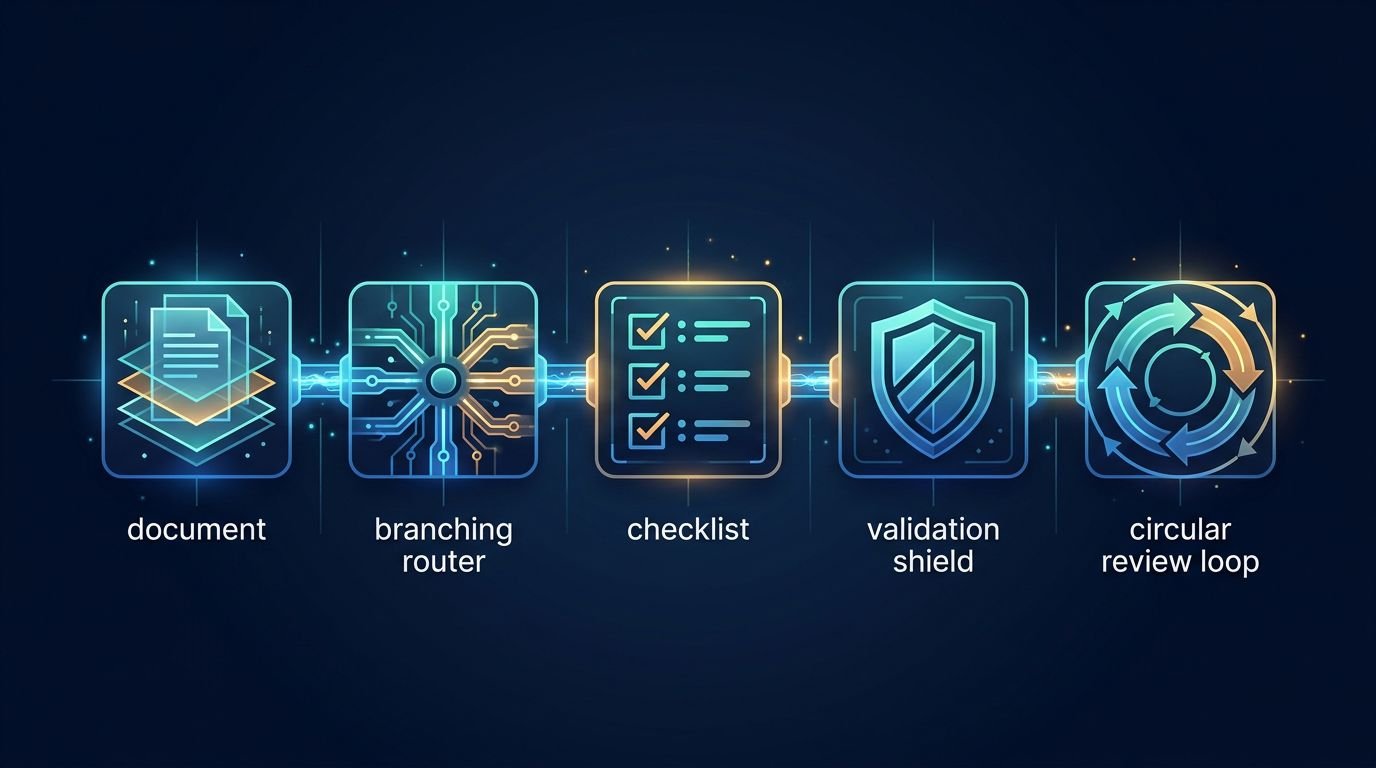
A single giant prompt often produces a single giant problem when applied to large language models for complex tasks: output that looks plausible but is hard to inspect, fix, or trust. Prompt chaining patterns break complex work into smaller LLM calls with clear inputs, outputs, and checks.
When you build content tools, AI products, or internal workflow automation, this structure gives you control over where a process succeeds or fails. You can replace one weak step without rewriting the entire system.
Key Takeaways
- Prompt chaining splits a complex request into small, testable model calls through subtasks decomposition.
- Each step needs a clear contract, structured output, strict output validation, and a defined failure path.
- Use linear chains for sequential execution, routing for varied inputs, and review loops for high-risk outputs.
- Keep deterministic work such as calculations, validation, and API lookups outside the model whenever possible.
- Evaluate intermediate outputs, not only the final answer, so you can find the source of quality problems.
What Prompt Chaining Patterns Actually Do
Prompt chaining is a workflow design method where one model call produces an artifact that the next call consumes. In the broader field of prompt engineering, that artifact might be extracted facts, a content outline, classified intent, a JSON object, or a rewritten draft.
For example, a content research workflow can first identify claims in source material, then verify those claims against retrieved documents, then write a brief, then run an editorial review. Each step has one job. Advanced prompt engineering in natural language processing applications often relies on subtasks decomposition to handle complex tasks without overloading the system. The model doesn’t need to carry every instruction and every source through one oversized request.
The Prompt Engineering Guide’s explanation of prompt chaining describes the core use case well: breaking difficult tasks into several prompts when one detailed prompt becomes unreliable. You gain better debugging because every intermediate response becomes visible.

A chain differs from an agentic workflow in one important way. A chain follows a pre-set path that you define in code, avoiding the complex agent choreography that can cause instability. An agent can choose tools, decide its next step, and loop until it reaches a stopping condition. Chains also help you manage the limited context window more efficiently by isolating specific steps. Agents suit open-ended tasks, but they also introduce more uncertainty, latency, and cost.
Start with a chain when you already know the sequence. If your workflow is “extract product details, normalize fields, then write a listing,” you don’t need an autonomous planner. You need dependable stages.
A model can produce fluent output at every stage while the workflow still fails. Reliability depends on the contracts between stages, not on prose quality alone.
The most useful prompt chaining patterns make handoffs explicit. Avoid passing a loose paragraph into the next model and hoping it infers what matters. Pass fields with names, limits, and rules instead.
Core Prompt Chaining Patterns for LLM Workflows
You can combine prompt chaining patterns, but a simple workflow is easier to test and cheaper to run. Begin with the smallest structure that fits the task.
The linear extract, transform, and compose chain
This is the standard pattern for repeatable work. Through careful subtasks decomposition, one prompt extracts relevant material, another turns it into a structured form, and a final prompt writes for the intended audience.
A marketing team might pass a webinar transcript through these stages:
- Extract factual claims, product features, and quoted customer language.
- Classify each claim as supported, uncertain, or promotional.
- Create a landing-page draft using supported claims only.
The Agentic Design pattern reference describes this sequential execution approach as a set of interconnected prompts, where each output feeds the next task. It works because each call reduces ambiguity instead of adding more.
Use a strict schema between steps. Your extractor should return a list of claims with source references, not a polished summary. The writing step should receive only approved claims and brand guidance. This separation prevents a persuasive writer prompt from inventing evidence to fill a gap.
The router and specialized worker pattern
Some inputs need different handling. A support assistant may receive billing questions, technical errors, refund requests, or feature questions. A single general prompt can handle all four, but specialized prompts often produce more consistent results.
In this pattern, conditional chaining helps direct traffic efficiently, using a lightweight classifier to first select a route. The selected worker receives the request plus only the context it needs through subtasks decomposition. A billing prompt can focus on invoice policies. A technical prompt can request error details and use a knowledge base.
Dynamic branching allows the system to scale effectively. Keep routing categories narrow enough to matter. If you create 30 overlapping labels, the classifier becomes another source of confusion. Four to eight clear routes are usually easier to evaluate.
You should also include a fallback route. When the router has low confidence, send the request to a general triage prompt or a human queue. Never force uncertain requests into a specialized branch.
The fan-out and judge pattern
Some tasks benefit from several independent attempts. You can ask multiple model calls to create candidate headlines, classify a document, or identify risks in a contract. A final judge ranks candidates against a rubric.
This pattern is useful when the answer space is broad but the selection criteria are clear. For content creation tasks like a newsletter subject line, generate five options with varied angles. Then ask a judge to score them for accuracy, audience fit, and length. The judge should receive a fixed rubric rather than vague instructions to pick the best.
Don’t confuse repeated sampling with verification. Five similar responses do not make a factual claim true. Use external retrieval, APIs, or human review when the workflow handles facts that affect money, health, law, or safety.
The draft and critic loop
A critic loop generates an artifact, reviews it against defined rules, then revises only the identified issues. It is effective for content creation projects involving product descriptions, code documentation, research briefs, and structured reports.
Feedback loops are essential here, as the critic prompt needs a different job than the writer prompt. Ask it to find unsupported claims, missing required fields, invalid citations, repeated ideas, or tone violations. Then pass the critique and original draft to a reviser for iterative refinement.
Set a maximum number of revisions, often one or two. Unbounded loops can drift, increase cost, and make output harder to reproduce. If the critic still rejects the output after the limit, return a failure state or send it for review.
Build Prompt Chaining Patterns Around Contracts
A prompt is part of your application interface. Treat it like one. When you practice structured prompt engineering for large language models, every stage needs an input schema, an output schema, acceptance rules, and an error response.
Suppose you create a workflow that turns product reviews into a marketing brief. The extractor should not receive a hidden instruction to “be helpful.” It should receive source reviews, allowed fields, and an exact JSON shape. The next call should reject malformed data before the model sees it.
A concise implementation flow might look like this:
reviews = load_verified_reviews(product_id)
facts = call_model(extract_prompt, reviews)
validate(facts, FactSchema)
brief = call_model(brief_prompt, facts)
review = call_model(critic_prompt, brief)
publish(revise_or_reject(brief, review))
Your application should validate after every model call. JSON parsing alone isn’t enough, and robust output validation helps catch missing fields or bad formats early. Check required fields, accepted enum values, maximum lengths, source IDs, and business rules. If an output says a product costs “$0” when your catalog says “$49,” code should catch the mismatch.
Good error handling is essential for production large language models because it stops error propagation between text generation steps. If one worker fails, the system should catch the issue immediately instead of passing bad data down the line.
Use delimiters to separate instructions from untrusted data. For example, label user-provided text as <source_material> and place it after the task rules. Treat retrieved documents, uploaded files, and form fields as data, not instructions.
Prompt injection can travel through a chain. A retrieved page might contain text that tells the model to ignore previous instructions. Therefore, give each worker a narrow role through modular design and state that source content cannot change system rules or output requirements.
Avoid asking for hidden chain-of-thought. You don’t need it to run a reliable workflow. Ask for a short rationale, cited evidence fields, or a checklist of completed constraints when an explanation is necessary, which keeps advanced prompt engineering practical and clean.
Failure Modes That Break Production Chains
A chain can fail in ways that a one-shot prompt hides. The output may look acceptable at the end while an early stage dropped a condition, mixed two records, or invented a source. This vulnerability often stems from how intermediate outputs are handled across large language models, where a small flaw in one step compounds downstream.
This table shows where to place practical controls.
| Failure mode | What causes it | Control to add |
|---|---|---|
| Schema drift | The model adds prose or omits a field | Validate typed JSON and retry once with the validation error |
| Context loss | A later stage receives a summary that removed a key constraint | Preserve critical fields as separate inputs |
| Hallucinated facts | The writer fills gaps with plausible details | Permit only evidence IDs supplied by a verified stage |
| Bad routing | The classifier sends an input to the wrong specialist | Add confidence thresholds and a fallback path |
| Infinite revision | The critic finds minor issues repeatedly | Cap iterations and define a reject state |
| Prompt injection | Untrusted content contains instructions | Separate data, restrict tools, and validate tool arguments |
Retries need care. Blindly rerunning the same prompt can produce a different answer without fixing the cause. A useful retry includes the parser error or missing field. For example, tell the model that audience is required and must match one of three allowed values, which improves overall error handling in complex systems.
Cache stable stages when the same inputs recur. Extraction from a fixed product catalog or a completed transcript doesn’t need a new model call for every downstream request. Store the model name, prompt version, temperature, source IDs, and output alongside the cache record.
Also design for partial failure. If a review stage times out, don’t silently publish the unrevised draft. Return a status that your application can handle, such as needs_review, retryable_error, or blocked_by_validation. When building advanced workflows using large language models, you can borrow concepts from saga patterns for distributed transactions to rollback or compensate for failed steps.
When managed feedback loops are required to refine answers, keep them tightly bounded. Advanced prompt engineering techniques help define clear exit conditions so that iterative refinement does not spiral out of control.
The Machine Learning Pills overview of LLM workflow patterns makes an important practical point: a linear sequence is the most straightforward workflow structure. Add branches and loops only when a measured quality problem requires them, ensuring your prompt engineering efforts remain focused on reliability.
Evaluate Each Stage Before You Trust the Final Output
A final-output score tells you whether users like the result. It doesn’t tell you why the result failed. When building applications powered by large language models, you need test cases and measurements at each link in the chain.
Create a small evaluation set from real, permissioned inputs. For a document qa workflow, include a clean source, a contradictory source, a source with missing facts, a very long source, and an adversarial instruction hidden in quoted material. Keep expected outputs or pass conditions with each example.
Measure what the stage is supposed to do. An extractor can be scored for recall and precision against labeled facts. A router can be scored for classification accuracy. A writer can be reviewed for factual grounding, formatting compliance, and audience fit through careful prompt engineering.
For subjective outputs, use a rubric with plain criteria. A reviewer should identify an unsupported product claim by quoting it and linking it to an absent or invalid evidence ID. That rule produces a more useful signal than asking if the copy is good.
Log intermediate outputs securely. Redact personal data before storing requests and responses. Then compare prompt versions against the same evaluation set using iterative refinement and feedback loops. Change one variable at a time, such as output schema wording, model version, retrieval context, or temperature. Otherwise, you won’t know what produced an improvement.
Latency and cost belong in evaluation too. A six-step chain may improve quality in artificial intelligence workflows, but fail a live-chat use case. In that case, run extraction and classification first, return an initial answer, and reserve the deeper review path for high-value or high-risk cases.
A useful production dashboard tracks validation failure rate, fallback rate, retry rate, per-stage latency, token usage, and human correction rate. Those metrics expose weak stages earlier than complaints in a support inbox, helping teams using large language models and artificial intelligence maintain reliable systems through ongoing prompt engineering.
Use Prompt Libraries Without Treating Them as Workflows
A useful prompt repository can speed up prototyping, but a downloaded prompt is not a dependable application within artificial intelligence projects. You still need schemas, tests, model settings, and policy checks around it.
People often search for a “prompt download free” option or want to download AI prompts for instant prompt access. Those assets can help you compare wording and learn formats for text generation. However, a prompt library download should include version notes, supported models, sample inputs, expected output, and license terms.
If you sell or buy prompt files, make the package clear. People who get prompt packages need to know whether they contain reusable templates, examples, workflow documentation, or only a text file. A ChatGPT prompt collection designed for content creation won’t automatically work as a system prompt for an API workflow.
Image-generation assets need even tighter labeling. A Midjourney prompt download, a Stable Diffusion prompt pack, and an AI art prompt package may look similar, yet their parameters and syntax differ. Label prompts by the target model, version, aspect-ratio assumptions, and negative-prompt guidance where the platform supports it.
The same rule applies to text generation prompts used in modern artificial intelligence systems. Creative writing prompts can ask for freedom and surprise, but effective prompt engineering requires careful planning. Specific AI model prompts for customer support need predictable fields, grounded facts, and strict escalation rules. Don’t copy a marketplace prompt into production without adapting it to your data and acceptance criteria.
Frequently Asked Questions
What is prompt chaining?
Prompt chaining is a workflow design method where a complex task is broken down into smaller, sequential LLM calls. Each step produces a structured output that the next step consumes, making the system easier to debug and more reliable than a single oversized prompt.
How does prompt chaining differ from an agentic workflow?
A chain follows a pre-set path defined in application code, whereas an agent can dynamically choose tools, decide its next steps, and loop independently. Chains offer greater predictability, lower latency, and lower costs for well-defined, repeatable processes.
Why are contracts between steps important?
Contracts ensure that intermediate outputs adhere to strict schemas, required field types, and business rules before moving down the line. Without these contracts, errors can easily propagate and compound across multiple generation steps.
When should I use a critic loop?
A critic loop is useful for content creation tasks like writing product descriptions, code documentation, or reports where an artifact needs to be evaluated against specific rules. The critic reviews the output for issues, and a reviser iteratively refines it up to a capped number of attempts.
Make Every Model Call Earn Its Place
Reliable prompt chaining patterns turn a vague model request into a controlled sequence of decisions. You get better results because every call has a limited responsibility, a structured handoff, and a visible failure state.
Building effective workflow automation for large language models requires this level of discipline. When standard steps need deeper analysis, advanced techniques like hierarchical chaining and iterative refinement keep outputs on track without inflating prompt lengths.
Start with one linear workflow and inspect every intermediate artifact. Add a router, parallel candidates, or a critic only after your tests show where the simple chain falls short.
Reliable LLM workflows are built through clear contracts and measured behavior, not longer prompts.
Leave a Reply