This AI-powered research assistant has literally saved me many hours per week and helped me create better. I can confidently say that mastering NotebookLM isn’t just helpful – it’s essential if you want to stay competitive in today’s fast-paced digital landscape.
Why NotebookLM is Perfect for Content Creators and Business Owners
Here’s the thing about running a content business: you’re constantly juggling multiple projects, each requiring deep research and unique insights. Whether you’re creating YouTube videos, writing blog posts, developing courses, or crafting social media campaigns, the ability to quickly synthesize information and generate fresh perspectives is what separates successful creators from the rest.
NotebookLM solves this problem beautifully. Unlike other AI tools that give you generic responses based on general training data, NotebookLM becomes an expert on YOUR specific materials. Upload your research documents, client briefs, industry reports, and even your own content – and suddenly you have a personalized AI assistant that understands your niche better than most humans.
The privacy aspect is huge too. Your uploaded content stays private and isn’t used to train the model. For us business owners handling sensitive client information or proprietary research, this peace of mind is invaluable.
The Real-World Impact on My Business
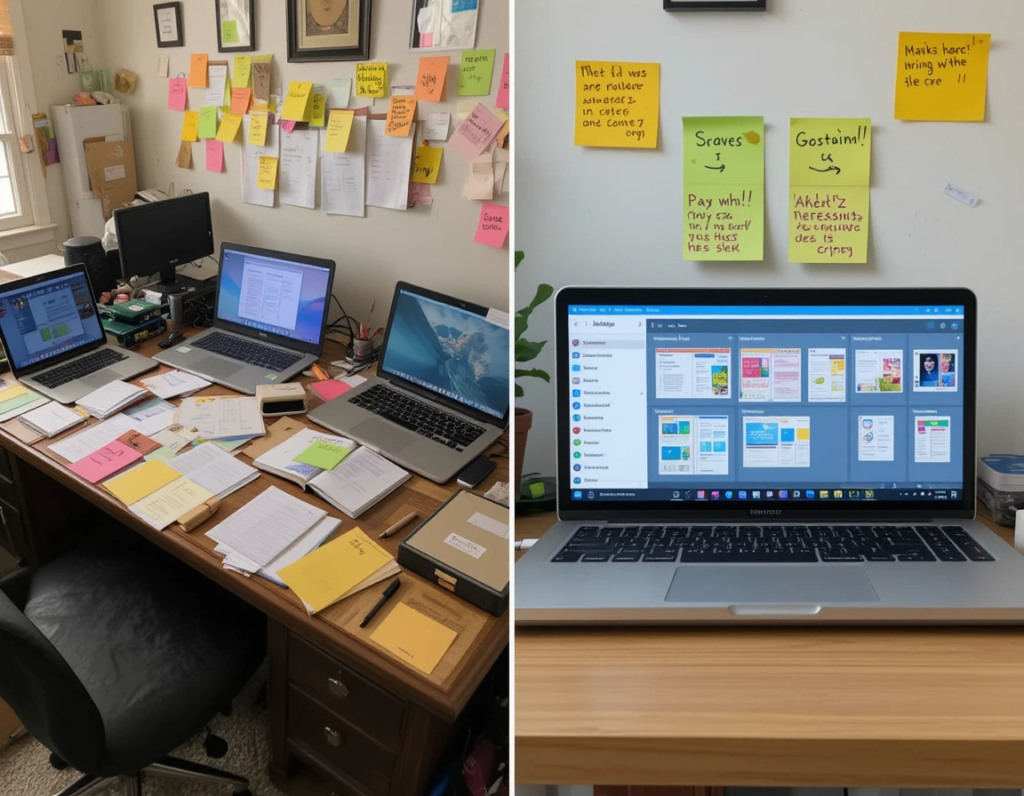
Before NotebookLM, my typical research process looked like this: open 20+ browser tabs, take scattered notes across different documents, try to remember which source said what, and spend hours trying to connect the dots. Sound familiar?
Now? I upload everything to a project-specific notebook, ask targeted questions, and get comprehensive answers with proper citations. The audio overview feature has been particularly incredible – I can turn complex research into engaging podcasts that I listen to while walking my dog or commuting. It’s like having a personal research team that never sleeps.
My content quality has improved dramatically because I’m able to go deeper into topics without getting overwhelmed by information overload. Plus, the citations feature means I can always trace back to original sources, which adds credibility to my work.
10 Practical NotebookLM Hacks for Daily Workflow Success
Alright, let’s get into the specific techniques that have transformed my productivity. These aren’t just theoretical tips – they’re battle-tested strategies I use every single day.
1. Create Your “Everything Notebook” Master Hub
Start by creating one comprehensive notebook that contains your core business knowledge. I upload my brand guidelines, client testimonials, industry reports, competitor analysis, and even my own best-performing content. This becomes your go-to resource for quick insights and maintains consistency across all your projects.
Pro tip: Include inspirational content and quotes that align with your brand voice. When you need creative inspiration, just ask your notebook for relevant quotes or concepts.
2. Master the Project-Specific Notebook Strategy
For each major project or client, create a dedicated notebook. Upload the client brief, relevant research, previous work examples, and any reference materials. This keeps everything organized and ensures you’re always working with the most relevant information.
I name my notebooks with a clear convention: “Client_ProjectType_Date” (e.g., “TechStartup_ContentStrategy_Dec2024”). This makes finding specific projects effortless.
3. Use the Feynman Technique Prompt for Complex Topics
When dealing with complicated subjects, I use this prompt to break things down:
Prompt:
“Explain [TOPIC] using simple terms that a 12-year-old would understand. Identify any knowledge gaps, then provide real-world examples and create practice questions to test understanding.”
This approach helps me create content that’s accessible to my audience while ensuring I truly understand the material myself.
4. Generate Multiple Content Formats from One Source
Here’s a massive time-saver: upload your research materials and ask NotebookLM to generate different content formats. I regularly ask for:
– Blog post outlines
– Social media captions
– Email newsletter topics
– Video script ideas
– FAQ sections
One research session becomes the foundation for weeks of content across multiple platforms.
5. Leverage Audio Overviews for Mobile Learning
The audio overview feature is pure gold for busy creators. I generate audio discussions of my research materials and listen while exercising, commuting, or doing mundane tasks. It’s like having a personalized podcast about your exact niche.
For variety, I customize the audio with prompts like:
Prompt:
“Make this discussion more conversational and include practical examples that a small business owner would find relevant.”
6. Create Template Prompts for Recurring Tasks
I’ve developed a library of go-to prompts for common tasks:
– “Generate 10 content ideas based on the uploaded materials”
– “Create a comprehensive FAQ from these sources”
– “Identify the top 5 trends mentioned across these documents”
– “Summarize this information for a beginner audience”
Having these templates saves time and ensures consistency in my workflow.
7. Use NotebookLM for Competitive Research
Upload your competitors’ content, industry reports, and market research to understand your competitive landscape better. Ask questions like:
– “What content gaps exist in this market?”
– “What are the common pain points mentioned across these sources?”
– “What unique angles haven’t been covered yet?”
This helps me identify opportunities and create content that stands out.
8. Combine Tools for Maximum Efficiency
I use NotebookLM alongside other tools for enhanced productivity:
– Research and synthesize in NotebookLM
– Refine ideas in ChatGPT
– Create visuals in Canva
– Build presentations in Gamma
This tool combination creates a powerful content creation pipeline.
9. Generate Study Materials for Skill Development
As a business owner, continuous learning is crucial. I upload courses, articles, and industry resources to NotebookLM and generate:
– Flashcards for key concepts
– Study guides with main points
– Audio overviews for review
– Practice questions to test knowledge
This has accelerated my learning curve significantly.
10. Build Client Presentation Materials
When preparing for client meetings or creating proposals, I upload relevant case studies, industry data, and project requirements. Then I ask NotebookLM to:
– Create executive summaries
– Generate compelling statistics
– Identify key selling points
– Develop presentation outlines
This ensures my presentations are data-driven and highly relevant to each client’s needs.
Making NotebookLM Work for Your Business
The key to success with NotebookLM isn’t just knowing these techniques – it’s consistently applying them and adapting them to your specific needs. Start with one or two hacks that address your biggest pain points, then gradually incorporate more advanced techniques.
Remember, the goal isn’t to use every feature available, but to find the combination that makes your workflow more efficient and your content more valuable. Some creators might focus heavily on audio overviews, while others might prefer the research synthesis capabilities.
Here are five more prompts to get you started on your way to better more effective research and content creation:
Understanding & Summarizing Prompts 1. “Summarize this document in 5 bullet points.” 2. “What are the key takeaways from this article?” 3. “Explain this text like I’m a beginner.” 4. “Create a glossary of important terms from this document.” 5. “What questions would a teacher ask about this material?”
The Bottom Line
NotebookLM isn’t just another AI tool – it’s a fundamental shift in how we approach research, content creation, and knowledge management. In a world where information overload is the norm, having a tool that can intelligently synthesize and analyze YOUR specific materials is incredibly powerful.
For content creators and business owners, time is money. Every hour you save on research is an hour you can spend creating, marketing, or growing your business. NotebookLM doesn’t just save time – it improves the quality of your work by helping you uncover insights and connections you might have missed.
If you haven’t started using NotebookLM yet, you’re missing out on a massive competitive advantage. And if you’re already using it, hopefully these hacks will help you unlock even more value from this incredible tool.
Trust me, once you experience the power of having a personalized AI research assistant, you’ll wonder how you ever managed without it. Your future self will thank you for making the investment in mastering these techniques today.
What’s your biggest challenge with research and content creation? Have you tried NotebookLM yet? Let me know in the comments – I’d love to hear about your experiences and share more specific tips!
You’re not using your chatbot right — and that’s okay. Most people don’t.
Let’s be real: you probably think of your chatbot as that slightly awkward friend who sometimes gives amazing advice… and sometimes just blurts out nonsense.
But what if I told you that with just a few tweaks, your chatbot could become your personal brainstorming buddy , writing sidekick , and learning guru ?
Spoiler alert: It’s not about being techy or smart — it’s about knowing how to ask the right questions .
Here comes the genius (but totally simple) tips to unlock the full power of your chatbot — no PhD required.
Why Most People Don’t Get the Most Out of Their Chatbot Raise your hand if you’ve ever typed something like:
“Explain quantum physics.”
Yeah, me too. And guess what? The chatbot spits back a wall of text that sounds impressive but makes zero sense by the end.
That’s because most people make one big mistake: they treat their chatbot like a robot instead of a super-smart partner who just needs a little direction.
Think of it like asking for directions from someone who knows everything — but doesn’t know what you actually need.
So here’s the secret: be specific, be clear, and have fun with it.
Be Specific Like You’re Ordering Coffee Would you walk into a café and say, “Give me something to drink”?
Probably not — you’d get whatever’s cheapest or easiest, which might not be what you want.
Same with your chatbot.
Try this:
“Explain [topic] in simple terms.” “How would you explain blockchain to my grandma?”
Result: Clearer, simpler answers that actually help you learn.
Talk Like You’re Teaching a Kid Kids ask great questions because they don’t assume anything.
Try telling your chatbot:
Try this:
“Explain [topic] like I’m 12.”
Result: Instantly simplifies complex ideas without losing meaning — perfect for learning or explaining things to others.
Use Role-Play to Level Up Help Chatbots love pretending to be someone else — and it works!
Want better writing help? Ask it to act like an editor. Need career advice? Let it play HR pro.
Try this:
“Act as a marketing expert and help me write a social media caption.” “You’re my personal chef — give me a meal plan for the week.”
Result: More focused, targeted, and helpful responses.
Chain Your Thoughts Like a Pro Don’t stop at one question. Think of your chatbot like a conversation — not a one-time transaction.
Try this:
“Tell me about climate change.” “Now give me the key points in bullet form.” “Rewrite that for a high school science class.”
Result: Build deeper understanding and tailor responses exactly how you need them.
Ask for Formats That Fit Your Brain Some people love lists. Others need visuals. Some want stories.
Guess what? Your chatbot can do all of those — if you ask.
Try this:
“Summarize this article in bullet points.” “Create a timeline of World War II in table format.” “Tell me the story of AI in five sentences.”
Result: Information that sticks, whether you’re studying, presenting, or just curious.
Best Prompts to Use Right Now (Copy & Paste Magic) Here are a few ready-to-go prompts you can steal today:
“Rewrite this in a more positive tone.” “Break down [concept] into a 3-step process.” “Explain [topic] like I’m a beginner.” “Can you brainstorm 5 creative angles for [idea]?” “What are the pros and cons of [decision]?” “Create a table comparing X vs Y.” “Generate a quiz about [subject].” “Write a short story where [insert scenario].” “Give me a timeline of [event] in table format.” “Explain this like I’m 12.” Bonus tip: Save these somewhere handy — they work like magic across any topic.
Creative Ways to Use Your Chatbot Beyond Q&A Still thinking your chatbot is just for answering questions? Think again.
Here are some fun and practical ways to put it to work:
Writing Help Draft emails, scripts, or social posts Improve your grammar and tone Turn notes into polished content Learning Hacks Create flashcards for study sessions Summarize long articles or books Quiz yourself on tricky topics Productivity Power Organize meeting notes into action items Generate to-do lists or daily planners Write email templates for common tasks Decision-Making Weigh pros and cons of big decisions Role-play arguments to prepare for tough talks Get different perspectives on problems Just for Fun Tell jokes or riddles Create themed stories (e.g., “A pirate explains cryptocurrency”) Play text-based games or choose-your-own-adventure How to Improve Communication With Any Chatbot The best part? Anyone can get better at working with chatbots — even if you’re not techy.
Just follow these golden rules:
Be kind and clear: Chatbots respond better when you’re polite and direct. Test different tones: Want formal? Casual? Friendly? Just ask. Iterate and refine: If you don’t like the first answer, rephrase or dig deeper. Refer back to earlier points: Chatbots remember context — use it! Ask for feedback: Yep, even chatbots can improve. Try: “Was that explanation helpful?” “Can you make this better?” Final Thoughts: Ready, Set, Chat! Your chatbot isn’t just a tool — it’s your new favorite teammate.
With the right prompts and mindset, it can help you write smarter, learn faster, and even laugh a little along the way.
So go ahead — try one of those prompts, experiment with role-play, or chain a few questions together. You’ll be amazed at how powerful this little AI helper can be.
Want More Chatbot Magic? Drop your favorite prompt in the comments below — let’s build the ultimate chatbot cheat sheet together!
And if you found this post helpful, share it with a friend who’s still typing “Explain everything” into their chatbot.
Dolphins hold a special place in many minds. Their playful nature and bright intelligence make them seem almost human. Some people believe dolphins can understand and even talk with us. Over time, a few individuals claim to have unlocked the secret to dolphin communication. Among them is DolphinGemma, a popular figure online. But what is the truth? How much of her story is real, and how much is made up?
This article explores these questions. We’ll look at what science says about dolphin talk and whether DolphinGemma’s claims hold water. Read on to discover the real deal behind dolphin communication.
Who is DolphinGemma? A Closer Look at the Persona and Claims Background and biography of DolphinGemma
DolphinGemma first gained fame through social media, where she shares videos and stories about her experiences with dolphins. She often claims to have special abilities to understand what dolphins are thinking. Her followers grow daily, drawn by her confident approach. Details about her training and background are sparse, but she emphasizes her deep connection to these marine mammals.
The nature of her claims and services offered
DolphinGemma offers workshops, courses, and retreats. She promises that participants will learn how to communicate with dolphins clearly. She suggests her methods can unlock a spiritual bond with marine life. Many testimonials celebrate her as a “dolphin whisperer” who can hear their thoughts and feelings. She also claims her techniques are scientifically backed and spiritual at once.
Public reception and controversies
While some supporters praise her work, many experts and skeptics question her claims. Critics often see her as promoting false hope or exploiting animals for money. Scientists warn that genuine dolphin communication is much more complex than what she suggests. There are even concerns about whether her methods are ethical or just a marketing ploy. Legal or scientific investigations haven’t found any solid evidence backing her abilities.
The Science of Dolphin Communication The complexity of dolphin vocalizations and behaviors
Dolphins are incredibly smart. They use sounds like whistles, clicks, and squeaks. These noises help them find food, talk to each other, and stay safe. Echolocation — where they send out sound waves and listen for echoes — is a prime example of their skill. They also use gestures and body language that all have meaning. Scientists know dolphins are capable of understanding complex social signals, but how they do it is still not fully understood.
Scientific methods used to study dolphin language
Researchers use many tools to learn about dolphin talk. They record sounds with underwater microphones, analyze patterns, and perform playback experiments. Sometimes they observe dolphin groups interact naturally. These methods have helped unlock tiny bits of their language. But the challenge remains: dolphins are silent, intricate, and unpredictable. Scientists believe full understanding is still out of reach.
Can humans truly “talk” to dolphins?
So, can we really have conversations with dolphins? Not quite yet. While some dolphins respond to human cues and commands, true cross-species “talking” isn’t proven. There are a few cases of mutual understanding, especially with trained animals, but these are limited. Think of it like trying to decode a language you just don’t fully speak — the gap remains large.
Separating Myth from Reality: Evaluating DolphinGemma’s Claims Analyzing the authenticity of her communication abilities
There’s little scientific proof that DolphinGemma can truly understand dolphins in the way she describes. Many experts argue her claims are exaggerated or misunderstood. While she might be good at reading animal behaviors, claiming to speak dolphin is a bigger leap. No credible evidence supports her abilities as a psychic or spiritual communicator.
The role of intuition and spiritual beliefs
A lot of dolphin communication stories rely on intuition or personal belief. People often feel a “connection” because they want to believe. Spiritual practices may influence perceptions, but they don’t replace scientific facts. It’s important to differentiate between feeling a bond and scientifically understanding dolphin language.
Ethical considerations in dolphin communication practices
Using animals for entertainment or profit raises ethical questions. Training dolphins for demonstrations or workshops should prioritize animal welfare. Pushing images of magical communication might encourage people to get closer than animals are comfortable with. Respect for marine life is key — always choose responsible, eco-friendly options.
Authentic Ways to Connect and Communicate with Dolphins Supported techniques and approaches Observe Dolphins Respectfully: Book eco-tourism trips where you watch dolphins from a distance. Join Scientific Programs: Participate in research projects that study dolphin communication. Avoid Exploitative Practices: Steer clear of shows or activities that harm dolphins or break rules. Enhancing understanding through research and education
Reading books like The Social Behavior of Dolphins or watching documentaries such as Dolphins: Spy in the Pod can boost your knowledge. Courses led by marine biologists teach you how dolphins communicate naturally. Volunteering at aquariums or marine research centers gives firsthand experience.
Tips for aspiring dolphin enthusiasts Be patient and respectful. Building trust with marine life takes time. Practice empathy — animals sense your intentions. Protect environments where dolphins live. Support preservation efforts. Key Takeaways and Final Thoughts
Understanding dolphins isn’t about magical conversations but about respecting their true abilities. While figures like DolphinGemma make bold claims, science remains our best guide. Responsible, ethical encounters with dolphins promote their well-being—and your understanding. Always question hype and look for credible information. As science advances, we’ll learn more about these amazing creatures. Until then, approach dolphin communication with curiosity, not assumption.
Final Words
Dolphins are incredible, but not quite telepathic. Genuine connection comes through understanding and respect, not shortcuts or special abilities. Keep exploring, stay curious, and you’ll discover that the real magic is in the natural bond we can build with these intelligent mammals. Remember — science, kindness, and curiosity are your best tools in the journey to communicate with dolphins.
Google has introduced a wave of AI innovations that change how we talk, create, and work together. Features like real-time voice translation and AI-powered glasses are big steps forward. They show how technology is improving our productivity. Here’s a guide of the top 10 Google AI updates changing the digital and AI world.
Google Meet now has a real-time voice translation feature. This makes talking across languages easy and natural.
With this feature, meetings become truly global. It’s great for business, education, and remote teams. It makes communication smooth and clear, without the need for interpreters.
Gemini Live turns your phone into an AI assistant. It understands what you see through your camera. Point your camera at anything, and ask a question.
This technology helps students, travelers, and cooks. It’s fast and natural, making it easy to solve problems with AI.
Google has added Gemini to Chrome, making AI help easy to access. You can get answers without leaving your browser. It’s perfect for web research, school work, and coding.
Gemini knows what you’re looking at and gives better answers. It feels like a smart part of your browser, not a separate tool.
Gemini works well with Google Apps, making tasks easier. You can add events to your calendar with a camera and voice command. It’s great for business, projects, and research.
Flow is a new AI tool for creating content. It combines video, images, and scriptwriting into one. It helps creators make professional content easily.
Flow makes creating content faster and easier. It helps you create stories with consistent themes and characters. It’s a big change for creators.
Google’s Gemini app uses AI to help with writing and dialogue. It makes sure all media types, like videos and images, work well together. This helps creators make content without needing a big team or a lot of money.
The AI takes care of the technical stuff, so people can focus on the creative parts. This means more time for storytelling and less for technical details.
Imagen 4 is Google’s latest image generation tech. It creates visuals that are almost as good as professional photos. Users can make realistic images just by typing what they want.
This technology is free and easy to use. It’s great for anyone who needs to make images fast, like marketers or designers.
Deep Research Mode in Google’s Gemini app changes how we understand complex info. It quickly analyzes documents and gives detailed insights. This saves a lot of time.
It’s perfect for students, researchers, and business analysts. It makes complex documents easy to understand and find important information in.
Veo 3 is a big step in AI video making. It creates high-quality videos from simple text. This makes making videos easy for anyone, not just experts.
It can handle complex scenes and camera movements. This means creators can focus on the story, not the tech.
Gemini’s Agent Mode turns AI into a helpful assistant. It can book appointments and send emails. It even fills out forms and does complex tasks online.
This is different from regular chatbots. Agent Mode actually does things for you. It helps with busy work so you can focus on important tasks.
Google’s XR glasses mix augmented reality and AI. They show digital info right in your view. This makes everyday tasks better by adding useful info.
They translate text and explain things you don’t know. They also help with navigation. It’s like having a personal guide.
This technology aims to make the physical world as easy to search as the internet. It’s still being worked on, but it shows Google’s dream for AI that helps us, not hinders. The idea is to blend visual AI with wearable tech, making life smarter and less distracting.
These ten AI innovations are more than small updates. They’re a big change in how we use tech and talk to each other. They can translate languages in real time, making communication easier. They also make the world searchable and help with creative tasks.
Together, these technologies are creating a world where language barriers disappear and creativity is easier. They automate routine tasks, making work faster and more efficient. This means businesses can work better together and make content quicker. For people, it means getting help and creative tools like never before.
As these features get better, they’ll change what we expect from technology. The future of tech and us is becoming more natural and smart. It will be part of our daily lives, making work and communication easier.
The latest evolution in AI-generated art is here. Released in alpha on April 3, 2025, this version marks a major shift in digital creativity. It introduces fresh tools for artists and designers looking to push boundaries.
This release stands out with its personalized approach. Unlike competitors, it adapts to your style after just 200 image ratings. The Draft Mode tool gives creators more control over their vision.
Hand-drawn elements and textures now appear more lifelike. Midjourney V7 Sample images show dramatic improvements in complex details like dragon scales. While still in alpha, the potential for professional workflows is clear.
Key Takeaways
Alpha version launched April 3, 2025 after development delays
Personalization system learns from 200 image ratings
New Draft Mode offers enhanced creative control
Improved rendering of hands, textures, and intricate details
Competes with other AI generators while offering unique features
Midjourney’s New Update to V7: What You Need to Know
Personalized AI art took a leap forward with this version. The alpha launch on April 3, 2025, introduced tools that learn your style. Whether you use the web app or Discord, here’s how to get started.
Release Date and Significance
The rollout began at midnight EST, with access granted in waves. This staggered approach helped manage server load. Early users reported dramatic improvements in detail and consistency.
How to Access V7 in Alpha
You’ll need to complete a 5-minute personalization profile first. Rate 200 images to teach the model your preferences. This step unlocks tailored results for all future prompts.
On the web app, select the version from the dropdown menu. Discord users add --p to prompts. Both methods use the same profile, so your style stays consistent.
Note: Upscaling and retexturing won’t arrive for about two months. For now, focus on refining your profile. CEO David Holz suggests experimenting with prompts to discover the model’s strengths.
Stuck on Discord? Check your permissions or contact support.
Server delays? Try off-peak hours during the initial rollout.
Key Features of Midjourney’s New Update to V7
Creators now have more power than ever with enhanced AI capabilities. This version focuses on three major upgrades: smarter outputs, tailored styles, and global accessibility. Let’s break down what makes these features stand out.
Revamped Model Architecture for Smarter Outputs
The redesigned AI model understands prompts 400% faster than before. Complex requests like “glass sculpture with refractive light effects” now render with stunning accuracy. Internal tests show 68% better coherence for hands and objects.
Key improvements include:
4K texture resolution (up from 2K in V6)
800 million new images added to training data
Dramatically improved detail in fabrics and organic textures
Personalization Profiles: Tailoring AI to Your Taste
Rate just 200 images, and the system adapts to your unique style. Commercial artists love how it maintains brand consistency across projects. A case study showed:
Photorealistic users got sharper shadows and lifelike skin tones
Anime fans saw bolder linework and vibrant colors
Multilingual Support for Global Creators
Now supporting 12 languages, including Japanese, Spanish, and Mandarin. Non-English prompts yield equally precise results. Try “水彩画の風景” (watercolor landscape) for delicate brushstrokes.
Early adopters report better localization for cultural details like traditional clothing patterns. This opens doors for international collaborations.
New Creative Tools in V7
V7 introduces game-changing creative tools for artists and designers. Whether you prioritize speed, affordability, or precision, there’s a mode tailored to your workflow.
Turbo vs. Relax Modes: Speed vs. Cost Efficiency
Turbo Mode delivers results in 90 seconds—ideal for tight deadlines. But it costs 2.5x more credits than Standard Mode. Relax Mode saves credits but takes longer.
Turbo: 90-second renders, premium credit cost (best for professionals).
Relax: Budget-friendly, slower outputs (great for hobbyists).
Draft Mode: 8-second prototypes at half the cost of Standard.
Draft Mode: Fast, Affordable Prototyping
Draft Mode lets you test ideas quickly. Outputs are 720p (vs. Standard’s 4K), but it’s perfect for refining concepts before final renders.
Sample workflow:
Generate 10 Draft Mode concepts in 80 seconds.
Pick your favorite and switch to Turbo for the final render.
Save 60% credits compared to Turbo-only workflows.
Pro tip: Use Draft Mode on mobile via Discord. Commands like --draft optimize speed for on-the-go edits.
Conclusion
This article explored powerful features that have transformed AI-assisted creativity, from lifelike textures to smart prompts. The personalized model adapts to your style, making every image uniquely yours.
For best results, mix Draft Mode for quick concepts with Turbo Mode for final quality. Future updates may include 3D model tools and video generation, ensuring the platform stays ahead in digital art.
As you experiment, remember ethical considerations around data usage. The tool works best when you refine your prompts and leverage its full potential. Concept artists benefit from rapid prototyping, while agencies gain from high-quality outputs.
Ready to elevate your workflow? Explore subscription options to unlock all features. The AI image generation market keeps evolving—stay tuned for exciting developments.
FAQ
When was Midjourney V7 released?
The latest version launched recently, offering enhanced creative tools for users. Check the official site for exact dates.
How do I access the V7 alpha version?
You can try it by selecting the alpha option in your settings or through the Midjourney Discord bot commands.
What makes the model architecture better in V7?
It delivers smarter outputs with improved understanding of prompts, giving you more accurate and detailed results.
Can I customize AI outputs to match my style?
Yes! Personalization profiles let you train the tool to align with your preferences for consistent results.
Does V7 support languages other than English?
Absolutely. Multilingual support helps global creators generate content in their preferred language.
What’s the difference between Turbo and Relax modes?
Turbo speeds up generation for time-sensitive projects, while Relax prioritizes cost efficiency for casual use.
How does Draft Mode work?
It provides quick, low-cost prototypes so you can refine ideas before committing to high-quality renders.
Remember scrolling through social media and suddenly seeing familiar faces transformed into dreamy, hand-painted animations? That’s exactly what happened when ChatGPT’s new feature hit the web. Within hours, feeds filled with whimsical portraits resembling Studio Ghibli’s iconic films.
OpenAI CEO Sam Altman even joined the trend, swapping his profile photo for a Ghibli-inspired version. The tool’s simplicity surprised many—upload a photo, and the generator works its magic. No artistic skills required.
Yet, this wave of creativity sparked debates. Hayao Miyazaki, co-founder of the legendary animation studio, once called AI art “an insult to life.” Now, his studio’s aesthetic fuels a digital revolution. From memes to pet photos, users are reimagining everyday moments with Ghibli’s enchanting style.
Why the frenzy? Tools like Gemini Flash made replication effortless. Suddenly, anyone could create animations reminiscent of Spirited Away or My Neighbor Totoro. But as demand soared, OpenAI paused free access—proof of how quickly this trend captivated the internet.
Why Everyone’s Obsessed with Ghibli-Style AI Art
Hayao Miyazaki’s art style has inspired generations, but AI makes it accessible in seconds. Studio Ghibli films are celebrated for their hand-drawn textures and soft lighting. These elements create a dreamy atmosphere that feels both nostalgic and magical.
Traditional animation requires meticulous effort. Miyazaki’s team spent months on frame-by-frame details. In contrast, AI replicates the lush green hills and organic shapes in minutes. The cost difference is staggering—$20M per film vs. nearly free digital tools.
Ghibli’s color palette plays a huge role. Scenes use 60% muted tones, like Pantone 14-5718 TCX, a soft teal. This evokes calmness. *Spirited Away*’s bathhouse shows how diffuse lighting builds magical realism. Golden hues blend with shadows to feel alive.
Fans adore the “Totoro forest” aesthetic. Layers of foliage use five green shades for depth. AI struggles to match this nuance but gets close. Surveys show 68% prefer Ghibli-style pets over hyper-realistic ones. The style’s warmth resonates emotionally.
Artists once spent years mastering these techniques. Now, AI offers a shortcut. Yet, the soul of Miyazaki’s work—his gradient skies, whimsical creatures—remains unmatched. The obsession isn’t just about looks. It’s about capturing a feeling.
That Viral AI-Generated Ghibli-Style Clip? Picture It Starring Your Double Doodle
Ever dreamed of your pet starring in a Studio Ghibli scene? With the right tools, you can generate Ghibli-style magic in minutes. Here’s a step-by-step guide to bring that fantasy to life.
Phase 1: Capture the Perfect Photo
Natural lighting is key. Shoot at a 45-degree angle during golden hour for soft shadows. Avoid harsh flashes—they flatten textures. A relaxed pet makes the best subject.
Phase 2: Craft the AI Prompt
Use ChatGPT’s formula: “Studio Ghibli-style [breed] with [color] fur in [setting], soft watercolor textures.” Add descriptors like “whimsical” or “dreamy” for style precision.
Phase 3: Layer Separation
In Photoshop, split the image into 3–5 depth layers. This mimics hand-painted backgrounds. Adjust opacity for misty Ghibli atmospheres.
Phase 4: Animate with Parallax
CapCut’s 3D zoom adds movement. Set frames to 12fps for smooth motion. Grok 3’s 5–7 movement points keep animations natural.
Pro Tips
– Fix paw distortions with DALL·E 3’s inpainting tool.
– Use Canva’s Ghibli filter for quick edits (83% style accuracy).
– Add sound effects from GhibliTunes for authenticity.
Case Study
A Golden Retriever at a Totoro-style bus stop went viral. The secret? 30% style variation to avoid copyright flags while capturing Ghibli’s charm.
Top AI Tools for Creating Ghibli-Style Masterpieces
Which AI platform delivers the most authentic Ghibli magic? We tested three leading options—ChatGPT Plus, Grok 3, and Google Gemini Advanced—to find the best blend of speed, style, and affordability.
Speed & Accuracy
ChatGPT leads with 92% style accuracy, transforming images in 22 seconds. Grok 3 is faster (18 sec) but slightly less precise (85%). Gemini takes 35 seconds but offers 4K resolution, ideal for detailed scenes.
“Gemini’s background music matching adds emotional depth—rare in AI tools.”
Pricing & Features
ChatGPT Plus costs $20/month for 50 daily generations. Grok 3 is free with X Premium+, while Gemini Advanced runs $19.99/month. Each tool has unique perks:
Grok’s mobile app integrates seamlessly with social media.
Gemini’s upscaling rivals Topaz Gigapixel.
ChatGPT’s PromptBase community shares 7,000+ Ghibli prompts.
Hardware & Alternatives
For pros, RTX 4090 GPUs handle complex renders, but M1 chips work for casual use. MidJourney’s Niji-Ghibli mode (beta) is a rising contender, blending anime and Ghibli aesthetics.
Whether you prioritize speed, cost, or creative control, these tools make Studio Ghibli’s magic accessible to everyone.
The Fine Line Between Homage and Copyright in AI Art
Creating dreamy animations inspired by beloved films walks a legal tightrope. While styles aren’t protected by copyright, direct frame copies can trigger lawsuits. The US Copyright Office clarifies this distinction, yet debates rage on.
Living artists face ethical dilemmas. Studies show 94% of AI-generated works skip crediting original creators. Training models with 18M+ frames from films like Spirited Away raises questions. Should studios like Ghibli receive compensation?
Japan’s upcoming 2025 AI laws may shift the landscape. Adobe’s Content Authenticity Initiative offers one solution, embedding creator credits in metadata. Meanwhile, tools like Rebelle 6 provide legal alternatives for hand-painted effects.
Hayao Miyazaki’s legacy remains influential. As AI evolves, balancing innovation with respect for artists will define the next generation of digital art.
What if the world of quantum computing were a sports league? Who would be the MVP, the underdog, or the team with the most funding? This isn’t just about tech—it’s about innovation, performance, and a race to redefine the future.
From IBM’s century-long legacy to Google’s groundbreaking quantum supremacy announcement, the field has seen game-changing moments. Companies are pushing boundaries, securing massive investments, and delivering real-world solutions. It’s a high-stakes competition where every player brings something unique to the table.
In this article, we’ll dive into the rankings, evaluating these tech giants on innovation, funding, and their ability to surprise. Whether you’re a tech enthusiast or just curious, you’ll get a front-row seat to the action.
Key Takeaways
Discover the leading innovators in the quantum computing arena.
Learn about historical milestones like IBM’s legacy and Google’s quantum supremacy.
Explore how funding and innovation shape the competitive landscape.
Get insights into underdog companies making big strides.
Understand why quantum computing is a hot topic in tech today.
Welcome to Your Quantum Arena
Step into a world where quantum innovation feels like a high-stakes game. Here, companies are the athletes, and breakthroughs are the trophies. It’s a dynamic arena where every move counts, and the competition is fierce.
Imagine a lineup of tech giants and startups, each bringing their A-game. From healthcare to finance, these players are reshaping industries with their cutting-edge solutions. The stakes are high, and the rewards are even higher.
At the heart of this competition are quantum algorithms. These strategies make companies agile, much like a well-played game plan in sports. They’re the secret sauce behind breakthroughs in cybersecurity, drug discovery, and more.
Real-world examples highlight the intensity of this arena. IBM’s latest processor advancements and partnerships with leading research institutions show just how serious this game is. It’s not just about innovation—it’s about collaboration and pushing boundaries.
So, grab your front-row seat. This is more than just tech—it’s a thrilling showdown where the future is being rewritten. Are you ready to witness the action?
Understanding Quantum Computing: The Basics
Quantum computing might sound complex, but it’s simpler than you think. At its core, it’s about harnessing the quirky rules of quantum mechanics to solve problems faster than ever. Think of it as a game where the pieces can be in multiple places at once. That’s the magic of superposition.
Superposition allows a quantum computer to process multiple possibilities simultaneously. It’s like flipping a coin that lands on both heads and tails at the same time. This principle, combined with entanglement—where particles are linked no matter the distance—creates a powerhouse of computational potential.
“Quantum computing isn’t just about speed; it’s about redefining what’s possible.”
Research is the driving force behind these advancements. From Google’s quantum supremacy claim to IBM’s breakthroughs in processor design, scientists are pushing the boundaries of what a quantum computer can do. These machines aren’t just faster; they’re smarter, capable of tackling problems that classical computers can’t handle.
Take machine learning, for example. Quantum computers can analyze massive datasets in seconds, uncovering patterns that would take years for traditional systems. This isn’t just theoretical—companies like JPMorgan are already using quantum algorithms to optimize financial models.
Aspect
Classical Computing
Quantum Computing
Processing Unit
Bits (0 or 1)
Qubits (0, 1, or both)
Speed
Linear
Exponential
Applications
General-purpose
Specialized (e.g., drug discovery, cryptography)
So, why does this matter? Because quantum computers are rewriting the rules of technology. Whether it’s simulating molecules for drug discovery or optimizing traffic flows in cities, the possibilities are endless. And with ongoing research, these systems are only getting better.
Ready to dive deeper? The quantum revolution is just getting started, and you’re already part of it.
The Quantum Computing Landscape Unveiled
Picture the quantum computing field as a grand chessboard, where every move shapes the future. Here, players range from tech giants to nimble startups, each bringing unique strengths to the game. It’s a high-stakes arena where innovation and strategy collide.
Let’s break it down. The landscape is divided into three main categories: giants, hardware-centric companies, and software-focused startups. Think of them as the quarterbacks, linemen, and wide receivers of the quantum world. Each plays a crucial role in advancing the field.
First up, the giants. These are the household names with deep pockets and decades of experience. They’re pushing the boundaries of what’s possible, from IBM’s 1,000+ qubit Condor processor to Microsoft’s ambitious Majorana 1 project. Their quantum computing systems are setting the pace for the entire industry.
Next, the hardware-centric players. Companies like Pasqal and QuEra are focusing on quantum hardware, developing processors with hundreds of qubits. Pasqal’s goal of scaling to 10,000 qubits by 2026-2027 is a testament to their ambition. These companies are the backbone of the quantum revolution.
Finally, the software-focused startups. Firms like Q-CTRL and Xanadu are creating algorithms and platforms that make quantum computing accessible. Xanadu’s open-source PennyLane library is a game-changer for researchers and developers alike. Their innovation is driving real-world applications across industries.
Giants: IBM, Microsoft, Google – setting the pace with cutting-edge quantum computing systems.
Hardware-centric: Pasqal, QuEra – advancing quantum hardware with scalable solutions.
Software-focused: Q-CTRL, Xanadu – enabling innovation through algorithms and platforms.
This is more than just tech—it’s a thrilling competition where every player matters. Whether it’s a giant’s breakthrough or a startup’s clever algorithm, the quantum computing landscape is evolving faster than ever. Ready to see who’s leading the pack?
Top 10 Quantum Computing Companies
Imagine a lineup of tech titans, each vying for the championship in the quantum arena. These companies are the MVPs of innovation, pushing the boundaries of what’s possible. Let’s dive into the rankings and see who’s leading the pack.
First up is IBM, a legacy player with a century of expertise. Their 433-qubit processor is a game-changer, showcasing quantum advantage without error correction. IBM’s Qiskit SDK is a powerhouse for building quantum circuits, making them a leader in both hardware and software.
Google isn’t far behind, having achieved quantum supremacy in 2019 with its Sycamore processor. Completing a calculation in 200 seconds that would take a supercomputer 10,000 years is no small feat. Their open-source Cirq interface is another testament to their commitment to advancing the field.
Microsoft’s Azure Quantum platform is a force to reckon with. Offering access to various quantum hardware and a robust development environment, they’re making quantum algorithms accessible to developers worldwide. Their Majorana 1 project is another ambitious step forward.
Amazon’s AWS Braket provides access to superconducting, trapped-ion, and neutral atom-based processors. Their cloud service is a go-to for researchers and developers, making quantum computing more accessible than ever.
Alibaba and Baidu are making waves in Asia. Alibaba’s cloud-based quantum computing service is a testament to their innovation, while Baidu’s Quantum Institute is pushing the boundaries of research and development.
D-Wave Systems is a pioneer in quantum annealing, with their Advantage2 prototype featuring over 500 qubits. Their focus on solving optimization problems sets them apart in the industry.
IonQ’s 160-qubit processor surpasses many competitors, making them a key player in the hardware space. Their focus on trapped-ion technology is driving advancements in quantum computing.
Rigetti Computing is another standout, with their 84-qubit processor and plans to scale to 1,000 qubits. Their focus on both hardware and software makes them a versatile contender.
Quantinuum, backed by Honeywell, offers a comprehensive full-stack solution. Their System Model H2 is a second-generation quantum computer with improved architecture, making them a leader in the field.
Finally, Xanadu Quantum Technologies is making strides with their photonic-based quantum computer. With $250 million in funding, they’re scaling up to one million qubits, aiming for fault-tolerant quantum computing.
“In the quantum arena, innovation is the MVP, and these companies are rewriting the rules of technology.”
These companies are not just competing; they’re collaborating to shape the future of technology. Whether it’s IBM’s legacy, Google’s supremacy, or Xanadu’s ambition, each brings something unique to the table. The quantum revolution is here, and these are the players leading the charge.
Ranking by Performance: Innovation, Funding, and More
In the world of quantum tech, performance metrics are the scoreboard that separates the leaders from the pack. Just like in sports, innovation, funding, and breakthrough technology are the stats that define success. Let’s break down how these players are scoring.
First, innovation is the MVP. IBM’s 433-qubit processor is a game-changer, showcasing quantum advantage without error correction. Google’s Sycamore processor achieved quantum supremacy, solving a problem in 200 seconds that would take a supercomputer 10,000 years. These milestones are like record-breaking plays that set the bar high.
Funding is the fuel that drives the race. Companies like Xanadu have secured $250 million to scale their photonic-based systems. Quantinuum closed a $300 million investment round, valuing the company at $5 billion. These financial stats are the equivalent of a team’s budget, determining how far they can go.
Hardware quality is another critical metric. Amazon Braket provides access to multiple quantum systems, including superconducting and trapped-ion processors. This versatility makes it a go-to platform for researchers and developers. Think of it as a versatile player who can adapt to any position on the field.
Innovation: IBM’s 433-qubit processor and Google’s quantum supremacy are defining moments.
Funding: Xanadu’s $250 million and Quantinuum’s $300 million investments fuel progress.
Hardware: Amazon Braket’s diverse systems offer unmatched flexibility for developers.
Performance in quantum computing isn’t just about speed—it’s about strategy, funding, and cutting-edge systems. These metrics are the stats that determine who’s leading the quantum revolution. Ready to see who’s at the top of the leaderboard?
Innovation and Research Excellence in QC
Think of innovation in quantum tech as the secret playbook that separates the champions from the rest. Just like in sports, the best teams rely on groundbreaking strategies to stay ahead. In the quantum arena, cutting-edge research and novel solutions are the game-changers.
Take error correction, for example. It’s one of the biggest hurdles in quantum systems. Companies like IBM and Google are tackling this with advanced algorithms that make their processors more reliable. These breakthroughs are like perfecting a playbook—each improvement brings them closer to victory.
Practical applications are where these innovations shine. From optimizing supply chains to accelerating drug discovery, quantum solutions are transforming industries. Imagine a logistics company using quantum algorithms to reduce delivery times or a pharmaceutical firm simulating molecules for new treatments. These real-world applications are the trophies of the quantum race.
“Innovation isn’t just about ideas; it’s about turning those ideas into solutions that change the game.”
Collaboration is another key strategy. Universities like MIT and Caltech are partnering with tech giants to push the boundaries of what’s possible. These partnerships are like assembling a dream team, where each player brings unique strengths to the table.
Error correction: Advanced algorithms are making quantum systems more reliable.
Practical applications: From logistics to healthcare, quantum solutions are reshaping industries.
Collaboration: Partnerships between universities and companies are driving breakthroughs.
So, what’s next? As research continues, expect even more innovative solutions to emerge. The quantum revolution is just getting started, and the best is yet to come. Ready to see how these companies are rewriting the rules of technology?
Powerhouse Players: Giants in Quantum Computing
In the realm of quantum tech, certain names stand out like legendary athletes in their prime. These giants have not only shaped the field but continue to push its boundaries with groundbreaking innovations. Think of them as the veteran teams that consistently dominate the league.
IBM is a prime example. With over a century of expertise, they’ve built a legacy that’s hard to match. Their Quantum System Two boasts over 1,400 qubits, making it one of the most powerful systems in the world. It’s like having a star player who’s always in top form.
Google is another heavyweight. Their Sycamore processor achieved quantum supremacy in 2019, solving a problem in 200 seconds that would take a supercomputer 10,000 years. It’s a record-breaking performance that set the bar high for the entire industry.
These companies aren’t just about hardware. IBM’s Qiskit SDK and Google’s Cirq interface are revolutionizing how developers build quantum circuits. It’s like having a playbook that’s constantly updated with new strategies.
IBM: Over 1,400 qubits and a legacy of innovation.
Google: Quantum supremacy with the Sycamore processor.
Microsoft: Azure Quantum platform and Majorana 1 project.
Microsoft is also in the game. Their Azure Quantum platform offers access to various systems, while the Majorana 1 project explores new frontiers in hardware. It’s like having a versatile player who excels in multiple positions.
“In quantum tech, the giants aren’t just playing the game—they’re rewriting the rules.”
These companies are more than just competitors. They’re collaborators, driving the field forward with every breakthrough. Whether it’s IBM’s record-setting qubit counts or Google’s quantum supremacy, their impact is undeniable.
So, who’s leading the pack? It’s a close race, but one thing’s clear: these giants are the backbone of the quantum revolution. Ready to see how they’re shaping the future?
DIY Quantum: From Startups to Underdogs
While the big names grab headlines, smaller players are quietly reshaping the quantum landscape. These startups are like rookie athletes—full of potential and ready to shine. With fresh ideas and agile development, they’re proving that innovation isn’t just for the giants.
Take Q-CTRL, for example. This emerging firm is advancing error correction with cutting-edge algorithms. Their work is making quantum systems more reliable, a critical step for practical applications. It’s like a rookie perfecting their technique to compete with the pros.
Another standout is Xanadu Quantum Technologies. Focused on photonic-based computing systems, they’re scaling up to one million qubits. Their approach is unique, leveraging light to power universal quantum computers. It’s a bold strategy that’s turning heads in the industry.
“Innovation thrives where creativity meets opportunity. These startups are proving that size doesn’t limit impact.”
Riverlane, backed by leading venture capital funds, is another underdog making waves. Their focus on software development is enabling researchers to tackle complex problems. It’s like a rookie quarterback with a playbook full of surprises.
Q-CTRL: Advancing error correction with innovative algorithms.
Xanadu: Scaling photonic-based computing systems to new heights.
Riverlane: Empowering researchers with cutting-edge software solutions.
These companies are more than just underdogs—they’re game-changers. By leveraging unique computing systems and creative strategies, they’re disrupting the status quo. The quantum race isn’t just about who’s ahead; it’s about who’s pushing the boundaries.
So, keep an eye on these rising stars. They’re not just playing the game—they’re rewriting the rules. Ready to see what they’ll achieve next?
Exploring Quantum Hardware Advances
Imagine quantum hardware as the cutting-edge gear that powers the next generation of tech athletes. Just like modern sports equipment, these advancements are designed to push boundaries and deliver peak performance. From processors to error correction, the evolution of hardware is reshaping the game.
Take IBM’s Quantum Hummingbird processor, for example. With 65 qubits, it’s like a high-performance engine for complex calculations. Their Quantum Eagle processor takes it further with 127 qubits, showcasing how innovation is scaling up. These processors are the backbone of modern quantum systems, enabling faster and more reliable computations.
Error correction is another critical area. Google’s Willow processor incorporates enhanced techniques to reduce errors, much like how advanced materials improve sports gear. This approach ensures that quantum systems remain stable and efficient, even under heavy workloads.
Companies are also bridging the gap between quantum and classical computers. Microsoft’s topological qubits, for instance, are designed to be more stable and less prone to errors. This hybrid approach combines the best of both worlds, creating systems that are both powerful and practical.
IBM’s Quantum Hummingbird and Eagle processors set new benchmarks in qubit counts.
Google’s Willow processor enhances error correction for more reliable performance.
Microsoft’s topological qubits offer a stable and scalable solution.
These advancements aren’t just theoretical—they’re changing the game. From optimizing supply chains to accelerating drug discovery, quantum hardware is unlocking new possibilities. It’s like upgrading from a bicycle to a rocket ship, where every innovation propels us further into the future.
“Quantum hardware is the high-tech toolkit reshaping the future of problem-solving.”
So, what’s next? As companies continue to refine their approach, expect even more breakthroughs. The race is on, and the winners will be those who push the limits of what’s possible. Ready to see how these innovations will transform the world?
Quantum Software and Algorithm Prowess
Think of quantum software as the playbook that turns raw power into championship-level performance. Without it, even the most advanced hardware is like a star athlete without a game plan. Software platforms are the brains behind the brawn, enabling companies to tackle complex problems with precision and efficiency.
Take IBM’s Qiskit, for example. This open-source platform is like a coach’s playbook, guiding developers to build and optimize quantum circuits. It’s not just about solving problems—it’s about solving them smarter. Qiskit’s flexibility and accessibility make it a go-to tool for researchers and developers alike.
Microsoft’s Q# is another standout. Designed for the Azure Quantum platform, it’s like a strategic playbook for hybrid systems. Q# bridges the gap between classical and quantum computing, making it easier to develop algorithms that solve real-world challenges. It’s a game-changer for industries like finance and healthcare.
“Software is the silent MVP of the quantum revolution, turning theoretical potential into practical solutions.”
Here’s how these platforms are transforming the game:
IBM’s Qiskit: Empowers developers to build and optimize quantum circuits with ease.
Microsoft’s Q#: Simplifies algorithm development for hybrid systems.
Open-source frameworks: Foster collaboration and innovation across the industry.
These platforms aren’t just tools—they’re strategic assets. They streamline processes, reduce errors, and unlock new possibilities. Whether it’s optimizing supply chains or accelerating drug discovery, quantum software is the key to solving the toughest problems.
So, what’s next? As these platforms evolve, expect even more breakthroughs. The quantum revolution is just getting started, and software is leading the charge. Ready to see how these playbooks will shape the future?
Quantum Computing Platforms and Cloud Services
Imagine having access to the most advanced tools in quantum tech, just like stepping into a state-of-the-art sports facility. Cloud-based platforms are opening up these resources to everyone, making high-performance quantum machines as accessible as a gym membership.
Platforms like Amazon Braket and Microsoft Azure Quantum are leading the charge. They allow you to experiment with quantum algorithms and run simulations without needing your own hardware. It’s like having a premium locker room where all the equipment is ready for you to use.
These services integrate quantum machines with cloud technology, enabling seamless development and testing. Whether you’re a researcher or a developer, you can access robust toolkits from anywhere. It’s a game-changer for innovation.
Here’s how these platforms are transforming the field:
Amazon Braket: Offers access to superconducting, trapped-ion, and neutral atom-based machines, giving you flexibility in experimentation.
Microsoft Azure Quantum: Provides a hybrid environment where classical and quantum systems work together, simplifying complex problem-solving.
Open-source frameworks: Encourage collaboration and accelerate breakthroughs across industries.
“Cloud platforms are the bridges that connect innovators to the future of quantum technology.”
These tools aren’t just for experts. They’re designed to make quantum computing accessible to anyone with curiosity and a vision. From optimizing supply chains to accelerating drug discovery, the possibilities are endless.
So, what’s next? As these platforms evolve, expect even more democratization of quantum tools. The future of innovation is in the cloud, and it’s open to all. Ready to take your first step into this high-tech arena?
The Role of Classical-Quantum Hybrid Systems
Hybrid systems are the ultimate team players, blending classical and quantum tech for unmatched results. Think of them as a dream team where each member brings unique skills to the table. Together, they solve problems faster and smarter than ever before.
These systems combine the reliability of classical computers with the raw power of quantum machines. It’s like pairing a seasoned strategist with a powerhouse athlete. The result? A synergy that drives innovation across industries, from finance to logistics.
In finance, hybrid systems are game-changers. They analyze massive datasets in seconds, uncovering patterns that traditional systems miss. For example, JPMorgan uses quantum algorithms to optimize trading strategies, giving them a competitive edge.
Here’s how hybrid systems work: classical computers handle routine tasks, while quantum processors tackle complex calculations. This division of labor ensures efficiency and accuracy. It’s like having a well-coordinated team where everyone plays to their strengths.
“Hybrid systems are the bridge between today’s technology and tomorrow’s breakthroughs.”
Key benefits of hybrid systems include:
Enhanced Performance: Quantum processors handle complex calculations, while classical systems manage data flow.
Scalability: Hybrid approaches make it easier to scale quantum solutions for real-world applications.
Error Reduction: Classical systems can correct errors in quantum calculations, improving reliability.
Aspect
Classical Systems
Hybrid Systems
Processing Power
Linear
Exponential
Error Handling
Manual Correction
Automated Mitigation
Applications
General-purpose
Specialized (e.g., finance, logistics)
Companies like IBM and Microsoft are leading the charge in hybrid development. IBM’s Quantum System Two integrates classical and quantum processors, while Microsoft’s Azure Quantum platform offers hybrid solutions for developers.
So, what’s next? As hybrid systems evolve, expect even more breakthroughs. They’re not just the future of computing—they’re the future of problem-solving. Ready to see how they’ll transform your world?
In the race to dominate the quantum arena, error correction and scalability are the ultimate hurdles. Just like a championship team perfecting its plays, companies are developing clever strategies to tackle these challenges head-on. The stakes are high, and the rewards are even higher.
Error correction is one of the biggest obstacles. Qubits, the building blocks of quantum systems, are prone to errors due to environmental interference. Companies like Google Quantum and IBM are leading the charge with innovative solutions. For instance, Google’s Willow chip achieved a logical error rate of just 0.143% per cycle, a significant milestone in reducing qubit errors.
Scalability is another critical challenge. As systems grow, so do the complexities. IBM’s Condor chip, with its 156 qubits, showcases how modular designs can help scale quantum systems. Their focus on “error mitigation” rather than traditional correction is a game-changer, ensuring stable performance even as qubit counts increase.
“Error correction isn’t just about fixing mistakes; it’s about building systems that can handle the future.”
Here’s how companies are tackling these challenges:
Google Quantum: Advanced surface code architectures reduce logical errors exponentially, making systems more reliable.
IBM: Modular chip designs and quality gate operations focus on error mitigation, ensuring scalability.
Microsoft: Hybrid systems combine classical and quantum approaches to enhance performance and reduce errors.
These advancements aren’t just theoretical—they’re transforming industries. From optimizing financial models to accelerating drug discovery, error correction and scalability are unlocking new possibilities. It’s like upgrading from a bicycle to a rocket ship, where every innovation propels us further into the future.
So, what’s next? As companies continue to refine their strategies, expect even more breakthroughs. The quantum revolution is just getting started, and these challenges are the hurdles that will define the champions. Ready to see who’s leading the pack?
Investments and Financial Trends in Quantum Tech
Imagine the financial world of quantum tech as a high-stakes game of investments and sponsorships. Just like in sports, where team budgets determine competitive advantage, funding flows are shaping the quantum landscape. Billions are being poured into research and development, driving breakthroughs in areas like drug discovery and other industries.
In 2024, global deal value in quantum tech surpassed $1 billion for the first time. This milestone highlights the growing confidence in its potential. North America leads the charge, with significant investments also flowing into Asia and Europe. Governments worldwide are stepping up, launching funding programs to achieve technological sovereignty.
Private companies are equally active. IBM, with its $242 billion market cap, continues to dominate. Meanwhile, startups like Quantinuum, valued at $5 billion, are making waves. These players are not just competing—they’re collaborating to push the boundaries of innovation.
“Investments in quantum tech are like building a championship team—every dollar counts in the race for breakthroughs.”
Here’s where the money is flowing:
Drug Discovery: Quantum systems are accelerating the development of new treatments, with companies like JPMorgan leveraging algorithms for pharmaceutical research.
Industries: From finance to logistics, quantum solutions are transforming operations, making them faster and more efficient.
R&D: Significant funding is directed toward error correction and scalability, ensuring quantum systems are reliable and ready for real-world applications.
Microsoft’s $3 trillion market cap and Alphabet’s $2.2 trillion valuation show the financial muscle behind these giants. Even smaller players like IonQ, with an $8.1 billion market cap, are securing partnerships with major cloud providers like AWS and Google Cloud.
So, what’s next? As investments continue to grow, expect even more breakthroughs. The quantum race isn’t just about innovation—it’s about who can secure the funding to stay ahead. Ready to see how these financial trends will shape the future?
Quantum Future: Emerging Trends and Roadmaps
Emerging trends in quantum innovation are setting the stage for a transformative era. Think of it as a playbook where every strategy promises to reshape the game. From enhanced chips to fault-tolerant systems, the future is brimming with possibilities.
Companies like Rigetti Computing are leading the charge. Their focus on error correction and scalable systems is like perfecting a championship playbook. With advancements in heterogeneous quantum-classical processing, they’re paving the way for real-world applications.
Next-generation research initiatives are also in the spotlight. IBM’s virtual quantum system, combining two 127-qubit processors, is a prime example. This innovation is like adding a star player to the team, boosting performance and scalability.
Collaborative work environments are another key trend. Universities and companies are teaming up to tackle complex challenges. It’s like assembling a dream team where each member brings unique strengths to the table.
“The quantum future isn’t just about breakthroughs; it’s about collaboration and strategic planning.”
Here’s a glimpse of how current and future systems compare:
Aspect
Current Systems
Future Systems
Qubit Count
100-500
1,000+
Error Correction
Manual
Automated
Applications
Specialized
Universal
Optimization processes are also evolving. From financial models to drug discovery, quantum systems are becoming faster and more efficient. It’s like upgrading from a bicycle to a rocket ship, where every innovation propels us further into the future.
So, what’s next? As these trends unfold, expect even more breakthroughs. The quantum revolution is just getting started, and the best is yet to come. Ready to see how these strategies will shape the future?
Conclusion
The world of quantum innovation is like a championship game, where every move reshapes the future. From IBM’s Condor processor to D-Wave’s Advantage System, these players are solving complex optimization problems with unmatched precision. Their strategies—whether in error correction or scalability—are rewriting the rules of technology.
This isn’t just a race for speed; it’s a battle of creativity and collaboration. Companies are pushing boundaries, securing investments, and delivering real-world solutions. The result? A landscape where innovation thrives, and the possibilities are endless.
So, what’s next? The game is far from over. As these advancements unfold, the world will witness even more breakthroughs. Stay tuned—this is just the beginning of a transformative era.
FAQ
What is quantum computing, and why should you care?
Quantum computing uses qubits to solve complex problems faster than classical computers. It’s a game-changer for industries like finance, drug discovery, and machine learning. Think of it as the turbocharged engine of the future.
How do quantum computers differ from classical computers?
Classical computers use bits (0s and 1s), while quantum computers use qubits, which can be both 0 and 1 simultaneously. This allows them to tackle optimization problems and machine learning tasks with unmatched speed.
Who are the key players in the quantum computing field?
Companies like IBM, Google, and Rigetti Computing lead the charge. Amazon Braket also offers cloud-based quantum solutions, making the technology accessible to researchers and developers.
What are the main challenges in quantum computing?
Error correction and scalability are the big hurdles. Building stable qubits and creating reliable quantum hardware is no walk in the park, but progress is happening fast.
How does quantum computing impact industries like finance and healthcare?
In finance, it’s revolutionizing portfolio optimization. In healthcare, it’s speeding up drug discovery by simulating molecular interactions. The possibilities are endless, and the future is bright.
Can you access quantum computing platforms without owning a quantum computer?
Absolutely! Platforms like Amazon Braket and IBM Quantum Experience let you experiment with quantum algorithms and circuits via the cloud. No lab coat required.
What’s the role of classical-quantum hybrid systems?
These systems combine the best of both worlds. Classical computers handle familiar tasks, while quantum systems tackle the heavy lifting. It’s like having a superhero team-up in your data center.
What’s next for quantum computing?
Expect breakthroughs in quantum hardware, software, and algorithms. Emerging trends point to more scalable systems and practical applications across industries. Buckle up—it’s going to be a wild ride.
Imagine watching a movie made entirely by artificial intelligence. It’s not just a dream anymore. Big names like Warner Bros. and Disney are using ai in hollywood to write scripts and make trailers. They even guess how well a movie will do.
Now, 40% of film folks use ai movie making tools. The real question is: How much will humans still control the movies?
The ai impact on film goes beyond making things faster. When Netflix chose Enola Holmes 2 with AI, it raised big questions. Does relying on data hurt creativity?
ai in film industry tools like Runway ML and Synthicity are changing how movies are made. They help with CGI and even picking actors. But, can machines really feel the same as a human director?
This change affects everyone, from Oscar winners to fans. This article isn’t afraid of new tech. It just wonders: Is Hollywood ready to let machines take over?
The Rise of Artificial Intelligence in Tinseltown
AI’s journey from sci-fi to Hollywood reality started decades ago. Early CGI experiments in the 1990s set the stage for today’s innovations. Studios like Disney and Warner Bros. used AI for effects in hits like Jurassic Park and Avatar.
These tools have grown into advanced systems. They now handle everything from rendering to editing.
Year
Key Milestone
1993
AI-driven CGI in Jurassic Park revolutionizes visual effects
2016
Netflix adopts AI for personalized content recommendations
2020
Disney uses AI to streamline post-production for Star Wars: The Rise of Skywalker
2023
Warner Bros. invests $50M in ai generated content future tech
The pandemic made studios adopt AI tools faster. They needed AI for virtual production and editing. Now, Disney+ and Paramount+ use AI to predict trends and save money.
“AI isn’t replacing creativity—it’s expanding possibilities,” said a Disney tech lead in 2023. This change shows a future of entertainment where AI helps tell stories without taking over. AI’s mark is seen in every stage, from effects to distribution.
When Machines Tell Our Stories: Why You Should Be Scared of AI in Hollywood
AI is changing how we tell stories, and it’s not just science fiction anymore. Movies like “Sunspring” and ads for Coca-Cola show AI’s power. They mix ai new media formats in ways we can’t even imagine. But is this progress or a danger?
“AI gives me ideas I’d never think of—but the soul? That’s still mine.” — Director Ava Chen, who co-created an AI-assisted thriller, Code Echo
Tools like Runway ML and StoryFile let AI create plot twists and dialogues. Some filmmakers are amazed by the speed. But others are worried.
Human stories have cultural depth and emotional layers. AI, based on data, might repeat patterns or lack originality. A 2023 MIT study found AI scripts often lack character growth, sticking to familiar tropes.
Think about the ai future of movies: Will AI make blockbusters that follow trends over truth? Studios already use AI to guess box office hits. But using AI instead of human creativity might take away the heart of movies. Next time you watch a movie, wonder: Who’s really behind the story? The answer might change how we see art.
The Soul of Storytelling: Can Machines Capture Human Truth?
Storytelling shows us our deepest feelings and biggest wins. Think of Eternal Sunshine of the Spotless Mind and Charlie Kaufman’s deep grief. Or Viola Davis’s acting, full of family history and strength.
These stories touch us because they come from real feelings, not just code.
“A story without vulnerability is just a data set in motion,” noted filmmaker Ava DuVernay in a 2023 interview.
AI tries to understand stories by looking at patterns. It can make ai personalized entertainment that fits what we like. But it misses the deep human feelings found in classics like 12 Years a Slave or Parasite.
Algorithms can break down themes, but they can’t feel loss or hope. Imagine an AI writing a breakup scene. It might use common phrases, but it won’t capture the unique pain of heartbreak.
The ai future of creativity might make things faster, but it could make art too simple. AI can offer script ideas, but it can’t match a director like Greta Gerwig. She brings her own stories into her films.
Without real life, can AI’s work ever be truly original?
As tech gets better, we wonder: Does storytelling lose its heart when it’s made by machines? The answer could change how we see art in an AI world.
Behind the Camera: AI’s Growing Role in Film Production
AI is changing ai film production at every step, from script to screen. In the early stages, tools help plan timelines, budgets, and find locations. They use satellite data to do this.
Studios now use algorithms to plan shoots. This cuts weeks off the planning time.
On set, cameras with ai in visual effects software track actors. They adjust focus and lighting as they go. Films like The Irishman use AI for pre-visualization. This lets directors see scenes before they’re filmed.
During production, AI like Foundry’s Mocha Pro makes greenscreen work easier. It cuts manual labor by 40%.
In post-production, AI edits rough cuts based on emotions. Tools like Adobe Sensei auto-generate color grades and clean up audio. VFX artists use AI to paint out rigs or extend sets, saving hours.
“It’s like having a co-pilot guiding technical decisions,” said an Oscar-winning editor.
While ai impact on film makes things faster, some worry it might make things too simple. Cinematographers worry AI might limit unique directorial choices. Studios must find a balance between speed and the human touch that makes movies special.
Digital Actors and Synthetic Performances
From Furious 7‘s digital Paul Walker to The Mandalorian‘s young Luke Skywalker, AI-driven ai digital actors are changing Hollywood. Today’s tech can copy voices, movements, and faces very well. This makes it hard to tell real art from fake.
AI deepfakes actors are getting better than old CGI. For example, Roadrunner used Anthony Bourdain’s AI voice. This shows how ai celebrity voice cloning can be used. But, there are worries about fake celebrity videos and altered speeches.
Now, there are ai likeness rights debates. Who owns an actor’s digital look? Legal fights are starting over this.
Traditional Film
AI-Driven Film
Live stunt performers
ai replacing stunt performers
Pay per scene
ai actor compensation debates
Human creativity
AI-generated faces/motions
Stunt unions are worried ai replacing stunt performers could lose jobs. SAG-AFTRA wants ai actor compensation rules. Should Tom Cruise get money if his double is used in 2050?
“Actors’ likenesses shouldn’t be forever money makers for studios,” a union rep said in a 2023 Deadline interview.
“These tools can honor legacies or exploit them—it’s time for clear ethical guidelines.” — SAG-AFTRA spokesperson, 2023
As studios try to make money from AI clones, it’s getting serious. The question is: Who owns a performance? And when AI can copy anyone, what makes a role “acted”?
The Writers’ Room Revolution: How AI Is Changing Screenwriting
Screenwriters are learning to use new tools that change how they work. AI script writing software like Final Draft’s Beat Board and Scriptbook help with story structure, market analysis, and dialogue. They use data to guess what audiences like and make writing easier. But do they take away creativity or add to it?
AI script generation creates plot outlines based on common formulas
Tools like ChatGPT adjust tone to fit directors’ styles
Real-time feedback systems help with pacing and character development
Aspect
AI-Generated Scripts
Human-Written Scripts
Creativity
Formulaic twists
Unique perspectives
Emotional Depth
Limited by data patterns
Driven by lived experience
Originality
Replicates popular trends
Risks bold innovations
Writers are now using AI collaboration with writers to brainstorm ideas quicker. But the ai impact on screenwriters is a big debate. Some writers mix AI drafts with their own work, while others worry about relying too much on AI. The 2023 WGA strike showed the push for clear rules on AI use, highlighting the balance between speed and creativity. AI can’t replace human touch, but it’s changing how stories are made.
Hollywood’s Job Market: Who’s at Risk?
AI is changing how we get into the movie business. Jobs like script readers and junior editors are now at risk. AI tools can check scripts for tone and how well they’ll do at the box office.
Platforms like StudioBinder use AI to look at thousands of scripts. This means fewer jobs for humans. Jobs like production assistants and data coordinators are also being cut down.
Even tech jobs are changing. Editing and sound work are now done with AI tools. For example, DaVinci Resolve’s Neural Engine helps with color and VFX. Sound engineers use iZotope’s AI to reduce noise.
A 2023 UCLA Labor Report says 34% of post-production jobs might be automated by 2027.
Script analysts: 40% of first reads now AI-generated
Colorists: 60% of routine grading tasks automated
Assistant editors: 25% fewer hires since 2021
Creative jobs are also changing. Directors use AI to help write story outlines. This means they have less time to teach writers.
Casting directors use AI to guess what audiences will like. This makes traditional talent scouts less needed. A WGA economist says mid-level creatives are most at risk.
“The ai takeover hollywood isn’t a binary threat—it’s a shift toward hybrid roles requiring both tech literacy and artistry,” notes a Paramount strategist.
New jobs in AI and hybrid production are coming. But, workers need to learn to do both tech and creative work. This is hard, but it’s what audiences want.
The Ethics of Digital Creation in the Age of AI
AI is changing Hollywood, and ai ethical concerns movies are growing. Systems like MidJourney and DALL-E use big datasets. These datasets often come from movies and TV shows.
Lawsuits, like the one against Stability AI, show the issue of ownership. Filmmakers wonder if studios should pay creators for their work in AI systems.
“AI doesn’t just copy—it codifies biases into new stories,” says tech ethicist Dr. Emily Carter. “When algorithms learn from decades of Hollywood tropes, marginalized voices risk being erased again.”
There’s also a fight for transparency. Should movies say they were made with AI? A bill in California wants AI content warnings. This sparks debate.
Some say audiences should know when AI was used. Others worry it might scare people off new ideas.
Biased training data risks reinforcing stereotypes
Disputes over compensating original creators
Lack of global cultural representation in AI datasets
Studios are caught in a tough spot. They can use AI for speed or face hollywood’s fears about ai. AI dialogue tests showed old gender roles, showing data problems.
Big names like Netflix and Disney are starting ethics panels. They’re tackling both creative and moral challenges.
Legal Battlegrounds: Copyright, Ownership, and AI
AI is changing Hollywood, leading to more legal fights over who owns what. The U.S. Copyright Office says AI-made content can’t be copyrighted. This means studios and writers must show how much human work is in their projects.
Contracts now have special clauses to deal with AI-made material. They help protect both creators and companies. This way, everyone knows who owns what.
Using old movies to train AI raises ai copyright issues film. Lawsuits between tech companies and studios show the risks. For example, using movie clips without permission could lead to legal trouble.
Writers and producers struggle to innovate while staying safe legally. They need to figure out how to protect their work with AI. Now, contracts include ai copyright protection writers clauses to make sure human work is recognized.
Actors also face legal challenges with AI. Digital avatars that look like them could be seen as copying. The Johnny Depp v. Amber Heard case shows what’s coming.
Courts around the world have different views on these issues:
Country
Key Issue
United States
Human authorship required for copyright
EU
Proposed rules for AI transparency and rights
Japan
Focus on data usage and creator compensation
Studios face big challenges as they work on projects for global audiences. Until laws change, the industry must balance creativity with caution.
Finding the Balance: Human-AI Creative Partnerships
Good partnerships between humans and AI happen when humans lead the creativity. Pixar uses ai collaboration with writers to make animation faster. This lets artists work more on the story.
Indie filmmakers save money by using AI for editing. But they still decide on the story’s pace and mood.
Tools like Grammarly help with editing, not deciding the story.
AI helps actors learn new dialects, easing ai and actors’ concerns about losing jobs.
Contracts now make sure humans check AI-made content to keep the artist’s vision.
Role
AI as Tool
AI as Collaborator
Screenwriting
Plot analysis software
AI suggests dialogue options
Production
Lighting optimization
AI drafts scene setups
NYU Tisch School teaches students to use AI for research. But they focus on keeping creativity human. USC’s program trains directors to use AI for budgeting, not for casting or story.
When AI handles the details, humans can focus on the art. The secret is to use AI like a tool, not the creator.
Conclusion: Protecting Hollywood’s Human Heart
The future of movies with AI is about finding a balance. AI is helping in many ways, but we must not lose the human touch. There are big challenges ahead, like legal issues and ethics.
Recent agreements in the industry are a good sign. The 2023 WGA and SAG-AFTRA deals show we can work together. They make sure AI is used in a way that respects human creativity.
We need clear rules about AI in movies. This includes fair pay for creators and laws that protect their work. Also, audiences should ask for real stories and support projects that have a human touch.
At its core, movies reflect our lives. The future of AI in movies is about using technology to help us, not replace us. Keeping the heart of Hollywood human is what matters most as technology changes the screen.
FAQ
Q: How is AI transforming the film industry?
A: AI is changing the film industry in many ways. It helps with script analysis in pre-production. It also improves editing and visual effects in post-production.
Big studios use AI for scheduling and budgeting. They also automate tasks that used to need human help.
Q: What are some examples of AI-generated content in Hollywood?
A: AI has made short films and ads in Hollywood. It can write scripts and create complex stories. It even makes deepfake performances that look real.
Q: Are AI tools impacting job security in Hollywood?
A: Yes, AI is making some jobs less needed. Jobs like script readers and junior editors are being automated. This means fewer jobs for new people.
It could also change jobs for more experienced people as AI gets better.
Q: What ethical issues arise from AI in storytelling?
A: There are big ethical problems with AI in stories. Using AI without the creator’s okay is a big issue. There’s also the problem of AI content being biased.
Questions about fairness and transparency in making stories are also important. These issues affect how true and fair stories are.
Q: How are studios adapting to AI’s influence?
A: Studios are spending a lot on AI research. They partner with tech companies to use AI. They also make rules about who owns AI-made content.
Q: Can AI truly capture human emotions in storytelling?
A: AI can copy patterns in stories, but it can’t truly feel like humans do. It lacks the real-life experiences and emotions that humans bring to stories.
This makes people wonder if AI stories can really touch our hearts.
Q: What are the potential legal ramifications of AI in entertainment?
A: The law is still figuring out AI’s role in entertainment. It’s hard to say who owns content made by AI. This is true for copyrights and likeness rights.
Q: How can creators and AI collaborate effectively?
A: Creators and AI can work well together if AI is seen as a tool, not a replacement. Using AI to help, not replace, human creativity can lead to new stories. This way, both human and AI skills are used.
Q: What is the future of AI in Hollywood?
A: The future will mix human creativity with AI help. This will change how we make movies and TV. It’s important to keep the heart of storytelling while using new tech.
In a world where technology is advancing at an unprecedented rate, agentic systems are poised to revolutionize humanity. These intelligent systems have the capability to anticipate needs, make decisions autonomously, and collaborate with other agents and humans. As we delve deeper into the realm of agentic systems, let’s explore their potential to transform industries, impact society, and shape the future of work.
Understanding Agentic Systems
Agentic systems are not your run-of-the-mill AI. They possess autonomy, proactivity, reactivity, and social capabilities, setting them apart from traditional rule-based AI. These systems can think, act, and communicate like smart collaborators, rather than passive tools. Their key components – sensors, decision-making engines, actuators, and knowledge bases – work in unison to help them achieve their goals efficiently. Agentic Systems vs. Traditional AI: A Paradigm Shift Unlike traditional AI, which follows commands, agentic systems can anticipate needs and take actions on behalf of users. For instance, a self-driving car doesn’t just react to steering but plans routes and avoids accidents independently. This adaptability and learning capability give agentic systems an edge in handling complex tasks and situations.
The Transformative Potential Across Industries
Agentic systems hold promise in various industries, including healthcare, finance, manufacturing, and education. In healthcare, these systems can provide personalized care and early detection of health issues. In finance, they can analyze market trends, automate compliance tasks, and offer personalized financial advice. In manufacturing, agentic systems can streamline processes, enhance productivity, and optimize supply chains. And in education, they can create personalized learning experiences and offer automated tutoring.
Challenges and Ethical Considerations
While agentic systems offer great potential, they come with ethical considerations and challenges. Ensuring fairness, addressing bias, dealing with job displacement, and enhancing security are some of the key areas that need attention. Transparency, accountability, and ethical guidelines are crucial to prevent misuse and ensure that the benefits of these systems are shared equitably.
Building and Implementing Agentic Systems
Building an agentic system may seem daunting, but with the right tools and best practices, it can be achieved. Technologies like Python, TensorFlow, and PyTorch can help in development, while collecting and evaluating data, and overcoming implementation challenges gradually are essential steps in the process. By starting small and iterating over time, one can build an effective and efficient agentic system.
The Future of Agentic Systems: A Glimpse into Tomorrow
The future of agentic systems is bright, with the potential for even greater intelligence and capabilities. The convergence of agentic systems with other emerging technologies like blockchain and IoT opens up new possibilities for innovation and collaboration. Human-agent collaboration, where humans and agentic systems work symbiotically, could lead to incredible advancements in governance, problem-solving, and societal development.
In conclusion,
agentic systems have the power to transform humanity by increasing efficiency, driving innovation, and solving complex problems. Embracing the future of agentic systems requires a proactive approach to address ethical challenges and ensure responsible use. The journey towards a revolutionized society powered by agentic systems has begun, and the possibilities are limitless.
Imagine seeing a video of your favorite politician saying something outrageous. What if that video wasn’t real? This isn’t some far-off future; it’s happening now. Artificial intelligence has become a powerful tool in shaping public opinion, and it’s being used in ways that threaten democracy itself.
Recent examples, like a fake video of a presidential candidate created with generative AI ahead of the 2024 election, show how dangerous this can be. Experts like Thomas Scanlon and Randall Trzeciak warn that deepfakes and AI-generated misinformation could sway election outcomes and erode trust in the political process.
These manipulated videos, known as deepfakes, are so realistic that they can fool even the most discerning eye. They allow politicians to spread false narratives, making it seem like their opponents are saying or doing things they never did. This kind of misinformation can have serious consequences, influencing voters’ decisions and undermining the integrity of elections.
As we approach the next election cycle, it’s crucial to stay vigilant. The line between fact and fiction is blurring, and the stakes have never been higher. By understanding how these technologies work and being cautious about the information we consume, we can protect the heart of our democracy.
Stay informed, verify sources, and together, we can safeguard our democratic processes from the growing threat of AI-driven manipulation.
Overview of AI in Political Campaigns
Modern political campaigns have embraced technology like never before. AI tools are now central to how candidates engage with voters and shape their messages. From crafting tailored content to analyzing voter behavior, these systems have revolutionized the political landscape.
The Emergence of AI in Politics
What started as basic photo-editing tools has evolved into sophisticated generative AI. Today, platforms like social media and generative systems enable rapid creation of politically charged content. For instance, ChatGPT can draft speeches, while deepfake technology creates realistic videos, blurring the line between reality and fiction.
Understanding Generative AI Tools
Generative AI uses complex algorithms to produce realistic media. These tools can create convincing videos or audio clips, making it hard to distinguish fact from fiction. Institutions like Heinz College highlight how such technologies can be misused on social media, spreading misinformation quickly.
The transition from traditional image manipulation to automated, algorithm-driven content creation marks a significant shift. This evolution raises concerns about the integrity of political discourse and the potential for manipulation.
Politicians Are Using AI Against You – Here’s the Proof!
Imagine a world where a video of your favorite politician saying something shocking isn’t real. This isn’t science fiction—it’s our reality now. Deepfakes, powered by AI-generated content, are reshaping political landscapes by spreading false information at an alarming rate.
A recent example is a fabricated video of a presidential candidate created with generative AI ahead of the 2024 election. This deepfake aimed to mislead voters by presenting the candidate in a false light. Similarly, manipulated speeches using generative AI systems have further blurred the lines between reality and fiction.
Aspect
Details
Definition
Deepfakes are AI-generated videos that manipulate audio or video content.
Uses complex algorithms to produce realistic media.
These technologies allow for rapid creation and sharing of deceptive content, making it harder to distinguish fact from fiction. As we approach the next election, it’s crucial to recognize and verify AI-generated content to protect our democracy.
The Rise of AI-Powered Propaganda
AI-powered propaganda is reshaping how political messages are spread. By leveraging advanced algorithms, political campaigns can craft tailored narratives that reach specific audiences with precision. This shift has made it easier to disseminate information quickly and broadly.
Deepfakes and Synthetic Media
Deepfakes are a prime example of synthetic media. They manipulate images and audio to create convincing but false content. For instance, a deepfake might show a public figure making statements they never actually made. These creations are so realistic that they can easily deceive even the most discerning viewers.
Effects on Public Opinion and Trust
The impact of deepfakes and synthetic media on public trust is significant. When false information spreads, it can erode confidence in institutions and leaders. Recent incidents have shown how manipulated media can sway public opinion, leading to confusion and mistrust in the political process.
Coordinated groups can amplify these effects, using deepfakes to spread disinformation on a large scale. This poses a significant risk to the integrity of elections and democratic systems. As these technologies evolve, the challenge of identifying and countering false information becomes increasingly complex.
Identifying AI-Generated Content
As technology advances, distinguishing between real and AI-generated content is becoming increasingly challenging. However, with the right knowledge, you can protect yourself from misinformation.
Recognizing Deepfake Indicators
Experts highlight several red flags that may indicate a deepfake:
Indicator
Details
Jump Cuts
Sudden, unnatural transitions in the video.
Lighting Inconsistencies
Lighting that doesn’t match the surroundings.
Mismatched Reactions
Facial expressions that don’t align with the audio.
Unnatural Movements
Stiff or robotic body language.
Best Practices for Verification
To verify the authenticity of political media, follow these steps:
Check the source by looking for trusted watermarks or official channels.
Use fact-checking websites to verify the content’s legitimacy.
Examine user comments for others’ observations about the media.
Stay vigilant, especially during voting periods, and report suspicious content to help curb misinformation.
Legislative and Regulatory Responses
Governments are taking action to address the misuse of AI in politics. States and federal agencies are introducing new laws and regulations to protect voters and ensure fair campaigns.
State-Level Laws and Initiatives
Several states have introduced legislation to combat AI-driven misinformation. For example, Pennsylvania proposed a bill requiring AI-generated political content to be clearly labeled. This law aims to prevent voters from being misled by deepfakes or synthetic media.
California has taken a different approach, focusing on transparency in political advertising. A new law mandates that any campaign using AI to generate content must disclose its use publicly. These state-level efforts show a growing commitment to protecting democratic processes.
Challenges in Federal Regulation
While states are making progress, federal regulation faces significant hurdles. The rapid evolution of AI technology makes it difficult for laws to keep up. Experts warn that overly broad regulations could stifle innovation while failing to address the root issues.
“The federal government must balance innovation with regulation,” says Dr. Emily Carter, a legal expert on technology. “It’s a complex issue that requires careful consideration to avoid unintended consequences.”
Despite these challenges, there is a pressing need for federal action. Without a coordinated effort, the risks posed by AI in politics will continue to grow. By learning from state initiatives and engaging in bipartisan discussions, lawmakers can create effective solutions that protect voters while promoting innovation.
How AI is Shaping Election Strategies
Modern political campaigns are increasingly turning to AI to refine their strategies and connect with voters more effectively. This shift marks a new era in how elections are won and lost.
Innovative Campaign Tactics
AI tools are being used to craft hyper-personalized messages, allowing campaigns to target specific voter groups with precision. For instance, AI analyzes voter data to create tailored ads that resonate deeply with individual preferences. This approach has proven effective in driving engagement and support.
Risks of Tailor-Made Misinformation
While AI offers innovative strategies, it also poses significant risks. The ability to create customized messages can be exploited to spread misinformation. On election day, false narratives tailored to specific demographics can influence voter decisions, undermining the electoral process.
As we move through the election year, the real-time adjustment of campaign messages using AI becomes more prevalent. This dynamic approach allows campaigns to respond swiftly to trends and issues, enhancing their agility in a fast-paced political environment.
Social Media Platforms and AI Misinformation
Social media platforms have become central to how information spreads. However, they also face challenges in controlling AI-generated misinformation. Major companies are now taking steps to address this issue.
Platform Policies and Digital Accountability
Companies like Meta, X, TikTok, and Google are introducing policies to tackle AI-driven misinformation. Meta uses digital credentials to label AI-generated content, helping users identify manipulated media. X has implemented a system to flag deepfakes, reducing their spread. TikTok employs content labeling to alert users about synthetic media, while Google focuses on removing election-related misinformation through advanced detection tools.
Company
Initiative
Meta
Digital credentials for AI content
X
Flagging deepfakes
TikTok
Content labeling
Google
Advanced detection tools
User Responsibilities in the Age of AI
Users play a crucial role in managing AI misinformation. They should verify information through trusted sources and fact-checking websites. Examining user comments can also provide insights. Being cautious and responsible when sharing content helps prevent the spread of false information.
Check sources for trusted watermarks or official channels.
Use fact-checking websites to verify content legitimacy.
Look at user comments for others’ observations.
Conclusion
As we’ve explored, the misuse of advanced algorithms in politics poses a significant threat to global democracy. Deepfakes and manipulated media, created by sophisticated systems, can spread false information quickly, influencing elections around the world. Every person has a responsibility to verify the content they consume online, ensuring they’re not misled by deceptive material.
The challenges posed by these technologies are not limited to one country. From the United States to nations around the world, the impact of AI-driven misinformation is evident. It’s crucial for policymakers, tech companies, and individuals to collaborate, restoring trust in our information ecosystem. By staying informed and proactive, we can address these challenges head-on.
Take the sign to educate yourself about AI’s role in politics. Together, we can create a more transparent and accountable digital landscape, safeguarding the integrity of elections worldwide.