

A prompt can work perfectly in one large language model and fail in another without producing an error. The JSON still parses, but the answer invents a price or ignores a source restriction. Silent regressions make model switches risky.
Prompt portability testing helps find these failures before you change providers or upgrade a model. Define shared task instructions as model-agnostic prompts, while adapting request formatting for each provider. Then compare the same cases across OpenAI, Anthropic’s Claude, and Google’s Gemini, without expecting identical results. Start by separating the task your product promises from the instructions each API needs.
What prompt portability testing actually measures
Prompt portability means meeting the same product requirements across supported models, not producing identical wording. Model-agnostic prompts give large language models shared task instructions, while the behavioral contract defines required outcomes. These may include output constraints for valid structured data, claims grounded in supplied records, an appropriate refusal, or a clarifying question when context is missing.
A backend swap can change those behaviors even when your application code stays the same. Models may interpret priorities differently, handle long context differently, or respond differently to ambiguous fallback rules. Provider-specific settings and schema support add another source of variation.
You can measure portability through outcomes rather than prose. For example, an AI tool directory might require every recommendation to come from a supplied catalog. One model may write a shorter description than another; both pass if they select supported tools and don’t invent ratings. A fluent answer with fabricated pricing fails, regardless of how polished it sounds.
That distinction keeps tests useful. Exact-string comparisons often reject harmless paraphrases, while a single “looks good” review can miss a broken product rule.
Separate the prompt contract from provider formatting
Treat the prompt as a versioned product interface. Document its task, accepted inputs, output constraints, and fallback behavior near your application code and test fixtures. This prompt schema keeps model-agnostic prompts focused on reusable task-level instructions. Then give each provider an adapter that translates those requirements into its request format.
Keep the task and failure rules in one place
Write the shared contract in plain, testable language. For a content recommendation feature, specify which catalog records are trusted, what fields the response needs, and when the model must say information is unavailable. Clearly mark retrieved pages and customer-submitted material as data, not instructions.
Make fallback behavior explicit. If a catalog has no verified price, require an unavailable value rather than a guess. If a request asks for a ranking without selection criteria, decide whether the product should ask a question or apply a documented default.
These rules should survive a provider swap. Store example inputs, approved source records, and expected behaviors with the contract so a reviewer can see what changed.
Let adapters handle API-specific details
Good prompt engineering separates product rules from API formatting. Adapters map shared instructions to provider roles, system prompts, tools, schema settings, and response parsing. Don’t assume similar API options work alike. Test rendered requests and answers after changes, and measure prompt optimization against the contract and fixtures, not wording preference alone.
Compare structured-output support without assuming parity
Structured responses are useful when software consumes the result. They reduce parsing failures, but each provider exposes schema control through its own API. Your application still needs to validate the response after generation.
These provider capabilities belong in separate adapters:
| Provider | Structured-output approach | Portability check |
|---|---|---|
| OpenAI | Structured Outputs supports schema-constrained responses and strict function calling. | Confirm that the chosen schema and required fields work with your selected API path. |
| Anthropic Claude | Claude Structured Outputs documents JSON formatting and strict tool use. | Test the configured output path and parse its result with your application validator. |
| Google Gemini | Gemini structured output supports schema-guided JSON responses. | Check schema compatibility and validate field meaning after parsing. |
Use Pydantic models as the canonical application-level definition of your prompt schema, separate from each provider’s response schema. Generate provider requests from a compatible subset where practical, then validate parsed responses against Pydantic models and any application-level output constraints. If one provider doesn’t support a schema feature you rely on, handle that difference in its adapter and tests.
A response that matches your JSON schema can still cite the wrong source or put an invented price in a valid field.
For free-form copy, don’t force every sentence into a rigid schema. You can validate structured metadata while evaluating the customer-facing writing against a separate editorial rubric.
Build a cross-model test harness around real failures
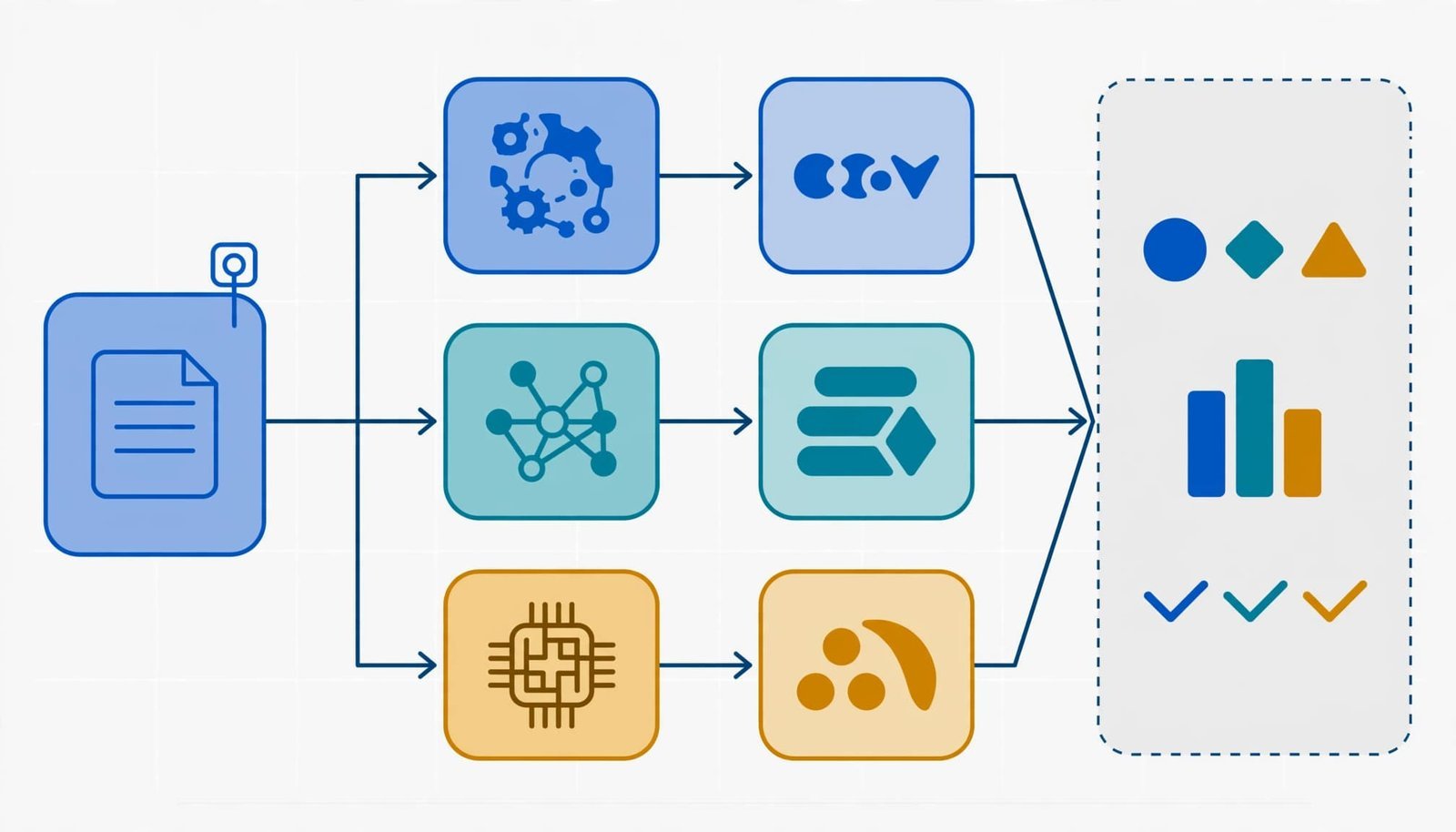
A harness sends shared fixtures and cases from automated test generation through each provider adapter, then records outputs and scores. This helps assess model-agnostic prompts against a stable contract, without expecting identical responses. Promptfoo’s getting-started guide shows a file-based approach to running evaluations across models and comparing results.
Freeze the inputs that affect the answer
Keep test cases consistent: each fixture should contain the user request, relevant conversation history, retrieved records, tool responses, and applicable settings. Stub external dependencies when possible. If one run sees a newly updated webpage while another sees yesterday’s copy, you can’t attribute the difference to the model.
Choose cases from costly failures, not only successful demos. For a directory covering free AI tools and premium writing software, test missing prices, duplicate listings, stale descriptions, and unsupported claims of being “top rated.” Include requests for new tools in 2026 when your source records don’t establish a launch date.
Content categories need distinct checks. An AI blog post generator may require source-grounded claims; a grammar checker comparison may depend on supported languages. The same generic quality score won’t capture both.
Repeat cases where variation matters
Run important fixtures more than once at the same recorded settings for regression testing. Track pass rate and the lowest quality score alongside latency, token use, and errors. Repeated runs reveal intermittent failures that a single polished response hides.
Keep comparisons fair by recording model identifiers, prompt versions, adapter versions, and generation settings. When any of those changes, treat the run as a new experiment. During model migration, run a broader cross-provider comparison. Cross-model scores are useful only when the inputs and acceptance rules remain stable.
Score fixed requirements and flexible language differently
Portability testing works best as layered evaluation. Code checks what code can verify; narrower rubrics assess meaning. A practical evaluation framework combines both. Anthropic’s guidance on agent evaluations describes prompt evaluation as a process: provide an input, apply grading logic, and measure success.

Use deterministic assertions for hard boundaries
Parse machine-consumed JSON and enforce output constraints. Check required fields, enum values, approved URLs, numeric ranges, and tool arguments. If your contract prohibits unsupported catalog entries, compare every returned identifier with the fixture’s allowed records.
Critical safety requirements deserve hard failures. A successful prompt injection, sensitive-data leak, or unauthorized tool call shouldn’t be averaged away by strong scores on easier cases. Likewise, don’t use an LLM judge to decide whether JSON parsed or an identifier existed in the source data.
Grade meaning with a narrow rubric
Writing quality, useful explanations, and grounded recommendations allow multiple valid phrasings. Give an LLM-as-a-judge or human reviewer the original request, permitted context, candidate answer, and a precise question. For example: “Does every pricing claim appear in the supplied catalog?”
Record the judge model and rubric version. Review borderline scores and disagreements against a small human-reviewed set, especially before changing the judge. Use reviewed findings for prompt optimization when they reveal a consistent issue. A broad instruction to “rate quality” is hard to audit and may reward confident wording over factual support.
Generate tests, then verify what they test
Handwritten fixtures often reflect what you expect to go wrong. Automated test generation can uncover cases you didn’t think to write. Microsoft’s PromptPex project extracts input and output specifications from a prompt, then generates test cases and evaluators.
Use generated cases to challenge the contract, not define it. Check that proposed inputs are valid and expected answers follow product rules. Review each evaluator, including an LLM-as-a-judge, to confirm it checks the right behavior. A generated test that demands an exact sentence can make a portable prompt appear broken when another model gives an equally correct answer.
The same review applies to generated adversarial cases. Promote useful test cases to versioned fixtures only after checking their expected behavior. PromptPex is research-oriented tooling, so evaluate its outputs and fit before relying on it for a release decision. No test generator replaces production incidents, customer reports, or a clear acceptance rule.
Put portability gates into your release process
A practical continuous integration setup has two speeds. Run a small, high-risk suite with test automation on pull requests; run broader cross-provider regression tests before a model migration or deployment. This keeps routine feedback useful without paying for every model and repeated case on each minor edit.
Make failures diagnosable
A failed test report should show the fixture, prompt and adapter versions, model identifier, parsed output, assertion results, and any evaluator score. Keep sensitive source material out of logs unless your storage policy permits it.
Classify the failure before prompt optimization or rewriting the prompt. It might come from missing retrieval context, an adapter mapping, a schema mismatch, a provider error, or an overly strict assertion. Retry transient transport failures separately from bad answers. Silently retrying a quality failure can hide a response that real users would receive.
Set gates according to product risk
Build workflow integration around product risk. Block releases for schema failures on machine-consumed output, violated output constraints, and confirmed security or tool permission violations. For variable copy quality, set a documented prompt evaluation pass-rate or rubric threshold based on your use case, then compare it with the current production version.
Monitor results by route. A strong overall score can conceal a quality regression in one language or customer workflow. After release, add confirmed failures to the fixture set for regression testing. Rerun them when you change the prompt, model, adapter, retrieval pipeline, schema, or make provider changes.
Prompt portability testing also informs business choices. It gives you evidence for routing a task to another provider or planning a model migration, but it doesn’t eliminate switching costs. Tool integrations, data handling, latency, and review workflows still affect the effort of a migration.
Key Takeaways
- Define portable behavior through a versioned contract, not identical model output.
- Use model-agnostic prompts for shared task rules, while provider adapters handle API differences.
- Test frozen, representative fixtures with both code assertions and narrow semantic rubrics.
- Repeat high-risk cases, inspect failures, and gate releases according to their consequences.
- Validate structured data in your application, even when a provider offers schema-constrained generation.
Frequently Asked Questions
Can one prompt work unchanged across all three providers?
Your core task instructions often can, but the complete request usually can’t. Roles, schema settings, tools, and response handling differ. Provider adapters preserve the shared contract while accounting for those differences, and tests show whether the resulting behavior meets your requirements.
How do you test responses that change wording?
Assert exact values only where the product requires them. Use source checks and focused rubrics for flexible language, then repeat important fixtures to measure consistency. Two differently worded answers can both pass if they satisfy the same factual and safety rules.
Do you need a paid evaluation platform?
No. You can start with versioned fixtures, application validators, and a small scripted test runner. A framework becomes useful when you need easier provider comparisons, assertions, and CI reporting. Model API calls and judge evaluations may still incur costs, so control suite size and frequency.
Conclusion
A model switch shouldn’t leave you guessing whether the product still works. Prompt portability means preserving required behavior, while allowing each provider to express a valid answer in its own way.
Keep the contract stable, adapt the requests, and test the failures that matter. That gives you evidence to weigh switching costs without mistaking a well-formed response for a correct one.
Leave a Reply