
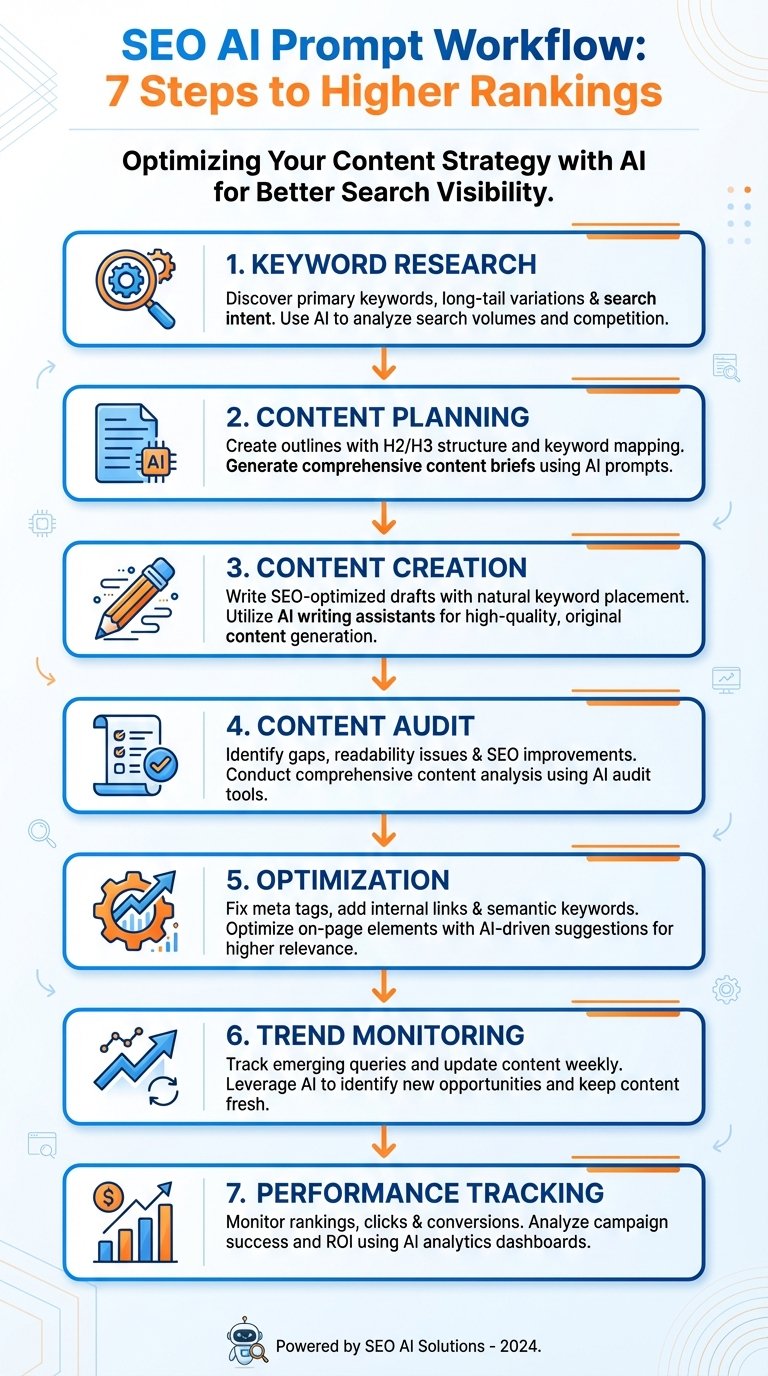
You remember the late nights. Blank doc, blinking cursor, zero clicks. Then you tried SEO AI prompts, and everything clicked. Clear, smart instructions in, stronger rankings out.
Here’s the simple truth. SEO AI prompts are just smart instructions you give AI tools, so they create content search engines love. In 2025, you win with conversational keywords, clean answers, and content that sounds human. You get speed, relevance, and less guesswork.
You’ll see faster briefs, sharper outlines, and on-brand drafts that match search intent. Great for businesses, marketers, and creators who want results, not fluff. If you need a jump-start, try these best free AI prompt tools for beginners. Then build your own SEO AI Prompts Collection for Higher Rankings.
Want a quick spark before we dive in? Watch this: https://www.youtube.com/watch?v=bZSfNMIOMHU
Craft Prompts That Create SEO-Friendly Content Fast
You do not need magic, you need clarity. When you feed clear SEO AI prompts into your tool, you get outlines and audits that save hours and rank faster. Good prompts are like GPS directions. Bad prompts are the “turn left at the duck” kind. Let’s write the good kind.
Prompts for Keyword-Rich Article Outlines
Outlines set the tone for ranking. You want structure, target keywords, search intent, and a logical flow. Tell the AI exactly what to include, where to place keywords, and how deep to go.
Try these prompt starters and adjust the variables in brackets:
- Act as a Senior SEO Content Strategist. Your task is to produce a comprehensive, high-ranking blog post outline for the topic: [primary topic]. The target audience is [target audience], and the tone should be [desired tone, e.g., authoritative yet accessible]. Structure Requirements: 1. Provide a logical hierarchy using H2 and H3 tags. 2. For every heading, include a ‘Search Intent Note’ (one sentence) explaining what the reader is looking for in that section. 3. Identify 8 long-tail keywords that align with [search intent, e.g., informational]. 4. Explicitly map each of the 8 keywords to the most relevant H2 or H3 heading to ensure natural integration. 5. Include a brief summary of the ‘Hook’ for the introduction and a ‘Call to Action’ (CTA) for the conclusion. Constraint: Ensure zero content overlap between sections and prioritize semantic richness to improve E-E-A-T (Experience, Expertise, Authoritativeness, and Trustworthiness).
- Act as an expert SEO Content Strategist. Your task is to create a comprehensive, high-ranking content outline for the topic ‘[topic]’ centered around the primary keyword ‘[primary keyword]’. Please provide the following components: 1. SEO Meta Description: A compelling 140–160 character description that includes the primary keyword and a clear call-to-action. 2. Engagement Hook: A captivating opening hook for the introduction (approx. 2-3 sentences) designed to reduce bounce rate and pique reader interest. 3. Skimmable Content Outline: A detailed structure using H2 and H3 headings. Ensure the flow is logical, addresses the user’s search intent, and provides comprehensive coverage of the topic. 4. FAQ Section: 5 frequently asked questions using exact-match phrasing for common search queries related to ‘[primary keyword]’. Provide a brief 1-sentence answer for each. 5. Internal Linking Strategy: Suggest 3-5 specific anchor text ideas for internal links pointing to pages about [related topics], explaining where they should ideally be placed within the outline. The tone should be authoritative yet accessible, and the content should be optimized for both readability and search engine crawlers.
- Act as an expert SEO content strategist and copywriter. Create a detailed blog post outline for a head-to-head comparison between [Product A] and [Product B]. The goal is to help [Target Audience, e.g., tech enthusiasts or small business owners] decide which tool fits their specific needs. The tone should be objective, authoritative, and highly analytical. Your outline must follow this structure:
- Introduction: Hook the reader, provide a high-level overview of both products, and state the primary use case for each.
- Comparison Table/Summary: A placeholder for a quick-glance comparison of core specs. Deep Dive Decision Criteria: Detailed sections for [Criteria 1, e.g., Features], [Criteria 2, e.g., Pricing], and [Criteria 3, e.g., Ease of Use]. Pros and Cons: A balanced bulleted list for both products.
- The ‘Best For’ Breakdown: Explicitly state which product is better for specific user personas or scenarios.
- Final Verdict: A definitive conclusion with a clear recommendation based on different budget or performance requirements.
- Act as an expert SEO Strategist. Your task is to generate a comprehensive appendix of 10 secondary keywords for the primary topic: ‘[INSERT PRIMARY TOPIC/KEYWORD HERE]’. For each secondary keyword, you must: 1. Identify the Search Intent using exactly one of these labels: [Transactional], [Commercial], or [Informational]. 2. Provide a brief ‘Strategic Rationale’ explaining why this keyword is relevant to the primary topic and how it helps capture a specific segment of the audience. Present your findings in a clean Markdown table with the following columns: Keyword, Search Intent, and Strategic Rationale. The tone should be professional and analytical, suitable for a digital marketing strategy document.
- Ensure the outline uses clear H2 and H3 headings and provides brief descriptions of what should be covered in each section.
- “Create an outline with topic clusters for [core topic]. Provide one pillar page and 6 supporting posts. For each, list title, angle, target keyword, and two semantically related terms sourced from user questions.”
How to specify structure and intent:
- Tell the AI the format, like “H2/H3 only,” “list first,” or “story lead.”
- State the audience level, like “beginner-friendly for busy marketers.”
- Set constraints, like “no fluff,” “no vague advice,” or “data-backed claims only.”
- Ask for keyword placement by section to guide on-page optimization.
Benefits for digital creators:
- Faster briefs, fewer rewrites, and stronger topical coverage.
- Clear section aims, so writing stays tight and useful.
- Better drafts on the first pass, because the map is solid.
Fun observation: bad prompts get you filler, hedging, and reworded facts. Good ones hand you SEO gold, complete with intent labels and keyword-to-heading mapping. For more prompt inspiration, scan these expert lists of 36 ChatGPT prompts for SEO in 2025 and this practical rundown of 22 simple AI prompts for SEO. If you want ready-made options, browse a curated list of best AI prompt marketplaces.
Example prompt you can paste: “Plan a 1,600-word article targeting the keyword ‘SEO AI prompts.’ Provide H2s and H3s with intent notes, suggested internal link anchors, and a FAQ section. Include 10 long-tail keyword ideas with intent labels, and map each long-tail to a section. Keep the outline scannable and non-repetitive.”
Optimize Existing Content with AI Audits
Your old posts can still win. Treat them like they are heading to the gym for a fresh workout. Use AI to run audits for gaps, readability, and on-page tweaks. You do not need a complex stack to start. A smart audit prompt covers the basics that most content editors and scoring tools look at.
Prompt ideas to analyze gaps:
- Act as a senior SEO Content Strategist. Conduct a comprehensive topical gap analysis for the provided article regarding the core topic: [Insert Topic]. Your goal is to identify opportunities to improve topical authority and search engine rankings. Please provide the audit in the following format: 1. Topical Gaps: Identify at least 4-5 high-value subtopics or keywords that are missing compared to top-ranking competitors. 2. Content Depth Evaluation: Identify specific sections that are ‘thin’ or lack sufficient detail, explaining why they need expansion. 3. Unaddressed Reader Questions: List 5 specific questions a reader might have that this article fails to answer (focus on ‘People Also Ask’ style queries). 4. Internal Linking Strategy: Suggest 5 strategic internal links to other related content on the site. For each, provide: a) The suggested anchor text. b) The specific section/paragraph where it should be inserted. c) A brief justification of how it helps the user journey. Maintain a professional, data-driven, and actionable tone.
- You are an expert SEO Content Strategist. Your task is to perform a comprehensive content gap analysis for the provided draft against the top three ranking results for the keyword: “[Insert Keyword]”.
- Context:
- Target Keyword: [Insert Keyword]
- Current Draft: [Insert Draft Content Here]
- Target Audience: [e.g., Beginners, Industry Professionals]
- Tone: [e.g., Authoritative, Instructional, Conversational]
- Task Objectives:
- Competitor Benchmarking: Analyze the top three search results for the keyword. Identify recurring themes, specific sub-topics, and semantic entities they cover that are missing or under-represented in the provided draft.
- Search Intent Alignment: Evaluate if the draft currently meets the user’s search intent (Informational, Transactional, etc.) compared to the top results.
- Expansion Strategy: Propose exactly two new H2 headings designed to close the identified content gaps. For each H2, provide 3-5 supporting bullet points detailing the specific data, arguments, or information that should be included to make the content more competitive.
- Output Format:
- Gap Summary: A concise list of missing sections or concepts.
- New H2 #1: [Heading Title] followed by supporting points.
- New H2 #2: [Heading Title] followed by supporting points.
- Strategic Value: A brief explanation of how these additions improve the draft’s SEO performance and user value.
Prompt ideas to fix readability:
- Rewrite the provided text to make it accessible for a 9th-grade student (approximately 14-15 years old). Follow these specific constraints: 1. Sentence Structure: Use short, punchy sentences and convert all passive voice to active voice. 2. Vocabulary: Retain all essential technical terms but simplify the surrounding context. 3. Conciseness: Strip away all filler words, redundant adjectives, and unnecessary jargon. 4. Illustration: Include exactly one concrete, real-world example that clarifies the main concept. The tone should be professional yet engaging. Please rewrite the following section: [INSERT TEXT HERE]
- Review the text provided below and perform two main actions. First, identify every sentence that exceeds 20 words in length; for these sentences, provide a tighter version that conveys the exact same information using fewer words. Second, identify any industry-specific jargon or overly complex terminology; flag these terms and suggest plain-language alternatives that a general audience would understand. Present your results in a structured format: list the original sentence, its word count, the rewritten version, and any jargon replacements made. Ensure the original meaning, tone, and nuance remain completely intact.
Prompt ideas for SEO tweaks:
- Act as an expert SEO Content Strategist and Editor. Your task is to perform a comprehensive keyword optimization audit on the text provided below. Use the primary keyword: ‘[INSERT PRIMARY KEYWORD]’.
- Keyword Placement Audit: Check for the presence and natural integration of the primary keyword in the following locations:
- The Title/H1
- The first 100 words of the introduction
- At least one H2 subheader
- The concluding paragraph
- Synonym & Variation Engine: Suggest 5-7 natural synonyms or long-tail variations of the primary keyword to prevent keyword stuffing and improve the flow of the writing.
- Semantic Coverage Analysis: Identify 4-6 Latent Semantic Indexing (LSI) keywords or related topical concepts that would enhance the article’s authority and help it rank for broader search intent.
- Actionable Recommendations: Provide a brief summary of necessary changes to improve the overall SEO health of the piece without compromising readability.
- [INSERT TEXT TO BE AUDITED HERE]
- Develop a high-performance linking strategy for a blog post or article focused on [Insert Primary Topic]. Please provide the following: 1. Three Internal Link Recommendations: For each, specify the target sub-topic, the exact SEO-optimized anchor text to use based on [Related Topics], and a brief justification for how this link improves the site’s topical authority. 2. Two External Link Recommendations: Identify two high-authority, reputable, and non-competing external sources (e.g., industry whitepapers, academic journals, or news outlets) that support the article’s core arguments. Provide the suggested anchor text and the rationale for the link’s credibility. 3. Placement and Context Guide: For all five links, describe the ideal placement within the article structure (e.g., ‘within the introductory hook’ or ‘under the first H2 subheader’) and the surrounding sentence context to ensure the links feel organic and encourage a high click-through rate (CTR). Ensure the strategy balances search engine visibility with a seamless user experience.
- Act as an expert SEO Copywriter specializing in search engine marketing. Your task is to craft a high-converting meta title and meta description for the following content: [Insert Topic/URL/Summary].
- Guidelines:
- Meta Title: Must be under 60 characters. Place the primary keyword ‘[Insert Keyword]’ at the beginning if possible. Use an active voice and include a unique selling point or benefit.
- Meta Description: Must be between 130 and 160 characters. Include the primary keyword exactly once. The copy should address the user’s search intent ([Select: Informational/Transactional/Commercial]) and conclude with a compelling Call to Action (e.g., ‘Discover how,’ ‘Shop the collection,’ or ‘Read our expert guide’).
- Tone: [Select: Professional/Witty/Educational].
- Format the output as follows:
- Final Meta Title: [Text]
- Title Character Count: [Count]
- Final Meta Description: [Text]
- Description Character Count: [Count]
Workflow you can use today:
- Paste your URL or draft into your AI tool with the audit prompt.
- Accept the gap fixes that add depth, not fluff.
- Update headings, tighten paragraphs, and add internal links.
- Refresh the intro and meta. Publish. Reindex.
Pro tip: mirror how popular content editors grade content without naming them. Ask the AI to flag keyword density issues, missing headers, thin sections, and weak CTAs. It is the same checklist, just faster. If you want an extra set of ideas before editing, peek at a curated take on 8 favorite ChatGPT prompts for SEO.
Key takeaway: your SEO AI prompts should be bossy, not vague. The more precise you are about intent, structure, and links, the better your content performs.
Put SEO AI Prompts to Work and Watch Rankings Climb
 Photo by Sanket Mishra
You do not need luck, you need a system. With SEO AI prompts, you can spot keyword shifts, update pages fast, and turn slow movers into steady winners. Treat your AI like a real-time research assistant that never blinks and never gets tired.
One smart move: keep a short list of prompts that track trends, refresh content, and flag quick wins. Use them weekly. Your rankings will thank you.
Track Trends and Update Content on the Fly
Trends move fast, so your content should move too. Use SEO AI prompts to watch search shifts in real time, then push targeted updates that keep pages relevant, useful, and clickable.
Try prompt formats like these to find what is rising now:
- Conduct a deep-dive research analysis on the topic: [topic]. Simulate an exhaustive scan of Google Trends, high-engagement subreddits, and niche-specific industry forums to identify rising trends, underserved questions, and pain points. Provide a list of 10 high-potential long-tail queries that are currently gaining traction. For each query, include the following: 1) The exact long-tail query, 2) The primary search intent (Informational, Transactional, Commercial, or Navigational), 3) A brief rationale for why this query is trending based on current user behavior, and 4) A content angle or headline suggestion to address the query. Format the final output as a clear, professional table for easy review.
- “Perform a comprehensive content gap analysis for the keyword: ‘[Insert Keyword]’. First, analyze the top 5 ranking results on Google for this specific keyword, identifying recurring themes, unique value propositions, and the primary user intent they satisfy. Second, compare these findings against my existing content or outline provided here: [Insert Content/Link]. Highlight 3-5 specific subtopics, niche angles, or frequently asked questions that are present in the top-ranking results but missing from my content. Finally, propose two new, high-impact H2 headings to integrate into my article. For each H2, provide a brief explanation of why it is necessary for SEO and a bulleted list of the key points that should be covered within that section to improve search relevance and depth.
- Generate 15 conversational keyword variations for the topic: [topic]. These keywords should reflect natural language patterns, long-tail queries, and voice search phrasing (e.g., ‘How do I…’, ‘Where can I find…’, ‘What is the best way to…’). Organize the keywords into a clear table with the following categories: 1. Informational Intent (users seeking knowledge or answers), 2. Commercial Intent (users researching products or comparing options), and 3. Transactional Intent (users ready to make a purchase or complete a specific action). For each keyword, provide a brief explanation of the specific user need it addresses. Ensure the tone is professional yet focused on human-centric search behavior.
- Analyze the seasonality and upcoming trends for the topic: ‘[topic]’. Provide a comprehensive strategy for the next 30 days to maximize engagement and search visibility. Your response must include: 1. Seasonality Analysis: Identify current trends, search intent shifts, and why this topic is gaining or losing traction in the upcoming month. 2. Title Optimization: Provide 5 high-CTR, SEO-friendly headline variations for existing or new content, incorporating seasonal hooks and power words. 3. FAQ Generation: List 5 frequently asked questions (FAQs) that users are likely searching for right now based on ‘People Also Ask’ patterns, along with concise, authoritative answers. 4. 30-Day Action Plan: A week-by-week breakdown of content updates or promotional steps. Tone: Professional and data-driven. Target Audience: Digital marketers and content creators.
Once you have the insights, point AI at your page and ask for targeted edits:
- Rewrite the introduction of the provided text to align perfectly with the following intent: [Insert Intent, e.g., ‘educating marketers on automation’]. The revised introduction should target [Insert Target Audience, e.g., ‘digital marketing managers’] and maintain a [Insert Tone, e.g., ‘authoritative yet conversational’] tone throughout. Ensure you hook the reader immediately by highlighting a specific value proposition or addressing a common industry challenge. You must include the exact phrase ‘SEO AI prompts’ exactly once within the first 100 words. The final output should be approximately 150-200 words and flow seamlessly into the main body of the article. Original Introduction: [Insert Original Intro Text]
- Based on the provided context regarding [Insert Subject/Product/Service Here], generate 5 new frequently asked questions (FAQs). Each answer should be written in a natural, conversational style that feels human and helpful. Constraints: 1. Keep each answer under 120 words. 2. Use a numbered list format with the question in bold. 3. Avoid technical jargon; explain concepts simply for a general audience. 4. Ensure each question addresses a distinct and high-value topic for the user.
- Based on the following article content [INSERT TEXT OR TOPIC HERE], develop a strategic linking plan to improve search engine rankings and user engagement. Your plan must include: 1. Three (3) Internal Links: Suggest relevant topics or pages from our existing site architecture that provide deeper context or related value to the reader. 2. Two (2) Reputable External Sources: Identify high-authority, non-competing websites (such as .gov, .edu, or industry-leading publications) that validate the claims made in the text. For each link, provide: – Optimized Anchor Text: Suggest descriptive, keyword-rich phrases that flow naturally within the sentence. – Strategic Placement Notes: Define exactly where in the article the link should be inserted (e.g., ‘In the section regarding X, after the sentence Y’) and explain the logic for why this link improves the reader’s experience or the page’s authority. Present your response in a structured list format.
Why this works for your business:
- You stay current, not reactive. AI picks up new questions before they peak.
- You reduce guesswork and update faster, which boosts topical relevance.
- You protect winners. Light edits keep stable pages fresh without breaking them.
- You make smarter resource calls. Update what moves the needle, skip what does not.
Helpful resources if you want outside proof and ideas:
- See what experts call the 9 Biggest SEO Trends of 2025, including AI-driven content and long-tail focus.
- If you need tools for prompts, scan these Top 10 AI Prompt Tools for Enhancing Creativity.
Quick workflow you can run every week:
- Pull trend data and rising questions for your niche.
- Update your priority pages with one new H2, one fresh example, and an FAQ.
- Refresh meta title and description to match new queries.
- Reindex and monitor clicks, time on page, and conversions.
Do this on a loop, and you keep your site fresh and rank higher.

Conclusion
You started with a blinking cursor, now you have a clear playbook. With SEO AI prompts, you give smart instructions, match intent, update fast, and protect winners.
Try one prompt today. Add a fresh H2, tighten your intro, and reindex. Share what moved the needle and build your SEO AI Prompts Collection for Higher Rankings.
Simple inputs, stronger rankings, repeatable wins. You got this, go conquer those search results.
FAQ:
Why are my AI-generated SEO articles getting impressions but not clicks?
The core problem is often generic AI prompts that lead to surface-level, ‘low-value’ content. This content, lacking true E-E-A-T, fails to stand out to users or satisfy Google’s quality signals, resulting in impressions without engagement.
What is a hierarchical AI prompt framework for SEO?
A hierarchical AI prompt framework involves layering instructions for the AI, guiding it to explicitly incorporate expertise, experience, authoritativeness, and trustworthiness (E-E-A-T) into its output. It moves beyond simple commands to create deeply valuable and credible content.
How can I ensure my AI-generated content meets Google’s E-E-A-T standards?
By using a hierarchical prompt framework that explicitly requests the AI to demonstrate E-E-A-T. This involves prompting for specific examples of expertise, sharing relevant experiences, citing authoritative sources, and building trust through factual accuracy and clear explanations.
Can advanced AI prompts truly help my content dominate search results?
Absolutely. When properly implemented, an advanced, E-E-A-T-focused AI prompt framework can transform your AI content from generic to foundational. This high-quality, relevant content is precisely what Google seeks to rank, leading to increased visibility, clicks, and domain authority.
Leave a Reply