
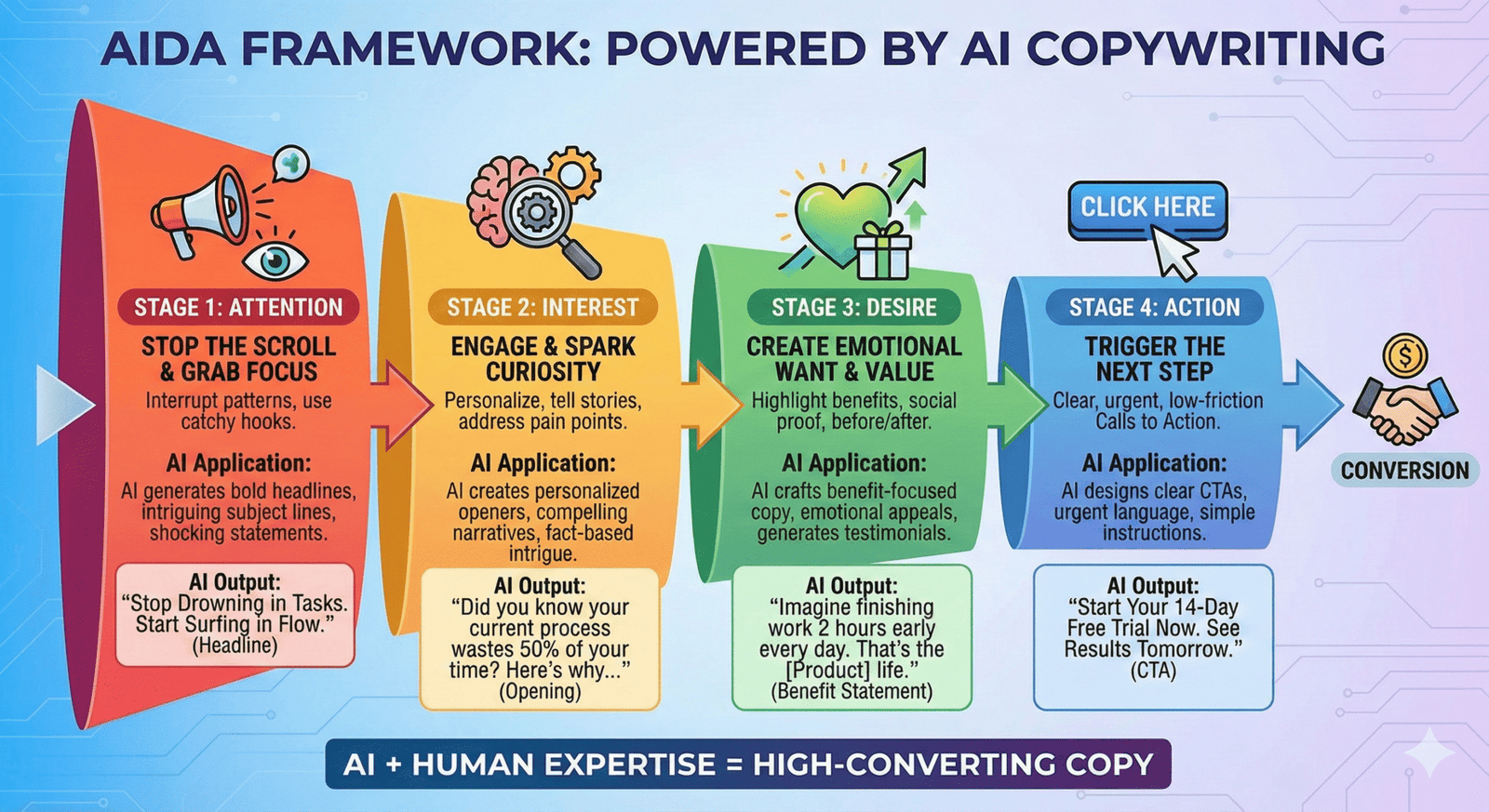
You know how tough it is to write copy that converts. Meet Maya, a marketer who spent weeks tweaking headlines and emails with little to show for it. Then she tried copywriting AI prompts, and her next campaign doubled clicks and cut her writing time in half.
Copywriting AI prompts are short instructions you give tools like ChatGPT to produce clear, persuasive text. You tell the AI who the audience is, what the offer is, and the tone you want. It returns options for headlines, emails, pages, and ads you can test fast.
This helps you if you write for a living, run online campaigns, sell homes, or are just starting with AI. Writers get fresh angles on demand. Online marketers can personalize messages and spin up A/B tests in minutes. Real estate agents can turn listings into friendly, local stories. Beginners and online entrepreneurs get a simple workflow that saves time and money.
If you want more practical tools, check out Enhance Your Copywriting with These AI Prompting Resources for a list of prompt tools and 50 free prompts you can try today. And if you like learning by watching, here’s a quick primer: https://www.youtube.com/watch?v=P08jrZhyNxw
Up next, you’ll get a set of high-converting copywriting AI prompts you can plug in and use right away.
Why Copywriting AI Prompts Boost Your Sales
You can generate high-converting copy in minutes. With copywriting AI prompts, you move faster, keep quality steady, and use tested structures that sell. In 2025, most marketers use AI daily, and teams that pair AI with human editing see better results. You get speed without giving up control.
 Photo by Google DeepMind
Save Time Without Losing Persuasion
Prompts let you focus on strategy, not wording. You decide the offer, audience, and goal. The AI drafts the first pass, and you refine. That cuts hours of typing into minutes of smart editing.
- Faster creation: Spin up 5 headline options in seconds, not hours.
- Consistent quality: Keep tone and brand voice steady across pages and emails.
- More testing: Try multiple angles and pick winners with data.
A quick prompt you can use today: Write three benefit-focused headlines for a home staging service targeting first-time sellers in Austin. Tone: friendly, confident. Include a clear call to action.
Teams that combine AI with your review process see stronger outcomes. Recent 2025 data shows marketers using AI for brainstorming and drafts while humans fine-tune messaging see clear lifts in performance. Want more prompt ideas? Explore Enhance Your Copywriting with These AI Prompting Resources.
Tap Into Proven Sales Formulas
AI pulls from patterns that work, such as AIDA (Attention, Interest, Desire, Action), PAS (Problem, Agitate, Solution), and 4Ps (Promise, Picture, Proof, Push). You get structures that guide readers to act.
- For writers and marketers: Generate AIDA variants for ads and landing pages, then A/B test.
- For real estate agents: Turn a plain listing into a story that sells the lifestyle, not just the square footage.
- For entrepreneurs: Scale offers across channels with the same proven skeleton.
Example prompt: Using AIDA, write a 120-word Facebook ad for a 3-bed family home near parks and schools in Denver. Emphasize safety, convenience, and a weekend open house.
If you need ad-specific ideas, this guide on AI copywriting prompts for attention-grabbing ads can spark new angles. With copywriting AI prompts, you plug into tested frameworks, keep voice on brand, and ship persuasive copy, fast.
Top High-Converting Copywriting AI Prompts for Different Needs
Use these copywriting AI prompts to move fast, keep your message sharp, and convert more readers into buyers. Each template includes when to use it and a quick way to tailor it. Try one, test it, then tweak based on data. If you want more prompt ideas later, explore these examples of advanced copywriting prompts and a guide to high-converting ad copy prompts.
 Photo by Matheus Bertelli
Landing Page Copy Prompt to Drive Leads
Prompt template: Create a landing page copy that focuses on benefits over features for [Product Name]. Highlight how it solves [specific customer pain points] and include a clear call-to-action to drive sales.
When to use it: Ideal for launches, new funnels, or when a page underperforms. You want clear benefits, fast scanning, and one action.
Customization tip:
- For marketers: Add sections for proof, objections, and FAQs. Include bullets like “perfect for busy parents” or “built for solo founders.”
- For entrepreneurs: Set one goal per page. Make the CTA specific, like “Start your free 14-day trial.”
- Pro move: Map copy to AIDA. Use a bold hook, then brief proof. Keep paragraphs short.
Quick example: “Stop losing hours to scheduling. [Product Name] books meetings for you, sends reminders, and fills your calendar.”
Email Sales Sequence Prompts for Repeat Engagement
Prompt template: Generate a series of email sales copy for [Product Name], each focusing on a different benefit. Ensure each email includes a persuasive call-to-action linking to [landing page or checkout].
When to use it: Great for online entrepreneurs building trust over a week. Works for SaaS trials, courses, services, and launches.
Customization tip:
- Plan a 5-email flow:
- Problem + promise: State the main pain and your fix.
- Benefit deep dive: Focus on speed, savings, or ease.
- Social proof: Add a customer quote and result.
- Objections: Tackle price, time, or risk with a guarantee.
- Urgency: End with a deadline or bonus.
- Keep CTAs clear: “Book your demo,” “Start your trial,” “Grab your spot.”
- Add a PS that repeats the CTA. It boosts clicks.
Tip: Rotate subject line styles. Use curiosity, clarity, and numbers. For extra ideas, see these go-to prompts for supercharged copywriting.
Product Description Prompts for E-Commerce Wins
Prompt template: Write a product description for [Product Name] that highlights its unique features and benefits. Make sure it's concise, persuasive, and includes a clear call-to-action.
When to use it: Best for store pages, Amazon listings, and proposal pages. Also useful for service packages.
Customization tip:
- Lead with a benefit in the first sentence. Then a short feature-to-benefit bullet set.
- For real estate agents: Treat the home as the product. Translate features to lifestyle:
- “South-facing windows” becomes “sunny mornings and warm afternoons.”
- “Near schools” becomes “5-minute school runs.”
- End with “Schedule a tour” or “Visit the open house.”
- For writers: Match client voice, then add a standout detail that answers “Why this, not that?”
Format idea:
- 1 line hook
- 3 bullets that turn features into outcomes
- CTA that frames the next step
Video Sales Letter Script Prompts That Convert Viewers
Prompt template: Create a script for a VSL that showcases [Product Name] as the solution to [customer problem]. Include testimonials and a strong call-to-action at the end.
When to use it: You run ads to a VSL, host a webinar replay, or add a video to your landing page. Works well when your offer needs visuals or demos.
Customization tip:
- Structure your VSL:
- Hook in 8 seconds. Name the core pain.
- Story that shows empathy and a turning point.
- Solution demo that highlights one key win.
- Proof: 2 quick testimonials, 1 case result.
- Offer: What they get, price, bonus.
- CTA: One action with a deadline or incentive.
- Add captions and big on-screen CTAs. Many viewers watch on mute.
- Preempt the top objection in the middle. It raises watch time and trust.
Social Media Ad Copy Prompts to Grab Attention
Prompt template: Develop ad copy for [Product Name] that targets [specific audience] on [platform]. Emphasize the value proposition, include eye-catching visuals, and drive traffic to [landing page].
When to use it: For Instagram, Facebook, TikTok, or LinkedIn ads. You need short, punchy text that stops scrolls.
Customization tip:
- Keep the first line under 80 characters. Lead with a benefit or number.
- Match platform norms:
- Instagram: short copy plus a clear image or Reels clip.
- LinkedIn: a crisp hook and a one-line insight.
- TikTok: problem-solution on-screen text and a fast cut.
- Add 2 versions: one with social proof, one with a bold claim. Test both. For more ad angles, browse these AI ad copy prompt ideas.
Sample hook ideas:
- “Double your bookings without more ad spend.”
- “Cut editing time by 50 percent with one tool.”
- “Stop losing leads at checkout.”
General Sales Copy Prompt for Quick Starts
Prompt template: As a seasoned copywriter, create an engaging sales copy for [Product Name]. Focus on highlighting its unique benefits, features, and value, tailored to [target audience]. Ensure it includes a clear and compelling call-to-action.
When to use it: You need flexible copy for pages, ads, or proposals. Great for quick drafts you can refine.
Customization tip:
- Add constraints to guide quality:
- Word count range, headline length, tone, and voice notes.
- Audience segment, use case, and one key objection to overcome.
- Ask for 3 angles: results-driven, story-driven, and proof-heavy. Pick the winner.
- Keep one promise per piece. Too many ideas slow the reader.
Pro tip: Combine with AIDA or PAS to keep flow tight. You can also prompt for two CTAs, a primary and a soft secondary, to catch hesitant buyers. If you need more inspiration, scan these curated copywriting prompt workflows.
Ready to use these copywriting AI prompts in your next campaign? Start with one template, measure clicks and replies, then refine. Small tweaks stack up to big wins.
Tips to Make Your Copywriting AI Prompts Work Even Better
Strong prompts give you clearer drafts, faster edits, and higher conversions. With copywriting AI prompts, you set the stage, then guide the output with details that match your audience, product, and goal.
Be Specific and Add Context
You get better results when the AI knows who you are talking to and what you are selling. Define the product, the reader, and the action you want. You refine prompts by adding details about your audience, such as pains, habits, and tone.
Include these in your prompt:
- Product: What it is, the top benefit, and one proof point.
- Audience: Role, stage, key objection, and desired outcome.
- Goal: Click, book a tour, request a quote, or buy now.
- Tone: Friendly, expert, bold, or warm.
- Constraints: Word count, format, and primary keyword.
Example: Write 3 PAS-style headlines for a family-friendly real estate listing in Denver. Audience: first-time buyers with busy schedules. Tone: friendly and confident. Include the keyword "copywriting AI prompts" once.
For more ideas on adding clear audience details, see this brief guide on being specific with audience details in prompts.
Pro tip: Use soft psychology where it fits. Add ethical urgency, social proof, or a limited bonus. Keep it honest and verifiable.
Test Multiple Versions for Top Results
Do not ship the first draft. Ask the AI for 5 headline angles, 2 short leads, and 2 CTAs. Keep one change per test, then run an A/B or split test.
Simple workflow:
- Generate 3 to 5 versions per asset.
- Test one variable at a time, such as headline or CTA.
- Track CTR, reply rate, or booked calls.
- Keep the winner, then iterate again.
Try variants with different tones and triggers:
- Scarcity: Waitlist spots, limited bonus, or deadline.
- Social proof: Ratings, case stats, or local reviews.
- Clarity: Plain benefits that match the reader’s goal.
Entrepreneurs see faster gains when they test weekly, not yearly. For a practical workflow that you can copy, skim this piece on using ChatGPT for copywriting, examples, and iteration.
Conclusion
You now have simple, proven ways to turn ideas into sales. With copywriting AI prompts, you write faster, keep your message clear, and stay on brand. You guide the AI with audience, offer, and goal, then shape strong drafts with AIDA or PAS. Testing a few angles, tracking clicks, and iterating gives you steady gains without guesswork. Like Maya, you can move from slow edits to consistent wins in days, not weeks.
Try one prompt right now for your next email, ad, or listing. Keep it specific, request two versions, and pick the one that speaks to your reader best. Stay honest, add proof, and make the next step obvious.
Grab your AI tool and craft copy that sells.
FAQ:
How do AI copywriting prompts boost sales?
AI prompts help generate high-converting copy faster, ensure brand consistency, and enable rapid A/B testing of different messaging angles, directly leading to increased sales efficiency and conversion rates.
What are the best AI copywriting frameworks?
Popular frameworks include AIDA (Attention, Interest, Desire, Action) and PAS (Problem, Agitate, Solution). These provide structured guidance for AI to produce effective sales copy.
Can AI copywriting really understand my audience?
Yes, when you guide the AI with specific details about your target audience’s demographics, psychographics, pain points, and desires, it can generate highly relevant and resonant copy.
How often should I test AI-generated copy?
Consistent testing is crucial. Start with testing different angles for key sales messages and iterate based on performance metrics like click-through rates and conversion rates.
Leave a Reply