

Your LLM can pass a polished demo yet fail on a vague customer request. Manual prompt edits often hide this gap because you test only remembered examples.
GEPA prompt optimization turns prompt changes into a measured search process. You evaluate real application runs, preserve the evidence behind each score, and use a separate model to propose targeted revisions.
It works best when your application handles repeatable tasks, produces meaningful feedback, and exposes enough failures to inspect.
Key Takeaways
- GEPA prompt optimization uses measured application evaluations, execution traces, and reflective model feedback to evolve prompts and other text-representable components.
- Actionable Side Information (ASI) helps explain why a candidate failed, so revisions can target issues such as ignored constraints, tool errors, or invalid citations.
- Pareto-based selection preserves useful prompt alternatives instead of optimizing only for the highest average score, reducing the risk of repeated failures on important request types.
- Reliable optimization requires representative optimization, validation, and holdout datasets, a written evaluation rubric, and metrics that track quality, cost, latency, and prompt size.
- Start with one editable component, set a metric-call budget, record experiment details, and skip GEPA when the task has no stable dataset, measurable outcome, or repeatable traces.
Why reflective prompt evolution works
GEPA means Genetic-Pareto. You give it text components to improve, such as system prompts, retrieval instructions, tool-use policies, or agent architectures. It creates candidate variants, evaluates them, and uses the results to decide what to try next.
The GEPA project documentation describes a broader scope than prompts alone. GEPA can optimize text-representable configurations, code, and multi-step LLM systems when you can define an evaluation metric.
Reflection uses evidence, not a score alone
A reflection model is an LLM that reviews failed runs and proposes a revision. Execution traces are records of what happened during a run, including retrieved passages, tool calls, intermediate outputs, parser errors, and final answers.
Actionable Side Information, often shortened to ASI, is diagnostic context returned alongside a score. A plain score of 0.4 says a candidate performed poorly. A trace can show that your agent retrieved the right policy but ignored a date restriction after a tool timeout.
That distinction changes the revision. The reflection model uses targeted meta-prompting to recommend a fallback rule, citation requirement, or check before the final answer.
Pareto selection keeps useful alternatives alive
A Pareto frontier is the set of candidates that aren’t clearly worse than another candidate across the evaluated objectives. One prompt may be more accurate on short questions. Another may follow formatting rules better on long inputs.
GEPA uses evolutionary search to sample and test candidates from this frontier, rather than repeatedly mutating only the current winner. That diversity matters because a prompt with the highest average score can still fail an important customer segment.
A strong average score can conceal a repeated failure on a small but high-value class of requests.
Standard reinforcement learning updates a policy toward a reward signal and often needs many rollouts. MIPROv2 focuses on proposing instructions and demonstrations. GEPA’s distinctive move is trace-driven reflection paired with Pareto-based candidate selection. The GEPA research paper provides benchmark details, but your own held-out evaluation should decide whether the approach is worth the run cost.
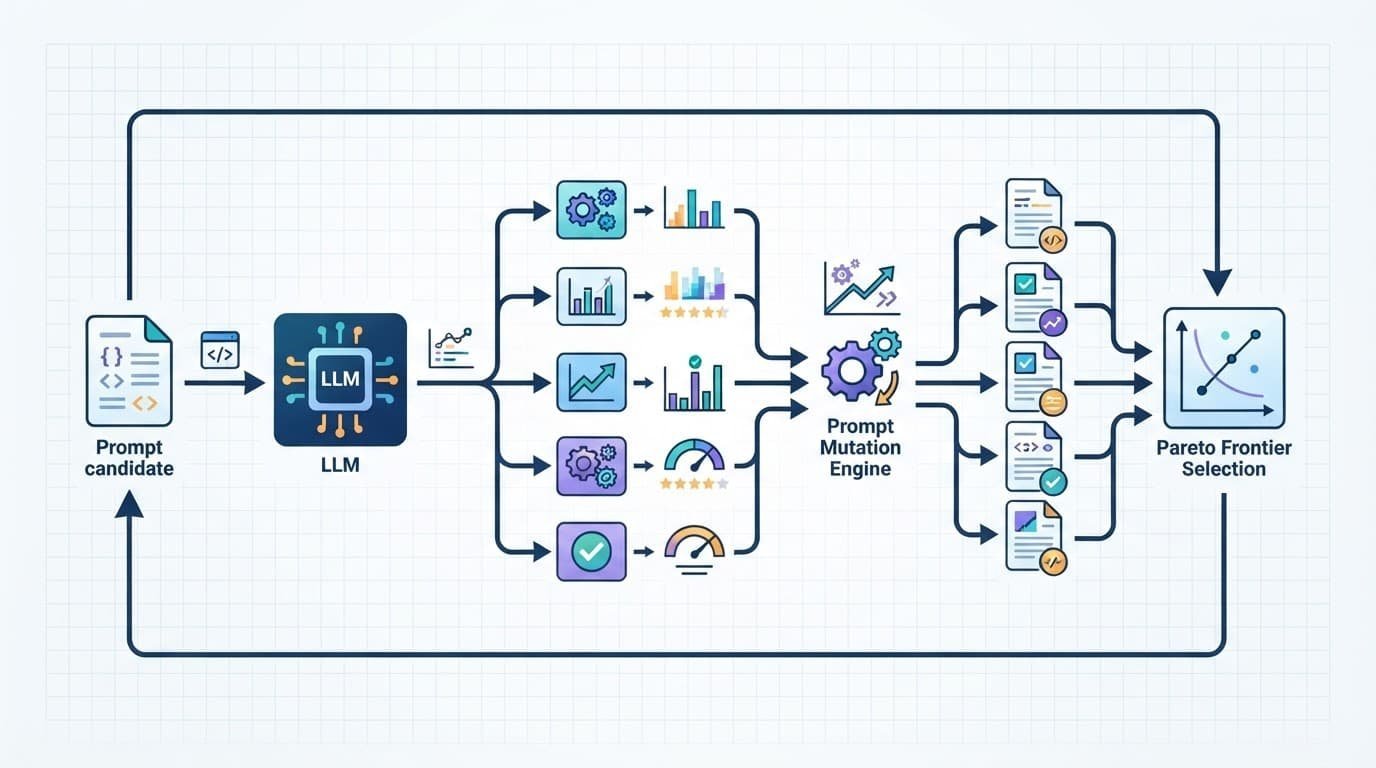
The GEPA prompt optimization loop, step by step
Start with a baseline prompt that already runs in your application. GEPA improves a working system faster than it rescues an undefined one.
Build a metric that points to the fault
Your feedback metric should return a score and useful diagnostic evidence. For a support assistant, combine answer correctness, required-policy compliance, citation validity, and escalation behavior. For a research agent, record source quality, factual claims, tool errors, and output format. Agent architectures also need checks for tool behavior, routing, and final responses.
The core loop follows five steps:
- Define the textual component you want to change, then freeze unrelated settings such as the task model, decoding parameters, and tool versions.
- Run the baseline candidate against a batch of representative inputs.
- Return a score, execution traces, and ASI from the evaluator. A compact contract looks like
score, asi, traces = evaluate(candidate, batch). - Give the reflection model a focused bundle of failures, then ask it to propose a revised instruction or configuration.
- Evaluate the new candidate and accept it only when it improves the selection criteria without breaking important cases.
Prevent prompt bloat and false wins
Prompt evolution can produce prompt bloat when you reward only task accuracy. That can create false wins through redundant rules or expensive output requirements. Set a maximum length for the optimized field, and penalize candidates that add unnecessary instructions. These limits protect quality and control cost.
A length limit acts as length regularization. It forces revisions to replace weak wording instead of stacking new exceptions onto old ones.
If you use the DSPy framework, the documented optimizer interface is dspy.GEPA. The DSPy GEPA overview explains its role as a reflective optimizer for evolving text components within a program. Keep your editable fields narrow at first, then expand the search after the metric proves reliable.
Design an evaluation that won’t fool you
GEPA can only optimize what the evaluation dataset reveals. A narrow dataset produces a prompt that memorizes your examples instead of representing the real task.
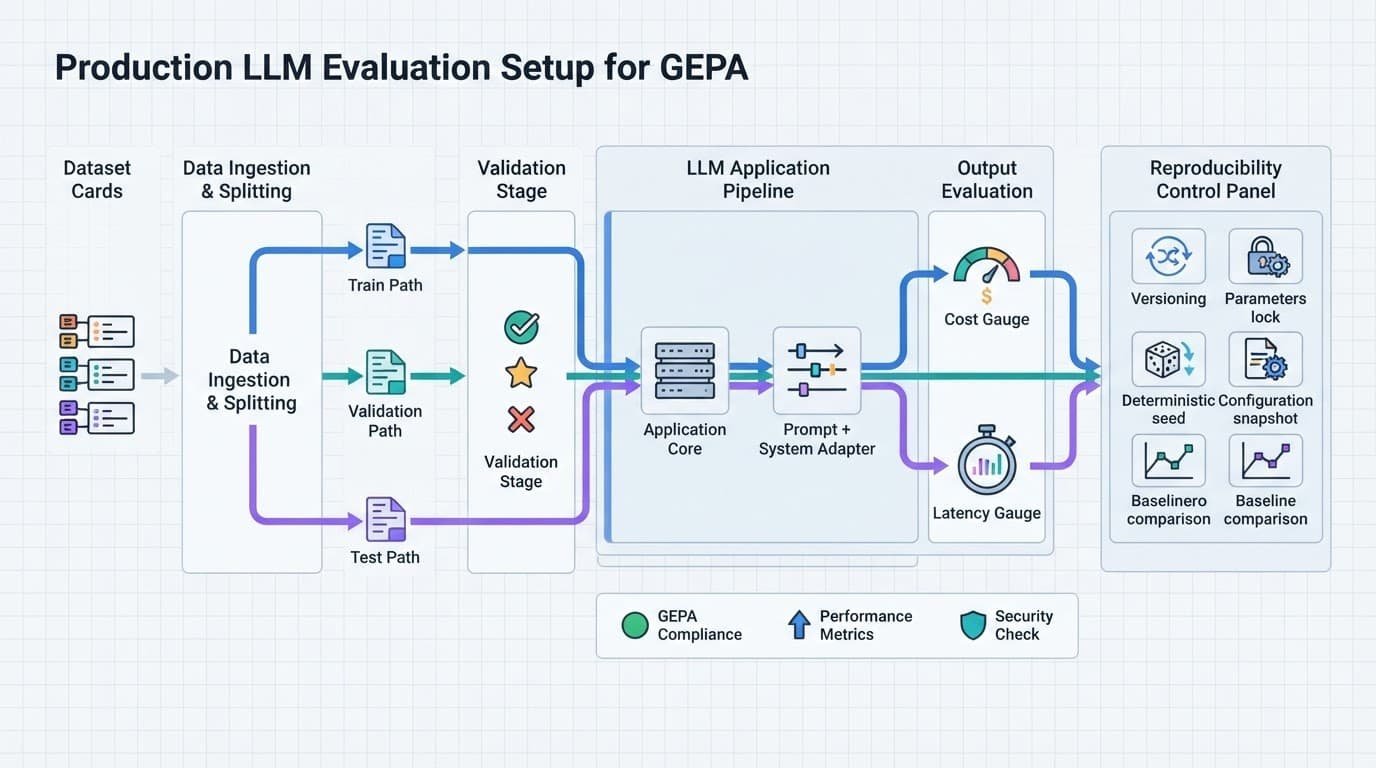
Give each dataset split a different job
Divide the evaluation dataset into separate optimization, validation, and holdout groups. Keep difficult examples in every group, including ambiguous requests, malformed inputs, missing context, and tool failures.
| Dataset split | What you use it for | What it protects |
|---|---|---|
| Optimization set | Generates feedback and candidate revisions | Fast iteration |
| Validation set | Selects among promising candidates | Overfitting |
| Holdout test set | Confirms the final result once | Honest reporting |
Start with 20 to 100 diverse examples when you need to inspect failures by hand. This range is a practical working point, not a universal GEPA setting. Add examples after you identify recurring error types that the current set misses.
Prevent prompt bloat and false wins
Track more than one number. Alongside quality, record prompt tokens, completion tokens, tool-call count, formatting failures, refusal errors, and median latency. A candidate that gains one point of accuracy while doubling runtime may not belong in production.
Use an LLM judge only with a written rubric, then spot-check it against human judgments. Otherwise, the optimizer may learn to satisfy the judge’s preferences instead of user needs.
Also freeze the validation set during an optimization run. If you repeatedly inspect and alter the metric after each result, that split becomes part of training.
Control cost, latency, and reproducibility
A GEPA run has two main costs: metric calls that execute your application and reflection calls that analyze failures. Model rollouts often drive the cost of a full agent run, especially with retrieval and external tools.
Set a budget before you optimize
Choose a maximum number of metric calls before the run starts. The official examples expose max_metric_calls as a budget control, and the official GEPA repository documents the adapter requirements behind those evaluations.
First, measure the baseline on the validation set. Then log each candidate’s quality, token use, tool calls, latency percentiles, and cumulative metric calls. Stop when new candidates no longer improve the validation result enough to justify the cost of additional metric calls.
Cache stable retrieval results during experiments when your production architecture permits it. Otherwise, a document-ranking change can look like prompt improvement.
Use a strong reflection model, then test its value
A weak reflection model can produce vague advice when traces contain conflicting tool output, long context, and several failure modes. It may repeat the existing prompt or recommend rules that don’t address the root cause.
GEPA doesn’t require one named frontier model. Still, test reflection quality on a small set of trace bundles before scaling the run. The model should identify the observed failure, point to trace evidence, and propose a bounded change.
Record model versions, temperatures, seeds where available, prompt templates, an evaluation dataset hash or version identifier, and tool versions. Reproducibility turns an attractive result into an experiment you can rerun.
Connect custom systems and know when to skip GEPA
You don’t need the DSPy framework to use this method. A system adapter connects GEPA to your own LangChain workflow, RAG pipeline, Pydantic AI application, API orchestration layer, or custom agent.
Build an adapter around observable behavior
Your adapter needs to run a candidate on an evaluation batch and return results. It also needs to extract the trace text relevant to the component under revision.
In practical terms, evaluate should return scores plus diagnostic context. extract_traces_for_reflection should isolate the failed tool sequence, retrieved context, or output fragment that a model reviewing the result needs to inspect.
Keep component names stable. In complex agent architectures, revise one prompt or routing component at a time. If a multi-agent system changes several prompts at once, you won’t know which revision caused the result. Test the routing prompt, retrieval prompt, and final-answer prompt in separate runs before testing combined changes.
Treat prompt collections as source material, not evidence
A “prompt download free” offer may help you attract readers who download AI prompts or get prompt packages with instant prompt access. Still, a prompt library download or prompt repository is only source material.
Even when your prompt files download as JSON, test text generation prompts, a ChatGPT prompt collection, and creative writing prompts against clear task examples. A Midjourney prompt download, Stable Diffusion prompt pack, or AI art prompt package needs image-quality evaluation rather than a text-only LLM metric. Match specific AI model prompts to the model that will run them.
Skip GEPA for one-off writing tasks, changing goals, or systems without measurable outcomes. Manual editing is faster when you have no stable dataset, no reliable evaluator, and no trace data.
Frequently Asked Questions
What is GEPA prompt optimization?
GEPA is a reflective evolutionary method for improving prompts and other text-representable system components. It evaluates candidates on application runs, reviews failure evidence with a reflection model, and uses Pareto-based selection to choose what to test next.
How is GEPA different from manual prompt editing?
Manual editing often relies on remembered examples and a single apparent winner. GEPA compares candidates against a defined evaluation set and uses traces and diagnostic feedback to connect revisions to observed failures.
What data does GEPA need to work well?
GEPA needs repeatable tasks, a reliable metric, representative examples, and traces that expose meaningful failure details. Separate optimization, validation, and holdout sets help prevent the optimized prompt from memorizing the examples used during development.
Can GEPA optimize an agent or RAG pipeline?
Yes. An adapter can connect GEPA to a LangChain workflow, RAG pipeline, API orchestration layer, or custom agent by running candidates and returning scores with relevant trace context. Revise one prompt or routing component at a time so you can identify which change caused the result.
When should you skip GEPA?
Skip GEPA for one-off writing tasks, changing goals, or systems without a stable dataset, measurable outcomes, or useful trace data. Manual editing is usually faster when there is no reliable evaluator for comparing candidates.
A disciplined way to improve prompts
A disciplined prompt optimization approach gives you a controlled way to improve LLM behavior when manual edits stop producing clear gains. Its value comes from trace evidence and a reliable metric that can reject attractive but fragile candidates.
Start with one prompt field and a small set of well-labeled failures. Expand prompt evolution only after you can explain why a candidate improved. Confirm that it still works on unseen requests with a held-out validation set.
Leave a Reply