
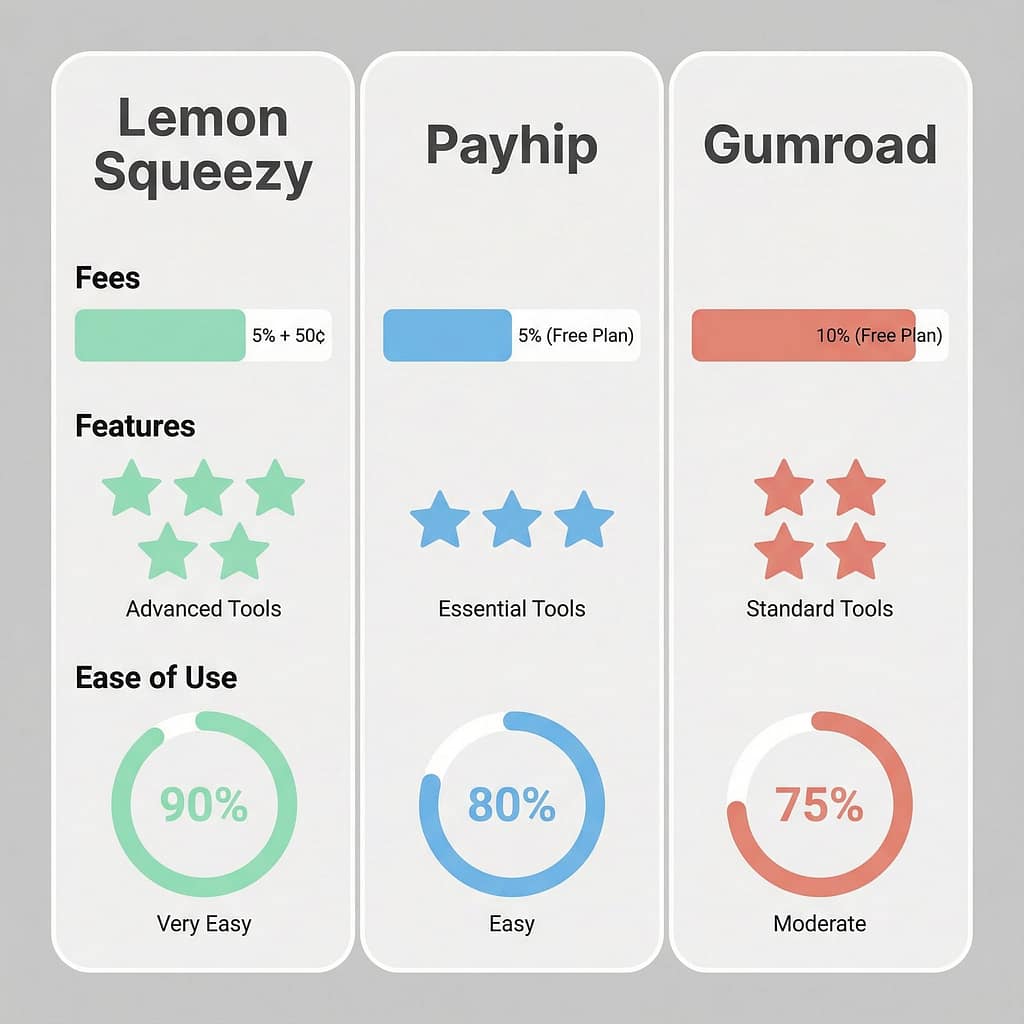
Lemon Squeezy vs Payhip vs Gumroad: Best for Small Digital Shops (My 2026 Pick Guide)
Choosing where to sell my digital products feels like picking a checkout line when I’m already late. I want something easy, trusted, and predictable, and I don’t want surprise fees nibbling away at every sale.
Digital products are booming in 2026, but the boring details matter more than ever: fees, taxes, and payout timing can turn a “good month” into a shrug. That’s why my shortlist comes down to three names I see everywhere: Lemon Squeezy, Payhip, and Gumroad.
In this Lemon Squeezy vs Payhip vs Gumroad comparison, I’m going to break down what actually affects my day-to-day: fees, taxes, setup, checkout, marketing tools, and who each platform fits. The goal is to help you pick the best platform for digital products for a small shop without overthinking it.
Quick decision guide: which platform fits my small digital shop?
If I’m trying to choose in under a minute, I start with one question: what pain am I trying to avoid, and what outcome do I want most?
Here’s the fast filter I use:
- If I want to start fast and I don’t care (yet) about higher fees as I grow, I lean Gumroad.
- If I sell worldwide and I want tax handling done for me, or I sell software with license keys, I lean Lemon Squeezy.
- If I want strong value over time and I’m selling downloads, courses, or memberships, I lean Payhip.
Now I’ll back those picks up with the details that usually decide it.
I want the fastest setup and a familiar marketplace feel: when Gumroad makes sense
When I’m starting from zero, Gumroad has a real advantage: it’s quick. I can upload a file, set a price, publish, and start selling without building a full storefront.
Gumroad also has a familiar vibe for buyers. Many people have bought something there before, so the brand recognition can reduce friction. For a tiny shop selling a first ebook, a Notion template, presets, or a small asset pack, that matters.
The tradeoff is the part that sneaks up on me later: fees. As of January 2026, Gumroad’s common pricing is 10% + $0.50 per sale (plus payment processing that can still apply). When I’m testing one product, I can live with that. When sales grow, it can feel like I’m paying “rent” on every checkout.
If you want a deeper outside comparison of the three, this 2026 roundup is useful context: Gumroad vs Payhip vs Lemon Squeezy vs IndieStand.
I hate tax headaches or I sell software licenses: when Lemon Squeezy is the better fit
Lemon Squeezy is the one I think about when I want fewer admin chores. The big headline is taxes: Lemon Squeezy works as a Merchant of Record for many sellers, which means it collects and remits applicable sales tax or VAT for you in supported regions. If I’ve ever stared at “VAT rules by country” and felt my brain shut down, I know why that matters.
It’s also strong for software sales. If I’m selling an app, a plugin, or anything that needs license keys, Lemon Squeezy has licensing tools and customer license management. That reduces the support emails that drain my week, like “I lost my key” or “I switched computers.”
It also supports a wider mix of payment methods than most creator-first stores, including cards plus wallets and regional options (more on that later). For international buyers, that can lift conversion.
The main downside I plan around is that some sellers report an approval or review step, depending on the account and product type. That can slow launch day if I’m in a hurry.
If you’re weighing it against Gumroad, this comparison can help frame the differences: Gumroad vs Lemon Squeezy: Which Platform is Best for Selling Digital Products?.
I want strong value for downloads, courses, or memberships: when Payhip wins
Payhip hits a sweet spot for small shops that care about margins and want built-in selling tools without duct-taping five services together.
For digital downloads, Payhip is straightforward. Where it starts to stand out is learning content and recurring revenue. Payhip supports courses, bundles, and drip content, which is perfect if my “one product” is really a library that grows over time.
Taxes are a key point too. Payhip is well-known for EU VAT handling, which helps if I sell to customers in Europe. I still need basic bookkeeping and clean records, but Payhip can remove a big chunk of the VAT stress.
Payhip also tends to feel like a “store builder” more than a single product checkout link, which matters when I’m building a brand and want multiple offers under one roof. For Payhip’s own side-by-side framing, this page lays out how they position it: Payhip vs Lemon Squeezy.
Pricing and fees that actually change my profit
Fees are emotional when you see them in real dollars. A difference that sounds small on paper becomes loud once I’m making steady sales.
Also, “fees” often mix three separate things:
Platform fee: the percent the platform takes.
Per-transaction fixed fee: often a flat amount like $0.50 per sale.
Payment processing: card network fees, PayPal fees, and other payment costs that vary by country and method.
Some platforms also offer monthly plans that reduce the per-sale cut. That can be worth it once sales become consistent.
A quick rule I use:
- If I’m testing or low volume, I prefer a fee-based plan so I’m not paying monthly for hope.
- If I sell steadily, a monthly plan can beat a percentage fee fast.
For broader perspective on Payhip as a Gumroad alternative, this is a solid read: Why Payhip Is Still the Best Gumroad Alternative 2026.
What I keep from $1,000 in sales (simple math, no spreadsheets)
Using January 2026 numbers from current published comparisons and platform info, here’s the rough “what I keep” picture on $1,000 in sales:
- Gumroad: about $895
- Lemon Squeezy: about $945
- Payhip (Pro plan example): about $971
This is meant as a gut-check, not a promise. Final totals can change based on payment method, buyer country, refunds, and any plan you’re on. Still, the direction is clear: Gumroad is easiest to start, but it’s usually the priciest once sales stack up.
Hidden cost checks: refunds, chargebacks, and per-sale add-ons
The fee page never tells the full story. What bites small shops is the messy stuff that shows up after the sale.
Here’s what I always check before committing:
- Refund handling: Can I issue refunds cleanly, and does the platform keep its fee or return it?
- Chargebacks and disputes: Who fights the dispute, and are there extra dispute fees?
- Payout timing: Do I get paid daily, weekly, twice monthly, or on a rolling delay?
- Minimum payout thresholds: Some platforms hold payouts until I hit a minimum.
- Per-sale fixed fees: A flat amount (like $0.50) hurts more on low-priced items.
- Add-ons that cost extra: Any feature I “assume” is included (email, affiliates, licenses) that actually needs an upgrade.
If I sell a $9 template, a $0.50 fixed fee stings. If I sell a $99 course, I care more about the percentage fee and chargeback risk.
Features that matter day-to-day: checkout, taxes, delivery, and trust
This is where I stop thinking like an accountant and start thinking like a solo shop owner. Every feature either increases conversion or cuts support time.
To make this practical, imagine three common products:
- a $15 ebook
- a $39 template bundle with updates
- a $149 mini-course
All three need a checkout that feels trustworthy, delivery that “just works,” and a way to handle taxes without panic.
Taxes and VAT: which one saves me the most stress?
If taxes are my biggest fear, Lemon Squeezy is hard to ignore. As a Merchant of Record for many sellers, it can handle the collection and remittance of applicable taxes for supported regions. That’s a big deal when buyers come from multiple countries.
Gumroad also positions itself as a Merchant of Record in many cases, which can reduce tax admin for creators selling globally.
Payhip is different. The standout is EU VAT support, which can be exactly what I need if Europe is a major market. If most of my customers are outside the EU, I still need to understand what I’m responsible for where I live.
No matter what platform I choose, I still keep clean records, track expenses, and set aside money for income taxes. The platform can help with sales tax or VAT, but it won’t run my whole business for me.
Payments and conversion: card, PayPal, Apple Pay, and global buyers
Checkout drop-off is often just “they couldn’t pay the way they wanted.”
As of January 2026, Lemon Squeezy accepts a wide mix of payment methods, including credit and debit cards, PayPal, Apple Pay, Google Pay, AliPay, WeChat Pay, and bank transfers. If I sell to a global audience, that menu matters because it removes excuses at checkout.
Gumroad has fewer payment options available to customers, which can be fine if my audience is mostly US-based card buyers. It can be limiting if I sell internationally.
Payhip supports standard payment methods, but it typically does not match Lemon Squeezy’s range. For many shops, standard is enough, but if I see a lot of international traffic, I pay attention here.
If you want a more feature-by-feature breakdown between Payhip and Lemon Squeezy, this overview is helpful: Payhip vs Lemon Squeezy? A Comprehensive Review.
Digital delivery and customer experience: downloads, updates, and support load
Delivery is where small shops quietly lose hours.
What I want:
- Buyers get their file immediately.
- Download links don’t break.
- I can update a product without chaos.
- I can handle “I lost my link” without a 20-email thread.
All three platforms handle digital delivery, but the support load differs based on what you sell.
If I sell software, Lemon Squeezy’s license management is the clearest differentiator. When customers can manage licenses in a portal, I spend less time playing help desk.
For downloads like ebooks and templates, Payhip’s store structure can make it easier to build a clean product catalog, bundle items, and deliver a more “shop-like” experience. Gumroad is still fine for simple delivery, but it can feel more like standalone product pages than a full storefront.
Marketing and growth tools: email, affiliates, coupons, and course selling
Most small shops don’t fail because of product quality. They fail because promotion is hard to repeat, and the system doesn’t help.
I care about marketing tools that I’ll actually use on a busy week: coupons, affiliates, simple email, and basic upsells or bundles.
Selling courses and memberships: where Payhip pulls ahead for learning content
If I’m building a course business, Payhip often feels like the most complete option out of the box. The reason is structure: courses, bundles, and drip content support a real curriculum, not just a pile of files.
This matters for long-term revenue because I can sell learning in layers. For example:
Starter course: a focused 90-minute course for a low price point.
Monthly add-ons: new lessons, templates, or office hours as a membership library.
That setup helps me keep customers longer, and it gives me a reason to email them that isn’t “please buy again.”
Affiliates, discounts, and simple promos: what I can run this week

All three platforms can support basic promos, but the best tool is the one I’ll use consistently.
Here’s the simple campaign I run when I want momentum without burning out:
Launch week discount: A short, clear offer (like 20% off for 5 days).
Evergreen newsletter coupon: A smaller discount that only new subscribers get.
Affiliate push: Invite a few creators with the same audience, give them a fair cut, and give them swipe copy.
Payhip includes affiliate tools and creator-friendly marketing features that make this kind of plan easy to repeat. Gumroad can also run coupons and simple promos quickly, which is part of its appeal for beginners. Lemon Squeezy supports marketing features too, and it pairs well with higher-priced products where the extra payment options and tax handling can lift conversion.
For another angle on Gumroad vs Payhip tradeoffs, this breakdown is worth scanning: Gumroad vs. Payhip (+ dealbreakers).
Conclusion
Here’s how I call it: Lemon Squeezy is my pick when I want strong tax handling and software licensing, Payhip is my pick when I want strong value plus solid courses and memberships, and Gumroad is my pick when I want the simplest quick start and a familiar brand, even if I pay more as I grow.
There isn’t one perfect platform. The right choice depends on what I sell, who buys it, and how steady my sales are. My best move is practical: pick the top two, run a small test sale, then commit to one for 30 days and focus on selling, not switching. If you do that, momentum starts to beat guesswork.
FAQ Section:
Which platform has the lowest fees?
Each platform has different fee structures (transaction fees, monthly plans). Gumroad has higher transaction fees but no monthly fee for basic. Payhip offers free and paid plans. Lemon Squeezy combines payment processing and platform fees into one rate.
Is Lemon Squeezy good for beginners?
Yes, Lemon Squeezy is designed to be user-friendly with built-in tax handling, making it great for beginners, especially those new to international sales and compliance.
Can I sell subscriptions on Payhip?
Yes, Payhip supports selling subscriptions, memberships, and various other digital products like courses, ebooks, and downloads directly from your storefront.
What are the main differences between Gumroad and Payhip?
Gumroad is known for its simplicity, discoverability features, and established audience, while Payhip offers more robust features for branding, marketing, and integrated storefronts and email marketing tools.
Do these platforms handle sales tax (VAT/GST)?
Lemon Squeezy offers comprehensive tax handling for global sales, including VAT/GST, often simplifying compliance. Payhip and Gumroad also have features to help with tax calculations and reporting, but Lemon Squeezy’s is often highlighted as a key differentiator.